
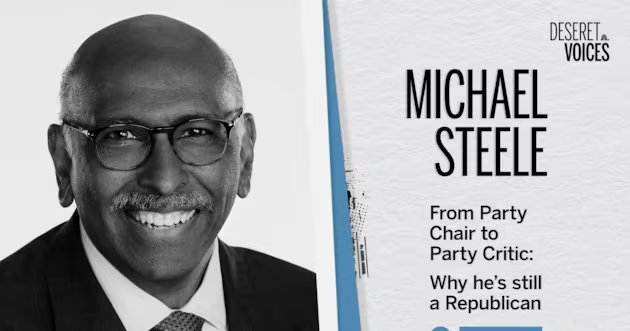
Political commentator Michael Steele has been a Republican for 50 years. While he may have some critiques of the evolution of the Republican Party, he says he is staying because he was here first.
Steele says he admired Ronald Reagan and his graciousness in defeat to Gerald Ford in the 1976 Republican primary.
On this episode of “Deseret Voices,” Steele shares why he identifies as a Lincoln Republican and the instinct that the Grand Old Party has lost.
Subscribe to “Deseret Voices” on YouTube, Apple Podcasts or Spotify.
Note: Transcript edited by Steven Watkins.
McKay Coppins: Michael Steele, thank you for coming on “Deseret Voices.”
Michael Steele: Oh man, it’s great to be with you. I love the opportunity.
MC: So Michael, I wanted to have you on because you have traveled one of the more interesting journeys over the last 15 years politically. You went from chairman of the Republican National Committee, effectively the institutional leader of the GOP from 2009 to 2011, to now being one of the most visible and outspoken critics of the Republican Party in the Trump era. And I want to get into your view of what the Republican Party has become under Trump, where you think it could go post-Trump, and some of your criticisms of the party right now. But before I do, I think it would be helpful for you to just kind of talk about what first made you a Republican. Like, establish your conservative bona fides here before we get into your kind of critiques of the party.
MS: The first time I got to vote, it was for the presidency of the United States in 1976.
MC: Wow.
MS: And in the course of the summer leading to that election, I had a number of conversations with my mother about politics. And my mom and dad were Roosevelt Democrats. They were, you know, my mom was born in ’28, excuse me, ’27, 1927, so she was a Depression-era kid, and grew up at a very difficult time for the country, compounded by Jim Crow laws that made it impossible for her to live the American dream because white folks had a view that Black people didn’t have a dream to live out. And so, all of that, dealing with having to raise me in a city at the time which was still, when I was very, very young, still segregated so she couldn’t go to parks in D.C., she couldn’t shop just anywhere in D.C., yes there were still “for whites only” signs up in D.C. Then you had the backdrop of the war in Vietnam, the sexual revolution, you have the upheaval in the Catholic Church, we’re a Catholic family. So there was a lot going on.
And so, this election in ’76, the war had been ended, the cultural revolution was well underway, the tensions from civil rights were evermore present despite the gains that were made. And we had a conversation about which direction the country should go and what it would sound and look like and what it would mean for me. That was important to her, what it would mean for me. And so I remember her saying to me, “Well, don’t be a Democrat because we’re Democrats. Go out and discover for yourself who you are.” So I did. I went out and I learned about both parties, I learned their history, I listened to the politicians. My dad, even though he was a Democrat, liked Nixon, and I think he liked Nixon for a number of things that had to do with affirmative action, which the Nixon administration put in place, and a few other positives. Of course, he had worked for the government, so he was kind of in that bubble a little bit. So that was always interesting conversations with him. My mom always kept her politics very close to her vest.
So it was a matter of my going out and discovering myself. And I listened to the candidates and I was struck by this guy from California, this former governor from California who decided to be an upstart and run against Gerald Ford for the nomination of the Republican Party, and his name was Ronald Reagan. And the thing that struck me about Reagan was he sounded a lot like my mother. And she didn’t appreciate that much when I told her that, but when you stopped and thought about it, he was a Roosevelt Democrat, right?
And so there was some consistency in terms of tenor and tone about self-reliance, about the ability to pursue your dreams, the fact that the government had a limited purpose and a limited role in your life, not no role, but a limited role. And I remember my mother and I having a conversation when my dad died. She then had remarried, but when I was young, my dad died, and there was a lot of pressure on her to take government assistance. And she refused. The pastor of our church, her family members, her friends at the laundry where she worked, said, “Hey Bell, you need extra help.” And she said, “No, I don’t want the government to raise my child.” In other words, she didn’t want to create dependency for me and her. And that sense of self-reliance and working it through stuck. And it was very Republican-esque.
And it registered with me. And of course looking at the history of the party, it was born out of this idea of equal rights and opportunity, the American words in our Constitution should mean something, “all men are created equal” then why is he a slave? And so those things sort of came together for me and when I went and told my mother I decided to register as a Republican, she said, “What the hell you go do that for?” It’s like, “Well, you told me to go out and this is where I landed.”
MC: She wanted you to go out and come to the same conclusion that she had. Like many mothers before her. That’s not a unique phenomenon.
MS: She was like, “No, OK, this fool goes out and goes all around the wrong neighborhood, goes in the woods and gets lost, now he’s stuck.” I’m like, “Mom, it’s not that bad.” But I admired Reagan, and I was really impressed with what he did in his loss to Ford. And his speech was not condemning. That speech could not be given today. Would not be given today by any Republican. And that’s the difference. That’s the difference if you want to talk about, you know, connect that dot, you know, to your opening question about the Republican Party under Donald Trump versus the Republican Party under Ronald Reagan. That speech that Reagan gave at the convention in defeat in 1976 would not be given by a Republican today.
MC: What do you think he said in that speech that wouldn’t fly or wouldn’t pass muster today?
MS: He didn’t condemn the guy who just beat him. He didn’t challenge the decision of the men and women in the room who decided they wanted the other guy. He didn’t make a mockery of the system because he was so self-absorbed and so into himself, and you would think he would be because he’s an actor from Hollywood, right? Self-absorption is kind of part of the whole deal there. Yeah, but in that moment, McKay, he thought about the country. He thought about the challenge that they’d all, we’d all just gone through, and he looked to the future. And he talked about the future. And he talked, he still leveled up the things he believed in and what he thought, you know, would be important. And that resonated for me in a lot of ways.
And so my Republicanism has always been anchored in an idea. The conservatism is how I may look at policy, right? But that’s not Republican. You know, so and I think it’s important because everyone kind of confuses all of this stuff, they kind of push it all into a mash. And if you’re looking at, you know, Burkean and Lincoln conservatism, it’s not what we see playing out today. And so you have to understand fundamentally what’s the origin story, what is the meat, what are you trying to do here? You’re trying to express through policy some ideas and ideals that you think about healthcare or road construction, right? But the fundamental thread is how you look at the country, how you look at the community of people that you’re asking, you know, to represent. And what philosophically moors you in a way or grounds you that allows you to stand firm on principle. The principle that fundamentally, whether you are pro-life or pro-choice, as a Republican, I’m going to fight for your right to be that.
MC: And you don’t, and that instinct is missing in the Republican Party today.
MS: That instinct is gone. That thing, that instinct has been wiped out. It is devolution, not evolution.
MC: I want to ask you about this, because you know, there is a whole category of Never Trump Republicans who broke with their party in 2016 for principled reasons. You’re among them. They believe that Donald Trump basically stood in opposition to the core ideals of the party, right? And then over the next decade, a lot of them, you know, went into media, they attracted, you know, predominantly center-left audiences, seemed to drift to the left ideologically. What makes you interesting is that you followed that professional trajectory, but you still talk about conservative principles, Republican principles. You didn’t leave the party, which is, you know, makes you unique among this kind of category of people we’re talking about.
MS: Crazy!
MC: Well, let’s start with that. Why not? Why haven’t you left the Republican Party, given what you think that it’s become?
MS: Because I was here first. And Donald Trump is not a Republican. On any level. I met and worked with the man, I know the man from working with him before he got into politics — 2013, 2014 — in that timeframe. Donald Trump was and is a Democrat, at the end of the day. I mean he was, I mean he just was. I mean that’s just, look at his voting record, look at how he registered. I mean that’s just what he was. And then he moved in and out of other stuff, but he was not a Republican. And what annoys me is the fact that every Republican that I know and worked with damn well knows that.
MC: And they have to pretend otherwise.
MS: And they have to pretend otherwise. And so it’s pathetic. And I have pity for them because I would not let Donald Trump move me off of what I believe. My mama didn’t raise me like that. I don’t need your love and attention, I don’t need your pat on my head. I don’t need it, don’t want it. And apparently there are a lot who do. And what that has led to is a corrosiveness inside the party that its leadership is feckless, rudderless, and without purpose. And therefore even though it says it wants healthcare reform, it can’t do it. Because it doesn’t know how. It doesn’t know what it would look like. It goes into old books that blow off the dust and they think we can reformulate and repackage something from 50 years ago and it will work in this economy today, and it doesn’t. And so it fall, they fall, but when they try to put and patchwork it together, guess what? You come up with “repeal and replace.” We’re so good at sloganeering. We’re so good at sloganeering. But we don’t do crap about policy. We don’t implement, we don’t do. We claim we hate deficits. How much have we contributed to the country’s debt? Just in the last year?
MC: You are speaking the language of a lot of, we’ll call them Mitt Romney, Paul Ryan Republicans, who are looking at the, you know, several years of Republican rule now and saying, you know, why is it that the deficit has exploded under Republican control of the government, right? Well, but OK, but let me just go back to this. So I, you know, I’ve heard you say that before, “I was here first.” And I think that’s like a really interesting and important instinct, right? Like you fundamentally believe that this institution can still be salvaged, can be preserved, can exist into the future. You know, I talked to Sarah Longwell, our mutual friend, you know, a couple months ago. And she does not, right? She says, “I don’t think the party is lost, I think there’s no coming back. My project now is to try to turn the Democratic Party into a place that center-right people like me can find a home.” Why don’t you share that view? Why do you think the Republican Party can still be turned back to what you want it to be?
MS: So in such an important question, I’m not trying to, I’m not nostalgic. This is my 50th year as a Republican. I’m not nostalgic about the party before Trump because the party before Trump had and needed a lot of work, all right? I can regale you with stories as a county chairman, as a state party chairman being a Republican, going into spaces in which some people saw the convenience of having a Black man in the room thinking that that would solve their problem, and the inconvenience from others that I was there in the room because “oh now we’ve got to deal with these issues.” So the party has since the 1930s struggled with itself. It had no response to the Great Society that Roosevelt put up. It had absolutely no response at all. And as a consequence, it started losing voters. And it had no way to get those voters back until it realized that within the country there was a growing faction of white people, largely white men, who had become disgruntled with the direction the Democratic Party was starting to move, a direction that the Republican Party had already been in and owned. We did the 13th, 14th, 15th amendments, there would be no Civil Rights, Voting Rights Act or Civil Rights Act without Republicans getting behind and pushing that through the Senate. Lyndon Johnson was not the savior of civil rights, right? He was a segregationist, just like a lot of folks from Texas. So let’s be honest.
But he saw the political winds, as did John F. Kennedy, and more especially Robert F. Kennedy. And so these political winds were shaping — culturally, politically, economically — a different direction for the country. And there were a lot of folks who wanted to stay in a place that actually, McKay, never existed. The 1950s is a fiction. Daddy in his suit with the top hat on and the briefcase walking out through the picket fence, the wife and the kids standing in the doorway saying goodbye, comes home from work, mommy’s there with pearls on in a full dress with an apron with dinner ready, the kids go rushing up to the fence to the picket fence to welcome daddy home, and they walk merrily into their little white house. Well, tell that to families who lived in Appalachia. That was not their experience in the 1950s. Tell that to the poor whites of Mississippi. That was not their experience in the 1950s.
MC: Yeah, there is this, it’s interesting, like there is a kind of iconography, aesthetic in the whole MAGA movement, right? When Trump talks about making America great again, he never exactly says when it was great, but the, you know, if you look at some of the kind of messaging that his campaigns put out, that, frankly, government agencies now like the Department of Homeland Security put out on social media where it is those kind of Norman Rockwell paintings of white families in the 1950s that were more kind of aspirational than ever kind of capturing reality.
MS: Thank you, thank you.
MC: But that, you know, that idea, that kind of false nostalgia permeates the entire Trump-era Republican Party now, right?
MS: And so now you’ve got young white men running around telling their young white women, “Y’all need to have babies. You don’t need a career.” So they’re trying to regress from the progress that women in this country made. I mean folks, women have only been allowed to vote for a hundred, for a little over a hundred years, right? And so now you, you know, all of the struggles that their grandmothers went through to secure rights, right? To work, try to get equal pay on a job, try to, you know, have the ability to have a baby and go back to work and not lose their job because they got pregnant. And now these young white men are telling the women, “Yeah, no, we’re not doing that. Y’all just going to stay home and get pregnant.”
Because they’re afraid that my kids and their children are going to outnumber them and replace them, which, again, is feeding into a fear which, again, going back to the original question, has been a thread within the party for a long time since the 1930s when it realized that, “Oh, we don’t actually have to be the party of civil rights because there are a large group of white Southern men who will vote for us.” Goldwater jettisons the Civil Rights Act in his 1964 campaign. When we realized oh, now that the Civil Rights Act and the Voting Rights Act are in place and this group of white men in the South are larger and more pissed off and they’re leaving the Democratic Party, and because the way you elected a president back then was through the South, because, remember, the blue states were Republican states, the red states were Democratic states, and those states were largely in the South. That’s how you got elected. It’s why President John F. Kennedy went to Dallas on that fateful day to shore up the Democratic Party in a state that was moving away from him months before the Democratic primary in ’64, right?
So that earth-moving moment moved Nixon to come up with a Southern strategy to play on the fears of white men through race and racism. All right, law and order. We’re bringing law and order. What? White communities, Black communities, Hispanic communities don’t need law and order too? What are you talking about? We’re going to make a very narrow argument to a very narrow group of very scared, somewhat racist people. And that worked. You know, the guy that I would support in 1980 for president started his presidential campaign in the segregated South of Mississippi playing to that raw threat. Reagan didn’t need to launch his campaign there, but he did. Why? Because that’s where the political power was aligning itself. He needed those votes. And you needed that vote as much in the Republican primary as you would in a general election.
MC: Did you see that instinct clearly in the 1970s, 1980s when you were new to the party? Did you feel like the party was pandering to racist impulses and uglier aspects of American life?
MS: That’s a great question. No, because it wasn’t as overt. It was much more subtle, it was much more subtle. It was much more coded, and it wasn’t as widespread. That’s the other thing to keep in mind, it wasn’t like we see today where you could go pretty much into any part of the country in even some of the bluest states and there’s a MAGA core. But the reality of it is, you’ve got to figure out what and you do over time, you’ve got to figure out what that looks like. And a lot of folks in the party really did not do that until much later. And by the time I got through the system in a way that I could begin to really not just rationalize it, but begin to make some countermoves against it, you know, so leveling up the idea of let’s build coalitions with this growing emerging group of voters out here that we’re not tapped into. Let’s try to re-make a new appeal to Black voters who have left the party since the 1960s and the 1950s and sort of become more competitive in the community by leveling up these issues on housing, on education, on economic development. And tap into the fact that yes, Black folks go to church too, but more importantly, Black folks are very entrepreneurial and the idea of the American dream still appeals to them after you know 390 years of segregation and racism and slavery, right? They still believe in this country. I mean stop and think about it. After all the crap we’ve been through. We’re not the thing they fear us to be to justify what they’re doing.
MC: Well, and something I always tell Republicans, white Republicans, is that a very clear finding in my life as a reporter — a political reporter who has traveled around the country and interviewed voters — is like, if you want to hear some real conservative ideas expressed, talk to, like, some Black church ladies, or some, like, Hispanic small business owners. You know, I think the Republican Party came to this conclusion falsely, wrongly, that minority Americans were just out of reach for them, right? That there was no way that they they could be reached and, like, the reality is a lot of conservative attitudes exist within the Black community especially, the Hispanic community. These groups are not monoliths, right? And the party had kind of given up on reaching them to to a certain degree.
MS: Well, and they became harder to reach because what happened? Going back again to the 1930s when you’re living in poverty, as the country largely was, that impacted Black people. I mean look at, I had to deal with, you know, my parents, my family had to deal with not only the fact that there were no jobs, right? And the jobs that they were getting were paying very little. They had kids to raise and mouths to feed. Oh, and then they couldn’t, they couldn’t just move about, you know, the cabin — as the commercial — as they weren’t free to move roam about the cabin at all, they had to stay in very specific lanes. They couldn’t look at white people in the face directly, right?
You know, Emmett Till was killed because, you know, he looked at a white woman and said something to her. What? That’s the world in addition to everything else? So the Democrats made an appeal on on a number of fronts that resonated. What has since fractured in the Black community with the Democrats is that they didn’t follow up on a lot of it. Black education, economic opportunity, healthcare, what, you know, how we’re raising our kids, where we can live, redlining, all that’s still there. So all the promises of the Great Society, right? You know, all the promises of the New Deal from Roosevelt, all the promises of: “Elect me and I will,” fill in the blank — they couldn’t cash the check.
And that also is what’s broken the Republicans because for years the Republicans were telling the conservative wing that they created, allowed to grow, the moral majority, “And now we’re going to now bring religion into our party in a way that the party never wanted to bring religion in the first place.” We didn’t have a pro-life plank in our party in 1976, we didn’t have it there in 1970. That was 1980, that was the deal that Reagan made with the moral majority. For what? To get those religious votes, that evangelical conservative voice that was beginning to move across the country and promised them, “We’re going to repeal Roe v. Wade, we’re going to get rid …” and for 50 years they kept buying that narrative, and they could never cash that check. Until Donald Trump. And then when he cashed the check, he cashed it along with a lot of other stuff that not only appealed to hard-right conservative evangelical types, but into disaffected, you know, conservative white Democrats in the South and in the Midwest and in other parts of the country where you don’t think they are, but they are.
MC: You were chairman of the RNC from 2009 to 2011, you presided over the party during the 2010 midterms which was a huge cycle for Republicans. I was looking this up, I had actually kind of forgotten how big of a cycle it was. Republicans won something like 63 House seats, right? Made historic gains in state legislatures, won governorships.
MS: Twelve governorships. And they haven’t been able to replicate it since.
MC: So you hang your hat on that. And you are understandably proud of having built up the, you know, the RNC chairman — if people don’t understand — is you’re kind of building the party as an institution that can raise money, turn out votes, prop up candidates at the local, state level. And so you obviously did your job very, very well there. But what that cycle is best remembered for is the rise of the Tea Party, right? Which at the time presented itself as a kind of small government anti-tax movement rooted in fiscal conservatism and constitutional principles, but which a lot of people now look back on and see in the right-wing populism that drove the movement, a foreshadowing of Trumpism. You know, that this was an early precursor to the rise of Trump and I wonder if your kind of perception of that movement has evolved over time.
MS: No, it hasn’t. I was there. I lived through it, I worked with a lot of the Tea Party members and the way you describe them, small government pro-constitution, they were very upset about big government Republicanism under George Bush. They were very angry about our engagement in Iraq. The war scenarios that had evolved or from their perspective devolved into this, you know, forever war, which was not the term then, but that’s what we know it as now. And that’s how it began. People forget Occupy Wall Street also began at the same time, they were two sides of the same coin. And the titular heads of those coins, if you will, were, would be in six years’ time, Donald Trump and Bernie Sanders.
And the reality of it is, Occupy Wall Street fell apart quickly because in the tent cities, in the protests that they were putting up in their tent cities, they had a problem with people behaving badly. And so the story became the crime stories that were people beginning to get robbed and getting hurt and so it distracted away from from the overall overarching message of Wall Street running our country and running it into the ground, pushing aside the little guy and the little gal who are trying to make their way. All that got lost. Tea Party consistent and persistent in that messaging, survived the 2010 cycle, did not survive the 2012 cycle. Because by 2012, a lot of its members, Joe Walsh for example, were taken out by a more aggressive conservative, nationalist perspective. And I knew the Tea Party had turned that corner when I was at a rally, I think it was in 2011, mid-summer ’11 or somewhere around there later, and there was a Nazi flag.
And so the interesting thing about the Tea Party piece was you had people within the movement who figured out they could make money off of it. And so they tried to monetize, I got uninvited to a number of Tea Party events because they thought I was going to come in and try to raise all this, I was like, “Dude, we’re just coming in to be supportive of our candidates.” The guy ran Chicago Tea Party didn’t want me to come to Chicago to their rally, even though I had guys like Joe Walsh and others that were running for various congressional races and statewide races, “No you can’t come, you’re just you want to come in and take our money.” I’m like, “OK, first off, what money?” Because a rally’s no one’s paying to come to this, but they were finding ways then to monetize it.
So you had, going back probably to the end of Bush’s second term, certain political actors realizing how best to monetize going forward not just the policy, like I mentioned on on abortion and healthcare, “Oh, OK, we’re going to raise money and put out this abortion message and people are going to write a check and send it in,” but on the politics. How you can monetize the politics. And by that I mean, how I can monetize the politics in a way that no matter what the subject is, I can get you motivated to give. I can get you angry to give. And so this idea kind of exploded. And it really changed the trajectory of the movement. And so by the time you get to 2012, those Tea Party members of Congress for example who ran and won in 2010 were gone.
MC: See that’s so interesting, I feel like that’s a missing part of the political history of the Tea Party. Because everybody remembers the 2010 Tea Party, and then what you’re saying is that something changed fundamentally in the party and a lot of even the key people were replaced between 2010 and 2012. You know, I wrote a biography of Mitt Romney and I read his journals that he kept during the 2012 cycle when he was running for president. And, you know, he had obviously run for president in 2008, failed to win the nomination. And in between those two campaigns, the Tea Party rose up. And it’s so funny because his initial impression of the Tea Party was that this was a movement rooted in fiscal conservatism, in small government ideas, and he was like, “That’s great, I can connect with them on those issues. I care about deficit reduction, I care about fiscal discipline, low taxes.”
And what he said was that by the time he was running for president in 2011, 2012 and he was talking to those groups, he felt like a lot of them didn’t care so much about the fiscal issues. They wanted to hear him, you know, bash immigrants and, you know, really just feed them red meat. And so his conclusion was: “Oh, these are people who are just mad, and they’re mad at the government and they’re mad at the establishment and they want to burn it all down.” And those people ultimately found a voice in Donald Trump in 2016, but you’re kind of saying that Mitt Romney’s initial reading of the Tea Party in 2010 was not necessarily wrong, it’s just that the party kind of transmogrified, the Tea Party transmogrified in those couple years.
MS: And that’s exactly right. In fact, you can go back and you will find quotes of me saying in 2010 in talking about the Tea Party, “If I were not chairman of the Republican Party, I would be Tea Party.” I would be very much involved in the movement because I very much believe this idea of a limited purpose government, free market enterprise, and all of the attributes of self-governance. The 10th Amendment, states’ rights, not the scary states’ rights, but the fact that states should be able to chart their course with as little federal interference as possible. I mean, look at what Republicans are doing today. They’re dictating to the states who can be citizens in their own community, what they can do, we’re policing the … Could you imagine the Republican Party back then advocating for what we just saw play out in Minnesota? No. So Mitt Romney had it exactly right.
MC: You actually see now even some kind of small government libertarian voices — and they’re very much voices in the wilderness at this point. But they were speaking out against what was happening in Minnesota and with ICE. They were kind of perplexed that so many conservatives were going along with it. Because they were like, “This is the thing that we were warning about.” A kind of dictatorial president turning the country into a police state is not something that the Tea Party of 2010 would have supported.
MS: And so that’s, though, to complete the circle, that’s why I’m still in the party, and that’s why I say I was here first. To remind people of those core principles and values. That’s why I’m involved, you know, with Our Republican Legacy organization, ORL, with this idea of leveling up these principles, these ideas that you know that once stood very firm foundationally for the party.
It’s why I define myself as a Lincoln Republican, because I’m not beholden to the whims and wiles of a presidential candidate or the whims and wiles of a movement within movements. I try to be consistent in my, I guess, theory of the case that fundamentally your civic civil rights, your civil liberties are fundamental. Without those, public policy doesn’t matter. If you can’t vote, it doesn’t matter whether or not you’re pro-life or pro-choice. If you can’t freely associate under the Eighth Amendment, it doesn’t matter whether you’re pro-gun or not. If you cannot articulate your opinion in the town square, whether you are a member of the press as like yourself, a well-refined journalist, or a news organization, or a guy with a bullhorn, it doesn’t matter. If you can’t do those things without your civil rights and civil liberties given to us under the Constitution and the Bill of Rights, it doesn’t matter. That’s the thing that the party stood for, that’s why we were formed. Because we actually believed those folks who were members of the Whig Party actually believed that Black people should be free because it otherwise made a lie of the words of the Constitution.
MC: You know, you started this conversation by talking about how many of your fellow Republicans fell in line behind Donald Trump. And that has been a very common criticism of the Trump-era GOP, that a lot of people seem to abandon long-held principles so that they could support the leader of their party for calculated political reasons. I have, like, kind of a counterintuitive take on this, which is that that is clearly true, but what that means is that the flexibility that has been demonstrated by these Republican politicians means that the GOP doesn’t need to remain a MAGA party indefinitely, right? Trump is going to be a lame duck president after the midterms, he’s got a couple years left in the Oval Office, and at some point a new leader will, you know, win the nomination, become the standard-bearer of the GOP, and have the opportunity to reinvent the party again. And all of these very flexible Republicans at the state level in Congress will probably fall in line behind that person, right? So is that actually a reason to be optimistic that the party can change, you know, when Trump is gone?
MS: I like your optimism. I’m not buying it. Because my question to them would be, were you lying to me the first time? Were you lying to me when Trump was in power, or are you lying to me now? You know, I’m sorry, if you’re going to sit there and I’ve got video of you saying that Donald Trump is Hitler, and then you sign up to be his vice president, and then you come back on the back end because you now want to be the person you’ve always been, I’m not buying it, I’m sorry. I’m holding you to who you are, right? Because there’s not that kind of jiu-jitsu flexibility in the world. You don’t, politicians can’t contort themselves but so much until they become unbelievable, right? In all sense of the word. In every sense.
MC: But then that would argue for, you know, a new generation of Republican leaders needs to come into power to change the party, is that what you’re saying?
MS: There you go. That’s what I’m talking about. Yes. Yes. Now you’re talking, McKay.
MC: Who do you like? Who you looking at?
MS: We’re working on it, baby. I got, I’m out in the garden, I’m watering. I’m trying to get it going. That’s exactly right. And it is going to be people who are going to be consistent in their orientation and what they believe. You cannot, I’m sorry, I guess it’s how I was raised and how I came into politics and because it was not easy for me. I had to be authentic. I had to actually show more than that. And that’s something that, you know, translated across a whole a lot of things in my life, in the reality of it is you realize you come to realize who you are. That journey that my mother set me on when she said, “Well, go out and find out what you believe. Don’t be be me, don’t be your Dad, don’t be what other Black folks in the community are, be yourself.”
And if you are your true self — Lindsey Graham — then you don’t bend. Because you will break. And that for me is what is important. Leaders are an extension of the people who put them in charge. Right now, regardless of what I think about Donald Trump, he’s an extension of me as an American citizen because he’s my president. But you know what? The Constitution gives me the ability and the right to say, “I don’t like what he’s doing. Because that’s not representative of my values and how I was raised.” I don’t know how many people raise their kids to behave the way this man is behaving. I don’t know how many people today sit their kids down and say, “Here’s an example of what I want you to be when you grow up.” I don’t know people who do that. And the fact that if you lie to your kids that way and you are raising your kids that way, it doesn’t matter what the future looks like, we’re screwed. But I have hope that people aren’t raising their kids like that, so that means there has to be a thread of consistency somewhere that they can hold onto that they can then weave into the story of their children and their grandchildren about what kind of country we should be. We once, I mean, I don’t know who looks at the Oval Office and go, “Wow.” Without that “wow” meaning something very, like, “wow.”
MC: Yeah, I was going to say there’s a lot of wows but maybe not in a like a hopeful, positive way. Michael, thank you so much for doing this. We can see you on “The Weeknight,” where you co-host a show Monday through Friday at 7 p.m. on MS Now. You know Michael, I just want to say, back when you were on the weekend, I used to get invited on your show. You went primetime, the phone stopped ringing. I don’t know what happened.
MS: [Laughter] Uh oh. Course correction on that, baby.
MC: Thank you for coming on “Deseret Voices.” I appreciate you.
MS: I appreciate it, McKay. It’s great to be with you. Thank you, man.
Leave a Reply