
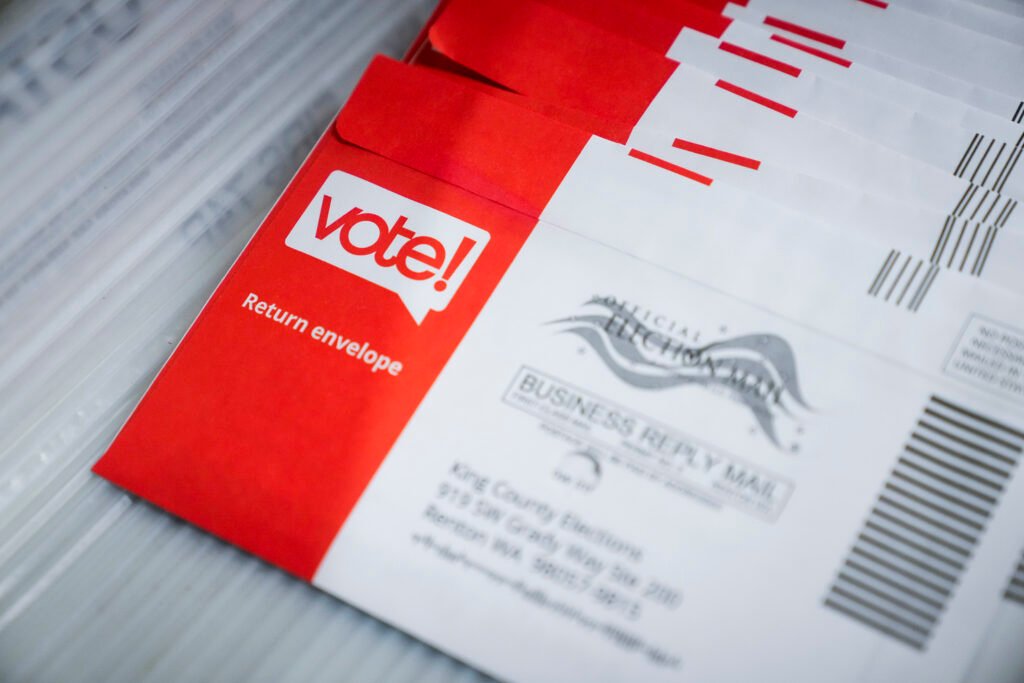
The Republican National Committee (RNC) is urging the U.S. Supreme Court to dramatically restrict mail-in voting nationwide and asking the justices to rule that ballots arriving after Election Day — even if mailed on time under state law — should not be counted.
If the Court sides with the RNC, millions of voters who depend on mail-in voting could be disenfranchised.
The brief filed Monday comes in a high-stakes case challenging Mississippi’s election law, which allows mail-in ballots postmarked by Election Day to be counted if they arrive within five business days. After a lower court upheld the law, a conservative appeals court struck it down, holding that federal law requires ballots to be received and counted by Election Day.
Mississippi appealed to the Supreme Court, setting up a case that could fundamentally reshape how federal elections are run in dozens of states.
From its opening pages, the RNC frames the routine counting of legally cast mail ballots – which has been practiced for decades — as a dangerous modern experiment that undermines public trust.
“Most Americans remember a time when results came quickly after election day,” the committee wrote. “Each election cycle dims that memory as States experiment with novel ballot-handling rules. One of those experiments is the prolonged receipt of mail ballots — three, five, fourteen, or even more days after election day.”
The RNC goes on to suggest that counting mail ballots after Election Day inherently invites wrongdoing, despite the lack of evidence that counting timely cast ballots leads to fraud.
“These post-election receipt deadlines invite ‘the chaos and suspicions of impropriety that can ensue if thousands of absentee ballots flow in after election day and potentially flip the results of an election,’” the RNC wrote. “It’s hard to blame Americans for those suspicions when some States produce quick results, while others take days to even know how many ballots need to be counted. When news anchors remind voters, ‘It’s not over yet,’ they’re right under any ordinary understanding. As long as ballots are still coming in, the election isn’t over.”
That framing echoes years of Republican conspiracies that cast doubt on election outcomes whenever late-counted mail ballots — which tend to favor Democrats because of demographic patterns — narrow or erase GOP leads.
What the brief does not acknowledge is how Republican leaders themselves have fielded those suspicions by repeatedly questioning the legitimacy of elections and promoting false fraud narratives.
That dynamic was on full display recently when Speaker of the House Mike Johnson (R-La.) echoed right-wing election conspiracy theories while discussing mail ballot counts in blue states.
“We had three House Republican candidates who were ahead on election day in the last election cycle, and every time a new tranche of ballots came in, they just magically whittled away until their leads were lost, and no series of ballots that were counted after election day were our candidates ahead on any of those counts,” Johnson told reporters. “It just looks on its face to be fraudulent.”
Johnson went on to concede that he had no evidence to support his claims.
Rather than confronting the role Republican leaders have played in stoking distrust, the RNC effectively asks the Supreme Court to treat that kind of suspicion — openly acknowledged to be unproven — as justification for throwing out lawful votes.
Another point of contention in the RNC’s brief is the dispute over what federal law means when it designates a uniform Election Day. Republicans argue that Election Day is not just the deadline for voters to decide, but the moment when the entire election must end.
“The election-day statutes govern when States must close the ballot box, not when voters must make their selection,” the brief states. “That’s why contemporary dictionaries define ‘election’ as a public process facilitated by the State, and it’s why the statutes regulate States, not voters.”
In other words, the RNC argues that states like Mississippi have wrongly centered voters in elections rather than the state-run process itself.
The RNC leans on a highly technical interpretation of federal law to minimize the role of individual voters altogether. Under its theory, a vote does not truly exist until it is physically in the hands of election officials — regardless of whether the voter complied with every rule in good faith.
“An ‘election’ is thus the State’s public process of selecting officers,” the committee added. “Until all ballots to be counted in that election are in the State’s custody, the election remains ongoing.”
Further in its brief, the RNC goes on to rely on 19th-century voting practices to argue that modern mail-in voting is constitutionally suspect, ignoring the prevalence of disfranchisement at the time and how elections have evolved to include more voters, not fewer.
The Supreme Court will hear oral arguments in the case in March.