
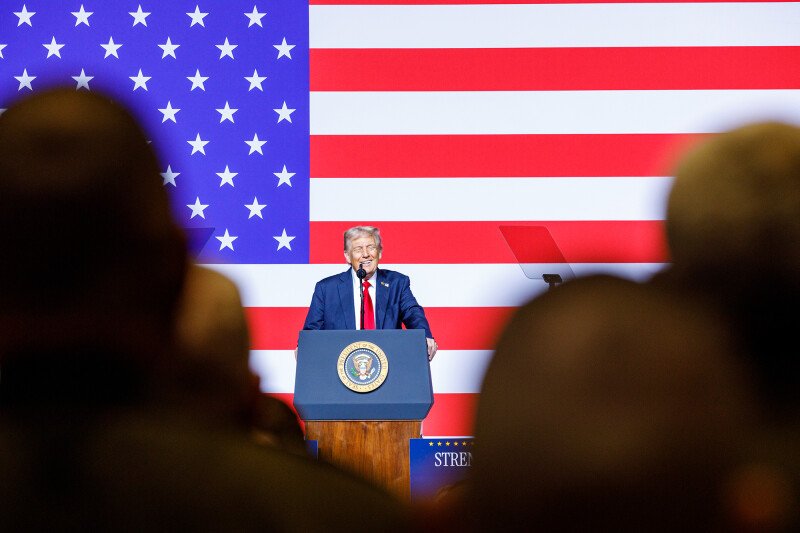
President Trump on Friday released his long-awaited Maritime Action Plan, a comprehensive strategy aimed at reversing decades of decline in U.S. shipbuilding and restoring the nation’s maritime industrial capacity to meet national security and economic objectives.
The plan sets out to expand domestic shipbuilding from less than 1% of global commercial ship construction to a level that can support both military logistics and international trade. It proposes hundreds of billions of dollars in new investments, the creation of Maritime Prosperity Zones to catalyze waterfront development, and the establishment of a Maritime Security Trust Fund to provide dedicated funding for the maritime industry.
“The United States can neither afford for its trade to and from foreign markets to be ferried almost entirely on foreign-built, -crewed, and -flagged ships, nor for the [Maritime Industrial Base] to be unable to build and maintain the vessels the United States needs to defend American interests on the high seas,” the White House said in introducing the plan.
Key targets include increasing the number of U.S.-flagged commercial vessels trading internationally, growing the pool of credentialed mariners, modernizing and expanding shipyard capacity, and reducing dependence on foreign-built ships and components. The strategy also calls for strengthening the Ready Reserve Fleet and developing autonomous vessel capabilities.
The 42-page document, directed by President Trump’s April 2025 executive order “Restoring America’s Maritime Dominance,” was developed by Secretary of State Marco Rubio and the Director of the Office of Management and Budget Russel Vought, in coordination with multiple federal agencies.
The United States currently operates only eight active shipyards capable of building vessels greater than 400′ in length. The repair base includes 22 shipyards with drydocking capability and 25 additional shipyards with topside repair capability.
The strategy is organized around four pillars: rebuilding U.S. shipbuilding capacity and capabilities; reforming workforce education and training; protecting the maritime industrial base; and supporting national security and industrial resilience.
Recommended actions include transforming shipbuilding, repair, and port infrastructure through investments in drydocks, cranes, panel lines, and automated material handling systems. The document calls for expanding federal financing programs, including the Title XI Federal Ship Financing Program, Capital Construction Fund, and Small Shipyard Grants.
The strategy proposes establishing Maritime Prosperity Zones modeled on Opportunity Zones to incentivize investment in waterfront communities and maritime industries. The zones would be designated for 10-year periods and include maritime supply chain entities, workforce development institutions, and advanced manufacturing initiatives. The Secretary of Commerce would designate 100 zones distributed geographically to include coastal areas, inland rivers, the Great Lakes, Alaska, Hawaii, and U.S. territories.
Recommended actions include imposing a universal fee on foreign-built commercial vessels calling at U.S. ports, assessed on the weight of imported tonnage. A fee of 1 cent per kilogram would yield roughly $66 billion over 10 years, while a fee of 25 cents per kilogram would yield close to $1.5 trillion, according to the document.
The strategy calls for expanding mariner training through a new Mariner Incentive Program that would provide financial assistance for maritime education, recruitment, training, and retention. It recommends modernizing credentialing processes and streamlining requirements to reduce barriers.
Federal investment is recommended to address deferred maintenance at the U.S. Merchant Marine Academy, Kings Point, N.Y., and to support state maritime academies. The document also calls for expanding training programs, including Accelerated Training in Defense Manufacturing and additive manufacturing centers of excellence.
Recommended actions include strengthening cargo preference requirements by gradually increasing the percentage of U.S.-bound containerized cargo that must move on U.S. vessels as ships are built domestically. The strategy also recommends establishing a Land Port Maintenance Tax equivalent to the existing Harbor Maintenance Tax for seaports.
Recommended procurement reforms include expanding multiyear and multivessel contracting, reducing administrative burdens, and increasing the use of commercial designs and other transaction authorities.
The strategy proposes establishing a Strategic Commercial Fleet of U.S.-built, internationally trading vessels that would receive financial support for construction and operation, and calls for funding the Maritime Security Program and Tanker Security Program to authorized levels. A proposed Maritime Security Trust Fund would provide dedicated funding for these and other programs supporting shipbuilding, fleet expansion, and maritime workforce development.
The document outlines actions to enhance U.S. presence in Arctic waterways, including increasing polar icebreaking capabilities, improving domain awareness, and developing defense infrastructure in Alaska and Greenland. It prioritizes the development of robotic and autonomous systems as cost-effective alternatives to manned vessels, recommending designated areas for streamlined testing of autonomous maritime technologies and adoption of modular and unmanned capabilities where appropriate.
The strategy identifies numerous deregulatory actions to reduce burdens on the maritime industry, including eliminating outdated requirements, streamlining compliance processes, and updating regulations to accommodate autonomous vessels.
The U.S. Coast Guard finalized 19 deregulatory actions in fiscal year 2025, according to the document.
The Trump administration intends to transmit a package of legislative proposals following publication of the fiscal year 2027 budget request. Proposed legislation would establish the Maritime Security Trust Fund, create Maritime Prosperity Zones, provide shipbuilding incentives, establish maritime scholarships, and implement measures to grow the U.S.-flagged fleet.
Several lawmakers, including those behind the SHIPS for America Act introduced last April, applauded the plan.
“I am grateful to President Trump and his team for devoting time and attention to revitalizing our maritime industrial base,” said Sen. Todd Young, R-Ind. “This plan is a much-needed, holistic approach to restore American commercial shipping dominance. There is substantial overlap between the president’s vision and the plan we’ve proposed in the SHIPS for America Act. The announcement today should serve as a wake-up call for Congress to act quickly on this bill in order to provide the legal authorities and resources necessary to make this plan a reality. It’s time to make American ships again.”
“As an author of the SHIPS for America Act, I’ve believed for a long time that revitalizing our shipbuilding and commercial maritime industries is something we can and must do together. Today’s release of the Administration’s Maritime Action Plan reinforces the urgency of this moment and shows there’s broad agreement on the need to act,” said Sen. Mark Kelly, D-Ariz. “Strengthening America’s maritime capacity will secure our supply chains, support our national security, rebuild our industrial base, and create good-paying jobs across the country. Now Congress needs to build on that momentum and pass the SHIPS for America Act.”
“After years of underinvestment, our country is recognizing the critical importance of revitalizing America’s maritime industry for our local economies and national security,” said Rep. John Garamendi, D-Calif. “There is much work to be done to strengthen our domestic maritime industry, and I am encouraged to see the administration’s commitment to the maritime industry through the release of its Maritime Action Plan. To accomplish this vision, Congress needs to pass the SHIPS for America Act.”
The Marine Engineers’ Beneficial Association, a maritime labor union, praised the plan’s release.
“For several decades, U.S. mariners, shipyards, and the maritime industrial base have fallen victim to unfair practices by foreign competitors, particularly China, that exploit the rules at America’s expense,” the association’s president, Adam Vokac, said in a statement.
“We believe the MAP provides meaningful, long-term solutions aimed at reversing the decline of our U.S. flag fleet and mariner pool, notably by expanding U.S. cargo preference requirements and incentives, providing tax relief for U.S. mariners, and dedicating financial investments to maritime workforce training and domestic shipyard capacity,” Vokac added.

Leave a Reply