 Internet Connectz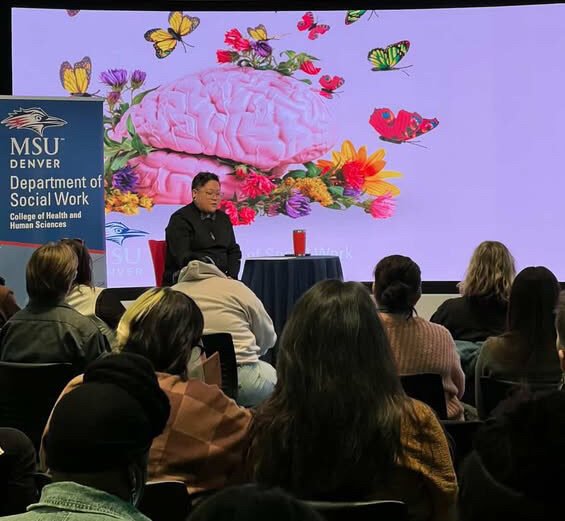
On Friday, February 6th, the MSU Denver Department of Social Work brought together nearly 200 registrants—including over 100 in-person attendees—for the 7th Annual Mental and Behavioral Health Conference. This year’s theme, “Supporting LGBTQ+ Mental & Behavioral Health in Times of Uncertainty: Healing Collective Trauma Through Belonging, Joy, and Resistance,” set the stage for a powerful day of
On Friday, February 6th, the MSU Denver Department of Social Work brought together nearly 200 registrants—including over 100 in-person attendees—for the 7th Annual Mental and Behavioral Health Conference. This year’s theme, “Supporting LGBTQ+ Mental & Behavioral Health in Times of Uncertainty: Healing Collective Trauma Through Belonging, Joy, and Resistance,” set the stage for a powerful day of reflection, learning, and community building.
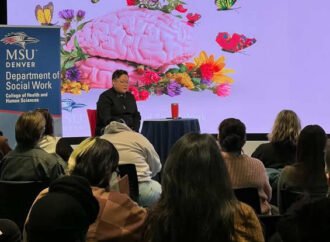
Moderator Bleu Vargas (she/they) sits at the front of the CAVEA Theater, preparing for the keynote with ALOK to begin.
A Keynote That Moved Hearts and Minds
The conference featured internationally acclaimed author, poet, and activist ALOK (they/them) as the keynote speaker, calling virtually from New York City. ALOK’s presentation was nothing short of transformative. What many attendees initially knew as a comedian and Internet personality revealed themselves to be a profound thinker, academic, and Stanford graduate whose words resonated long after the conference ended.
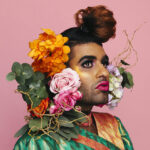
“I have a problem with this word, ‘frivolous’… people in power tend to frame joy as frivolous because it works,” ALOK shared during the moderated keynote. “Joy makes it sustainable to keep showing up.”
One Graduate Social Work (MSW) student attendee reflected on the experience: “Before the conference, my familiarity with their work was limited to their presence as a comedian on TikTok. I was not prepared for the depth of their analysis and the remarkable eloquence with which they articulated complex ideas. They presented concepts I had never before considered, and their words have continued to resonate with me. They spoke about how joy is expansive and happiness is contagious...
Creating Community Through Learning
Beyond the keynote, attendees engaged in three breakout sessions, each offering two to three workshop options that addressed critical aspects of LGBTQ+ mental and behavioral health from micro to macro perspectives.
Highlighted Sessions:
“The Queer Adjusted Systemic Lens: Advancing Justice and Affirmation in Relational Practice” – August Tousignant-Stanton (they/them), LCSW, LMFT, delivered what became the conference’s breakout hit. The session was so wildly popular that organizers found themselves continuously adding chairs to accommodate the growing crowd of in-person attendees eager to learn about queer-affirming systemic approaches to relational practice. The standing-room-only energy spoke to the hunger for frameworks that center LGBTQ+ experiences in therapeutic work.
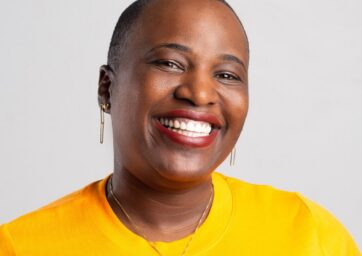
Olivia Hunte (she/they), MSW, Affiliate Faculty
“Embracing Multiplicity: Black LGBTQIA+ Sense of Belonging Experiences” – MSU Denver’s Department of Social Work teaching affiliate, Olivia Hunte (she/they), MSW, presented her dissertation research using a creative qualitative method that transformed participant quotes and experiences into poetry. This innovative approach allowed attendees to experience the intersection of Black and LGBTQIA+ identities in a deeply moving and accessible format.
“Meaning, Scope, and Scale – Resisting the Intrapersonal Impacts of Moral Injury and Fascism for Therapists” – Led by Janelle Peters (they/them), LCSW, this session called on students and care providers to engage in deeper self-reflection through small group discussions based on current events. Peters guided attendees through critical conversations about preventing moral injury while continuing to show up for clients in challenging times.
MSU Denver Social Work Faculty Leading the Way
The conference proudly featured several presentations from MSU Denver Department of Social Work faculty and affiliates, demonstrating our commitment to advancing LGBTQ+-affirming practice:
Assistant Professor Megan R. Westmore (she/her), PhD, LMSW co-presented “Advocating for Policies and Systems that Support LGBTQ+ Inclusive and Accessible Sexual Health” virtually with Hal Lersch (they/them). Their session addressed the specific and often overlooked sexual health needs of LGBTQ+ individuals with intellectual and developmental disabilities (I/DD), bridging critical gaps in both disability justice and queer health advocacy.
Affiliate faculty Liz Downey (she/her), LMSW partnered with Chelsea Newton (she/her), LCSW, M.Ed. to present “Beyond the Therapy Room: Queer Leadership in Building Inclusive Mental Health Systems for LGBTQ+ Survivors of Trafficking and Exploitation.” This macro-level session highlighted the importance of systemic change in supporting some of our most vulnerable community members.
Affiliate faculty Kai Dunn (they/them), LCSW, LAC offered “Authenticity as Ongoing Practice: Supporting Clients in Gender Exploration,” providing practical clinical guidance for therapists working with clients navigating gender identity—reframing authenticity not as a destination but as a continuous, evolving practice.
These presentations, alongside affiliate faculty member Olivia Hunte’s session, showcased the depth of LGBTQ+-focused expertise within the MSU Denver Department of Social Work and our commitment to training the next generation of affirming practitioners.
A Day That Affirmed What We Already Know: Community Matters.
The conference’s fully hybrid format—with in-person sessions on the 4th floor of the Jordan Student Success Building and virtual options via Zoom—ensured accessibility for all participants. Yet what emerged most powerfully from the day was something that transcended format: the urgent and immediate need for community and safe(r) spaces for LGBTQ+ students, community members, academics, and clinicians and their allies.
The timing of this conference could not have been more critical. As of January 2026, there are 648 active anti-trans bills across the United States that seek to restrict health care, ban LGBTQ+ inclusive curricula in schools, exclude transgender youth from athletics, and otherwise endanger and harm transgender people across the United States (Trans Legislation Tracker, 2026). GLAAD has documented at least 255 attacks against LGBTQ people in policy and rhetoric since the current administration took office on January 20th, 2025 (GLAAD Accountability Project, 2025).
The attacks are comprehensive and coordinated. On the first day of the current administration’s term, Executive Order 14168 was released, officially recognizing only two genders, male and female, erasing legal recognition of gender identity as a valid and protected status (White House, 2025). Federal agencies have been ordered to stop collecting data on gender identity, which could have disastrous consequences for how the government tracks hate crimes against LGBTQ+ individuals (Movement Advancement Project, 2025). The administration ordered a freeze on all federal funding grants, loans, and aid while those receiving them were assessed to ensure they were not promoting “Marxist equity, transgenderism, and green new deal social engineering policies” (Office of Management and Budget, 2025).
For LGBTQ+ people themselves, the fear is palpable. According to a Pew Research Center survey conducted in January 2025, 78% of LGBTQ adults expect the administration’s policies to have a negative impact on people who are transgender, and 71% expect a negative impact on those who are gay, lesbian or bisexual (Pew Research Center, 2025). Trans people are four times more likely to face violent attacks than their cisgender peers and more than 40 percent of trans people have attempted suicide (The Trevor Project, 2024; National Center for Transgender Equality, 2024).
In this context, the 7th Annual Mental and Behavioral Health Conference became more than an educational event—it became a refuge. A space where LGBTQ+ individuals and allies could gather, share knowledge, process collective trauma, and find strength in solidarity. Where joy could be claimed as resistance, as ALOK so powerfully articulated. Where belonging wasn’t just discussed theoretically but actively created through the act of coming together.
The emotional weight in the room during ALOK’s keynote—the tears, the silence, the collective holding of space—reflected a community that desperately needs to be seen, heard, and affirmed. Every breakout session that addressed LGBTQ+ experiences, every small group discussion, every moment of connection between attendees reinforced what research already tells us: community connection and belonging are protective factors for LGBTQ+ mental health, especially during times of crisis.
As one attendee reflected, “I didn’t realize how much I needed this space until I was in it.”
This work matters. This is why we gather.
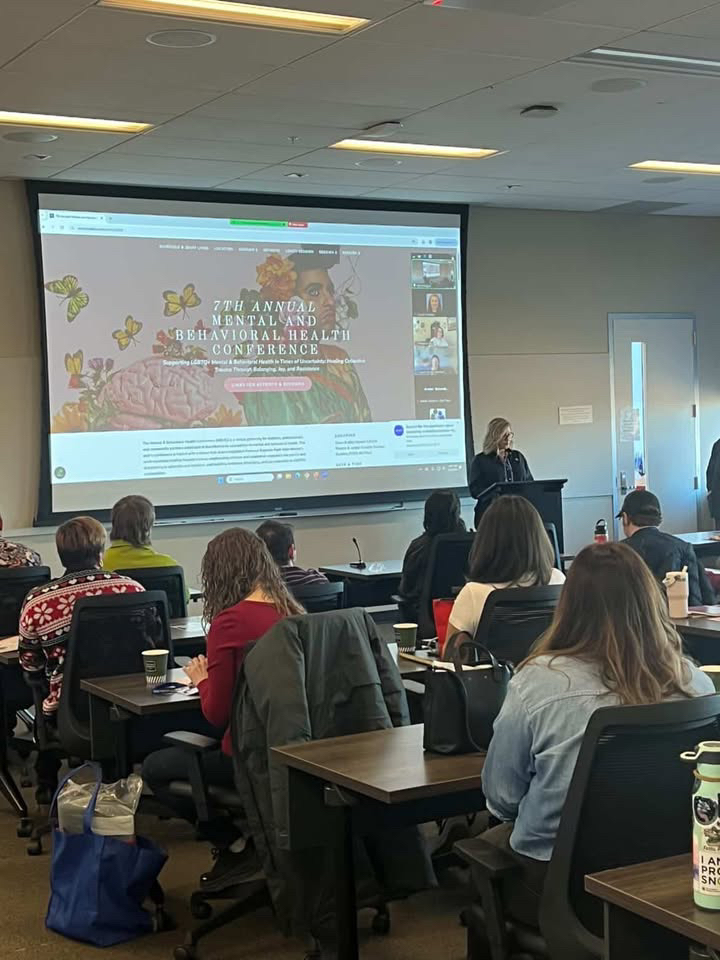
Samantha Montague (she/they), Social Work Student Services, Operations & Finance, welcomes a full room of attendees to the 7th Annual Mental & Behavioral Health Conference.
Gratitude and Looking Forward
The Department of Social Work extends deep gratitude to our partners who made this vital gathering possible:
- MSU Denver’s Office of Student Affairs, Student Engagement and Well-being – our essential on-campus partner
- Mile High Behavioral Healthcare – Mental Health Champion Sponsor
- Chroma Wellness Center – Access Sponsor
To the nearly 200 participants who joined us—whether in the Jordan Student Success Building or from screens across the country—thank you for showing up. Thank you for creating community. Thank you for reminding us that in times of uncertainty, we find our strength in each other.
The conversations started on February 6th continue, the community we built that day endures, and the work of healing collective trauma through belonging, joy, and resistance carries on.
__________________________
For more information about future conferences and events, visit the MSU Denver Department of Social Work website and events page, or follow us on social media.
References
GLAAD Accountability Project. (2025). Trump accountability project. GLAAD. https://www.glaad.org/trump
Movement Advancement Project. (2025). LGBTQ policy spotlight: Executive actions. https://www.lgbtmap.org/
National Center for Transgender Equality. (2024). 2024 U.S. transgender survey. https://transequality.org/
Office of Management and Budget. (2025). Memorandum on temporary pause of financial assistance. Executive Office of the President.
Pew Research Center. (2025). LGBTQ adults’ views on Trump administration policies. https://www.pewresearch.org/
The Trevor Project. (2024). 2024 national survey on LGBTQ youth mental health. https://www.thetrevorproject.org/
Trans Legislation Tracker. (2026). 2026 anti-trans bills. https://translegislation.com/
White House. (2025). Executive order 14168: Defending women from gender ideology extremism and restoring biological truth to the federal government. https://www.whitehouse.gov/












Leave a Comment
Your email address will not be published. Required fields are marked with *