
Summary: the day so far
It’s a lively day in international politics after the US intervention in Venezuela, with much comment and question about what happened, what it means and what’s to come. As many prominent figures are speaking up and developments continue on the ground in Caracas, we’ll keep you up to date with the news as it happens.
Here’s where things stand:
-
The governments of Spain, Brazil, Chile, Colombia, Mexico and Uruguay put out a strong joint statement saying the US actions in Venezuela “constitute an extremely dangerous precedent for peace and regional security and endanger the civilian population”, in an apparent reference to the Trump administration’s assertion that the US will “run” Venezuela and oversee oil production there.
-
Venezuela’s defense minister, General Vladímir Padrino López, issued a statement recognizing the vice-president, Delcy Rodríguez, as the country’s acting president. He said Venezuela’s military “categorically reject the cowardly kidnapping” of the dictator Nicolás Maduro and his wife, Cilia Flores by the US.
-
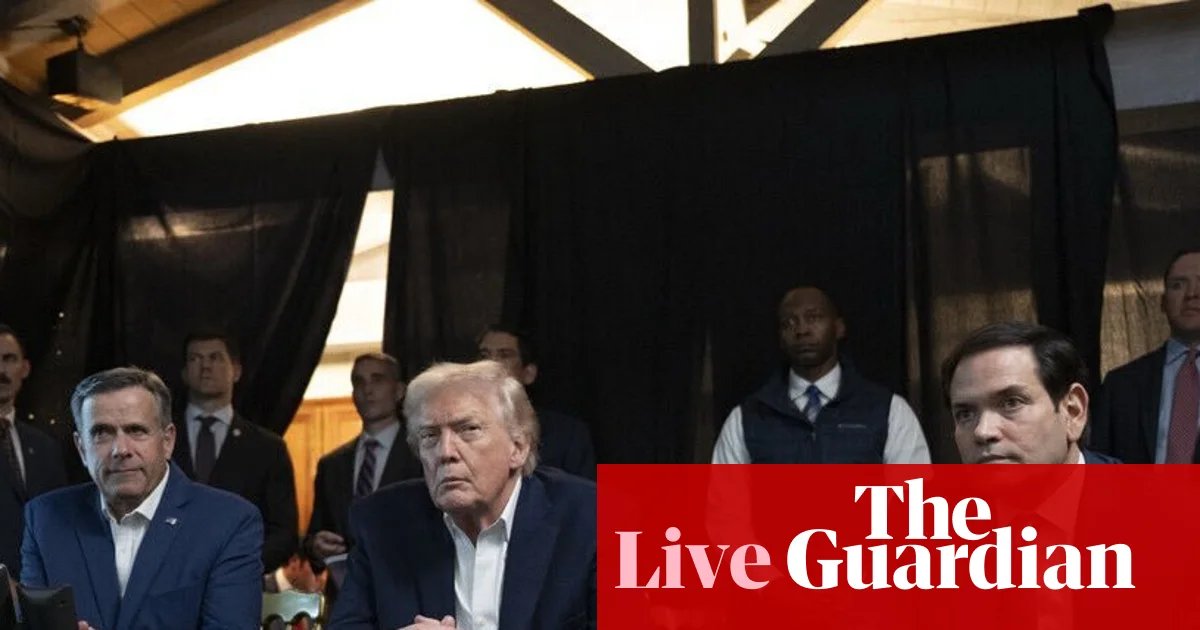
US Secretary of State Marco Rubio attempted to distance this weekend’s invasion of Venezuela from other invasions such as the US in Iraq more than 20 years ago, saying the events, despite their apparent similarities, are “very different.”
-
Rubio said on CBS that the US will continue to place pressure on Venezuela by seizing Venezuelan oil shipment boats. The Trump administration has repeatedly expressed a desire to take control of Venezuela’s vast oil reserves after ousting Maduro..
-
Prominent US Republicans including Rubio and Senators Tom Cotton and Jim Jordan, both senate committee chairmen, on Sunday were swiftly backpedaling on Donald Trump’s assertions in a press conference on Saturday, just hours after the military intervention in Venezuela and the snatching of Maduro, that the US “will run” Venezuela in transition. The men essentially talked about pressuring the country’s Venezuelan leadership to comply with US demands about its future conduct.
-
Pope Leo – the first American pontiff – said Venezuela must remain an independent country, as he called for respect of human rights after Nicolás Maduro’s capture by the US. Addressing crowds at the Vatican in Rome after Sunday prayer, the Pope – who spent years as a missionary in Peru – said: “The good of the beloved Venezuelan people must prevail over any other consideration.”
Key events
The New York Times reports a number of factors finally led the Trump administration to invade Venezuela and abduct president Nicolás Maduro – including Maduro’s dance moves.
The newspaper reports that Trump presented Maduro with an ultimatum in December, telling him to leave office and go into exile in Turkey. Maduro refused.
Then, Maduro went back onstage this week, dancing to an electronic song that said “no crazy war” in his voice.
According to sources the Times spoke with, that was the last straw for the administration.
Maduro’s “regular public dancing and other displays of nonchalance in recent weeks helped persuade some on the Trump team that the Venezuelan president was mocking them and trying to call what he believed to be a bluff,” two confidential sources told the Times.
The New York Times and the Washington Post learned of the secret US government raid to abduct Venezuelan president Nicolás Maduro before it happened, but did not publish what they knew “to avoid endangering US troops,” Semafor reports.
The New York Times and the Post knew of the raid, approved by Donald Trump on Friday night, soon before it was scheduled to begin. But the newsrooms and the Trump administration were in contact and that the administration urged the newspapers to hold off on their reporting, the Semafor report says.
Over 40 Venezuelans were killed in the operation and some US personnel were injured, US and Venezuelan authorities announced.
José Olivares
The Colombian guerrilla group, the National Liberation Army (Ejercito de Liberación Nacional), also known as the ELN by its acronym in Spanish, condemned the US invasion of Venezuela on Saturday, calling for a stand against the US government in the region.
In a statement by the ELN’s central command, the insurgent group said it “joins the voices of the international community that reject and condemn the attacks by the United States against Venezuela, which violate its sovereignty.”
The ELN also stressed that the US government’s further intervention in the region should be confronted.
“We stand with all patriots, democrats, and revolutionaries from Colombia and the continent to confront the imperial plans against Venezuela and the people of the South,” the ELN’s central command wrote in their statement.
The statement was distributed among ELN Telegram groups and was viewed by the Guardian.
The ELN is a far-left insurgent group in Colombia that has engaged in a longtime conflict with the Colombian government since the 1960s.
In 1997, the US government declared the ELN to be a terrorist organization and has accused the group of engaging in cocaine trafficking and other crimes to further its political insurgency. Throughout the civil conflict in Colombia, the US government provided support to Colombian armed forces to fight the ELN and other guerrilla groups, including the Revolutionary Armed Forces of Colombia (FARC), the latter of which signed a peace treaty in 2016.
The Colombian government and the ELN have attempted, in various instances, to engage in peace talks to end the conflict, similar to the ones with the FARC. Those talks have been unsuccessful, including recently under the current presidency of Gustavo Petro.
The ELN has evolved throughout the years and has increasingly ventured into Venezuela, expanding its reach and increasing its strength. According to the most recent unsealed indictment against Venezuelan president Nicolás Maduro and other co-defendants, including his wife, Maduro provided protection to the ELN and other far-left Colombian guerrilla groups.
One of Maduro’s co-defendants, former Interior and Justice Minister Ramón Rodriguez Chacín, was allegedly “assigned” by Maduro “to provide the FARC and ELN with protection and support,” the indictment reads.
During the fall, the Trump administration began striking a number of boats in the ocean near South America, claiming without evidence that traffickers and “narcoterrorists” were transporting drugs. In October, Defense Secretary Pete Hegseth announced that the US military targeted and struck a boat allegedly affiliated with the ELN, killing all three men onboard.
Nearly all countries within the European Union, except Hungary, issued a statement about the US-Venezuela crisis, saying the “will of the Venezuelan people” was the only way to restore the country’s democracy, Reuters reports.
“The European Union calls for calm and restraint by all actors, to avoid escalation and to ensure a peaceful solution to the crisis,” 26 EU countries said in a statement.
“Respecting the will of the Venezuelan people remains the only way for Venezuela to restore democracy and resolve the current crisis,” the statement added.
Donald Trump is now fine with the principle of regime change imposed on another country by the United States, according to a short telephone interview he conducted on Sunday morning.
Talking to The Atlantic, the US president said, after the US removal by force of Venezuelan president Nicholás Maduro and Trump’s rapid assertions that the US will run the country in the interim: “You know, rebuilding there and regime change, anything you want to call it, is better than what you have right now. Can’t get any worse.”
His interviewer pointed out that Trump had specifically in the past campaigned against a policy of favoring regime change in other countries, and he campaigned in 2024 on a policy of “America first” and shying away from military intervention abroad.
Trump didn’t explain how he thought removing the president of Venezuela and trying to engineer how that country will be run was or will turn out to be a fundamentally different kind of venture from the US invading Iraq, removing Saddam Hussein and operating inside that country.
What he did say was: “I didn’t do Iraq. That was Bush. You’ll have to ask [President George W] Bush that question, because we should have never gone into Iraq. That started the Middle East disaster.”
Trump threatens Venezuela’s interim leader
Donald Trump on Sunday threatened Venezuela’s interim leader, Delcy Rodriguez, that if she did not comply with demands from the US that she could pay a “bigger price” than the captured president Nicolás Maduro.
The US president conducted a short telephone interview with The Atlantic magazine as he was on his way to play golf in Florida.
“If she doesn’t do what’s right, she is going to pay a very big price, probably bigger than Maduro,” Trump said.
The US has commandedVenezuela to stop involvement in “narco terrorism” drug smuggling operations to the US, distance itself from US adversaries such as Cuba, Iran and militant proxies such as the Hezbollah group and facilitate the US overseeing its oil operations.
He did not explain his comments on Saturday that the US will run Venezuela, which senior Republican figures such as secretary of state Marco Rubio were backpedaling from at speed on Sunday.
Summary: the day so far
It’s a lively day in international politics after the US intervention in Venezuela, with much comment and question about what happened, what it means and what’s to come. As many prominent figures are speaking up and developments continue on the ground in Caracas, we’ll keep you up to date with the news as it happens.
Here’s where things stand:
-
The governments of Spain, Brazil, Chile, Colombia, Mexico and Uruguay put out a strong joint statement saying the US actions in Venezuela “constitute an extremely dangerous precedent for peace and regional security and endanger the civilian population”, in an apparent reference to the Trump administration’s assertion that the US will “run” Venezuela and oversee oil production there.
-
Venezuela’s defense minister, General Vladímir Padrino López, issued a statement recognizing the vice-president, Delcy Rodríguez, as the country’s acting president. He said Venezuela’s military “categorically reject the cowardly kidnapping” of the dictator Nicolás Maduro and his wife, Cilia Flores by the US.
-
US Secretary of State Marco Rubio attempted to distance this weekend’s invasion of Venezuela from other invasions such as the US in Iraq more than 20 years ago, saying the events, despite their apparent similarities, are “very different.”
-
Rubio said on CBS that the US will continue to place pressure on Venezuela by seizing Venezuelan oil shipment boats. The Trump administration has repeatedly expressed a desire to take control of Venezuela’s vast oil reserves after ousting Maduro..
-
Prominent US Republicans including Rubio and Senators Tom Cotton and Jim Jordan, both senate committee chairmen, on Sunday were swiftly backpedaling on Donald Trump’s assertions in a press conference on Saturday, just hours after the military intervention in Venezuela and the snatching of Maduro, that the US “will run” Venezuela in transition. The men essentially talked about pressuring the country’s Venezuelan leadership to comply with US demands about its future conduct.
-
Pope Leo – the first American pontiff – said Venezuela must remain an independent country, as he called for respect of human rights after Nicolás Maduro’s capture by the US. Addressing crowds at the Vatican in Rome after Sunday prayer, the Pope – who spent years as a missionary in Peru – said: “The good of the beloved Venezuelan people must prevail over any other consideration.”
Senator Jim Jordan spoke further on Sunday to echo Trump’s claims accusing Venezuela of taking oil that belonged to the US government.
“When that country took assets that belonged to American companies — that’s wrong,” Jordan said on CNN’s State of the Union. “That’s all President Trump is saying is going to change in the future relative to oil. I think that makes sense. They took property from American companies. That makes sense that there’s going to be some kind of compensation, some kind of reckoning for that.”
After Hugo Chavez was elected president in 1999, his “Bolivarian Revolution” movement nationalized a number of privately-run oil fields and reserves in Venezuela, including some owned by international oil companies. Resources from the state-owned petroleum company were then used to fund social programs in the country.
Trump on Saturday accused Nicolás Maduro, Chavez’s successor, of stealing oil from the US. In recent months, as the Trump administration’s pressure on the country increased, the administration seized a Venezuelan oil ship. Trump later said the US would keep the oil or sell it.
Republican Congressman and chairman of the Judiciary Committee Jim Jordan said on Sunday that the US government’s abduction of Venezuelan president Nicolás Maduro and his wife were consistent with the “America First” philosophy Trump ran on.
“Getting a bad guy brought to justice who’s had a five-year arrest warrant, that is certainly consistent with that theme and that message as well,” Jordan said during CNN’s State of the Union. “So I think the American people appreciate that. And, frankly, I think that’s the message we go tell the American people in this midterm election. President Trump and Republicans did what we said we would do. We’re doing that.”
Jordan’s claims contrast with hardline Maga Republican Rep. Marjorie Taylor Greene’s comments, who called out the Trump administration’s actions, saying they did not follow “America First.”
Spain, Brazil, Chile, Colombia, Mexico and Uruguay condemn ‘dangerous precedent’ set by US attack on Venezuela

Sam Jones
The governments of Spain, Brazil, Chile, Colombia, Mexico and Uruguay have just put out this strong joint statement in response to what they term “the gravity of the events occurring in Venezuela”, saying the US’s actions “constitute an extremely dangerous precedent for peace and regional security and endanger the civilian population”.
In an apparent reference to the Trump administration’s assertion that the US will “run” Venezuela and oversee oil production, the six governments also express concern “regarding any attempt at government control, administration, or external appropriation of natural or strategic resources”.
The statement reads:
We express our profound concern and rejection of the military actions carried out unilaterally on Venezuelan territory, which contravene fundamental principles of international law, particularly the prohibition of the use and threat of force, and respect for the sovereignty and territorial integrity of States, enshrined in the Charter of the United Nations. These actions constitute an extremely dangerous precedent for peace and regional security and put the civilian population at risk.
We reiterate that the situation in Venezuela must be resolved exclusively through peaceful means, by means of dialogue, negotiation, and respect for the will of the Venezuelan people in all its expressions, without external interference and in accordance with international law. We reaffirm that only an inclusive political process, led by Venezuelans, can lead to a democratic and sustainable solution that respects human dignity.
We reaffirm the character of Latin America and the Caribbean as a zone of peace, built on mutual respect, the peaceful settlement of disputes, and non-intervention, and we call for regional unity, beyond political differences, in the face of any action that jeopardises regional stability. We also urge the Secretary-General of the United Nations and the Member States of the relevant multilateral mechanisms to use their good offices to contribute to de-escalating tensions and preserving regional peace.
We express our concern regarding any attempt at government control, administration, or external appropriation of natural or strategic resources, which is incompatible with international law and threatens the political, economic, and social stability of the region.
Delcy Rodríguez recognized as Venezuela’s acting president by defense minister

Tiago Rogero
Venezuela’s defense minister, General Vladímir Padrino López, issued a statement recognizing the vice-president, Delcy Rodríguez, as the country’s acting president.
In the document, Padrino López first stressed that the Venezuelan armed forces “categorically reject the cowardly kidnapping” of the dictator Nicolás Maduro and his wife, Cilia Flores, and said US troops had “cold-bloodedly assassinated much of his security detail, soldiers and innocent civilians”, without providing specifics such as names or death toll.
He then wrote that, in “strict compliance” with Venezuelan law, the military would abide by a supreme court ruling appointing Rodríguez “in an acting capacity, with all the powers, duties and faculties of the president of the republic”.
Yesterday, at the press conference following Maduro’s capture, Donald Trump said Rodríguez, who had served as vice-president since the contested 2018 election, would be left in charge of the country and was willing to work with the US to “make Venezuela great again”.
Although Rodríguez kept a defiant tone in a televised address hours later, demanding the immediate release of Maduro and his wife, the US secretary of state, Marco Rubio, said on Sunday that Washington would judge her and other remaining figures in the regime by their “actions and facts” in the coming days, not by their public statements.
Padrino López added in his Sunday statement that the armed forces would “guarantee the country’s governability” and use “all available capacities to defend the country, maintain internal order and preserve peace.
He also wrote that Venezuela’s military apparatus, in what he described as a “perfect fusion of the people, police and armed forces”.
He also wrote that Venezuela’s military apparatus, in what he described as a “perfect fusion of the people, police and armed forces” – a reference to the militias the regime says it has at its disposal – remained mobilized to “confront imperial aggression, forming a single combat bloc to ensure the freedom, independence and sovereignty of the nation”.
Edward Helmore
Georgia congresswoman Marjorie Taylor Greene, a stalwart Maga Republican, told NBC’s Meet the Press that Maduro’s capture is not “America First”.
“If this was really about narcoterrorists and about protecting Americans from cartels and drugs being brought into America, the Trump administration would be attacking the Mexican cartels” Greene said Sunday.
Many Republicans argued Sunday that the US military action in Venezuela conforms to “America First” because it projects good house-keeping in the Western Hemisphere that benefits the US.
Greene said she was “not defending Maduro and of course I’m happy for the people of Venezuela to be liberated.”
“But Americans celebrated the liberation of the Iraqi people after Saddam Hussein. They celebrated the liberation of the Libyan people after Gaddafi. And this is the same Washington playbook that we are so sick and tired of that doesn’t serve the American people, but actually serves the big corporations, the banks, and the oil executives.”
Speaking of Maga priorities, she said “we don’t consider Venezuela our neighborhood. Our neighborhood is right here in the 50 United States, not in the southern hemisphere”, adding “my understanding of ‘America First’ is strictly for the American people, not for the big donors that donate to big politicians”.
U.S. Representative Marjorie Taylor Greene (R-GA) gets into an elevator as she heads to her final vote, at the U.S. Capitol in Washington, U.S., December 17, 2025. REUTERS/Evelyn Hockstein Photograph: Evelyn Hockstein/Reuters
House Minority Leader Hakeem Jeffries stopped short of criticizing the Trump administration’s abduction of Venezuelan president Nicolás Maduro on Sunday morning, instead criticizing the lack of congressional approval for the operation and Donald Trump’s domestic policies.
“Donald Trump claims that he’s going to run Venezuela. He’s done a terrible job running the United States of America. Life hasn’t gotten better for the American people over the last year; life has gotten worse,” Jeffries said. “So the notion that he’s going to run Venezuela and make life better for the Venezuelan people of course is belied by the facts as to what he’s done as President here in the United States of America.”
Jeffries said that the operation was a “military action” and urged the Trump administration to consult with congress before any further steps.
“This was not simply a counter narcotics operation. It was an act of war. It involved, of course, the Delta Force. And we’re thankful for the precision by which they executed the operation, and thankful for the fact that no American lives were lost,” Jeffries said. “So of course this was a military action, and pursuant to the Constitution, only Congress has the power to declare war to authorize acts that take place in this regard.”
“We have to make sure when we return to Washington D.C. that legislative action is taken to ensure that no further military steps occur absent explicit congressional approval,” Jeffries added.
Marco Rubio attempts to distance US attack on Venezuela from past invasions
Secretary of State Marco Rubio attempted to distance this weekend’s invasion of Venezuela from similar invasions in recent decades, saying the events, despite their similarities, are “very different.”
Some analysts equated the US invasion of Venezuela and the abduction of president Nicolás Maduro to other events in recent decades, including the invasion of Iraq and other military excursions in the Middle East.
“This is not the Middle East. And our mission here is very different. This is the Western Hemisphere,” Rubio said on CBS News’ Face the Nation. “Within the Western Hemisphere, we have a country, potentially a very rich country, that has cozied itself up — under the control of this regime — has cozied up to Iran. Has cozied up to Hezbollah. Has allowed narco-trafficking gangs to operate with impunity from their own territory, allows boats with drugs to traffic from their territory.”
The US invaded Iraq in 2003 and overthrew the government of Saddam Hussein under the guise of ridding the country of “weapons of mass destruction” and Hussein’s alleged ties to terrorist groups.
Secretary of State Marco Rubio said on CBS News’ Face the Nation pushed back on questioning regarding why other top Venezuelan officials and Nicolás Maduro allies were not also abducted by US forces. Rubio underscored that the operation to abduct Maduro was a complicated one.
“Imagine the howls we would have from everybody else if we actually had to go and stay there four days to capture four other people,” Rubio said. “We got the top priority.”
A number of other top Venezuelan officials, who worked closely with Maduro, remain in the country. One of those, Venezuelan interior minister Diosdado Cabello, has also been indicted by the US government and has a $25 million reward.
“It is not easy to land helicopters in the middle of the largest military base in the country — the guy lived on a military base — land within three minutes, kick down his door, grab him, put him in handcuffs, read him his rights, put him in a helicopter and leave the country without losing any American or any American assets. That’s not an easy mission,” Rubio said.
“And you’re asking me: ‘why didn’t we do that in five other places at the same time?’ I mean, that’s absurd.”
Marco Rubio: US to continue to pressure on Venezuela by seizing oil shipment boats
Secretary of State Marco Rubio said on CBS News’ Face the Nation that the US will continue to place pressure on Venezuela by seizing Venezuelan oil shipment boats.
“There’s a quarantine right now in which sanctioned oil shipments, there’s a boat, and that boat is under US sanctions, we go get a court order, we will seize it,” Rubio said. “That remains in place, and that’s a tremendous amount of leverage that will continue to be in place until we see changes that — not just further the national interest of the United States, which is number one — but also that lead to a better future for the people of Venezuela.”
The Trump administration has repeatedly expressed a desire to take control of Venezuela’s vast oil reserves after ousting Maduro.
In December, the US government seized a Venezuelan oil tanker off the coast of Venezuela, considered by some analysts to be an act of piracy. Trump then said that the US would keep or sell the seized Venezuelan oil.
During Trump’s press conference on Saturday, he said that Venezuela had stolen oil that belongs to the US, despite oil being in Venezuelan territory.
US senator Chris Murphy, questioned the Trump administration’s motives for abducting and removing Venezuelan president Nicolás Maduro on CNN.
“If this is really just about the oil, if this is really just about the natural resources, if this is just about getting a bunch of Donald Trump’s friends even richer, I don’t think there is a single American family who would support having their son or daughter put into harm’s way to defend the interests of Wall Street,” Murphy said. “This is once again American oil interests, American financial interests, coming before the actual national security interests of the United States.”
Chris Murphy, the US senator from Connecticut, criticized the Trump administration’s invasion of Venezuela on CNN.
Murphy equated the US attacks on Venezuela and the abduction of Venezuelan president Nicolás Maduro to other US wars in other parts of the world.
“Over and over again we have seen these warmongering neocons, many of which have influence in this White House, cheerlead us into war under the guise of removing a ‘very bad man’,” Murphy said, likely referring to the long-running US wars in the Middle East. “That ends up getting a lot of Americans killed.”
Republican walks back Trump’s claim US will ‘run’ Venezuela

Ed Pilkington
Tom Cotton, the Republican chair of the Senate intelligence committee, admitted on CNN’s State of the Union that there were “still a lot of questions to be answered” about what happens next in Venezuela. He reined sharply back on Trump’s claim that the US would run the country, redefining that startling comment as meaning that the leadership would have to abide by US demands.
“The president wants to give them a chance to turn the page in Venezuela and to help America achieve our policy goals there,” he said. Cotton listed some of the US government’s demands, including: “we want them to stop the drug trafficking. We want them to kick out the Iranians, the Cubans, the Islamic radicals.”
“Just return to being a normal nation that will help build stability, order and prosperity, not just in Venezuela, but in our backyard,” Cotton added.
Cotton also gave a more lukewarm assessment of Venezuela’s vice president Delcy Rodriguez, whom Trump has indicated the US could possibly work with. “We don’t recognize Delcy Rodriguez as the legitimate ruler of Venezuela,” the senator said.
He added: “I don’t think that we can count on Delcy Rodriguez to be friendly to the United States until she proves it.”

Leave a Reply