
Donald Trump says he has signed the US agreement with Iran, while the White House tells the BBC the deal is in effect
US officials reveal details of the deal: the 14-paragraph agreement says Iran will never have a nuclear weapon, and also commits to a $300bn fund for the "reconstruction" of the country – but the US is not required to contribute
The agreement declares the "immediate and permanent termination of military operations on all fronts, including in Lebanon"
And it says the US and Iran "commit to negotiating and achieving the final deal in maximum 60 days, extendable with mutual consent". Read the key points of the deal here
Donald Trump earlier warned the deal is "not final"
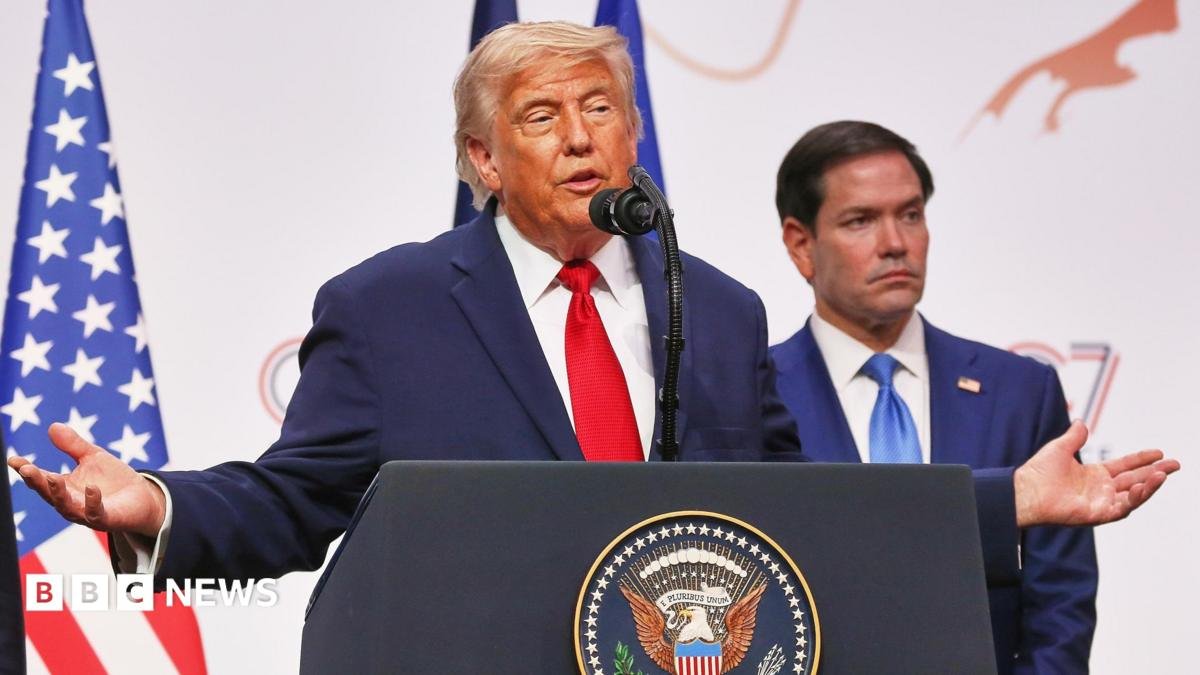
He said the US could resume attacks if the agreement doesn't work out – "If they don't behave, we'll go right back to dropping bombs right smack in the middle of their head, OK?"
Edited by Caitlin Wilson
Iran's parliamentary speaker, Mohammad Bagher Ghalibaf, says in an interview that aired on state TV that the Strait of Hormuz "will not return to pre-war conditions".
He adds: "Iran has the right to sovereignty over the Strait of Hormuz and of course we will receive a fee for services."
The country will charge ships crossing the key passage after 60 days.
In the longer-term, the deal signed by Trump notes that Iran will work with Oman and other Gulf states to set up a "broader" agreement on how to manage the Strait of Hormuz.
The US believes that Iran will assert its rights "aggressively", but that the Gulf states would "never" accept a future in which there is a tolling system in place, the official said.
You can read more about the agreement here.
Donald Trump has just left the Palace of Versailles in France, where he was having dinner with French President Emmanuel Macron after the G7 summit.
Asked about the deal before getting into the presidential motorcade, Trump told reporters: "It's signed. Signed in Versailles. Just signed it."
We can bring you a bit more information now about how the so-called memorandum of understanding has come into effect.
US President Donald Trump attended a post-G7 dinner at the Palace of Versailles in France on Wednesday night.
Also on Wednesday night, Trump signed the Iran document, the White House tells the BBC. It has also been signed by Iranian President Masoud Pezeshkian, according to the White House.
The signing by the two leaders comes after Iranian parliamentary speaker Mohammad Bagher Ghalibaf and US Vice-President JD Vance electronically signed the agreement on Sunday, the White House explains.
Earlier, both Trump and Iranian officials indicated that there would be a formal signing ceremony sometime later this week. It's unclear whether that will still go ahead now.
The agreement between the US and Iran is now in effect, the White House tells the BBC, kick-starting the extendable 60-day period for the US and Iran to come to a more final deal.
Senior US officials have revealed the contents of the memorandum of understanding between the Trump administration and Iran ahead of an expected signing ceremony in Switzerland on Friday.
The key parts of the agreement include Iran's inability to ever have a nuclear weapon; traffic returning to the Strait of Hormuz, which will remain toll-free for at least 60 days; the lifting of US sanctions; and an end to hostilities, including in Lebanon.
The details were revealed while Trump spoke at the G7 summit in France, where he said the US would "bomb the hell" out of Iran if it didn't abide by the terms of the deal.
In a later retort, Iran's parliamentary speaker and key negotiator Mohammad Bagher Ghalibaf, who agreed the deal with the Trump administration, told state media his distrust of the US remained, and Iran's "finger is on the trigger".
Our Washington correspondent writes the agreement leaves all the key questions around Iran’s nuclear programme to the final negotiations.
Arriving in Paris ahead of a state dinner with French President Emmanuel Macron at Versailles, Trump said the allotted 60-day negotiation period was not a hard deadline for Iran.
As for Friday, while US Vice-President JD Vance was originally slated to be present at the ceremony, Trump hinted that he "might" stick around.
Gary O'Donoghue
Chief North America correspondent
Vessels at the Strait of Hormuz, as seen from Musandam, Oman, on Tuesday – the waterway has been a key sticking point between the US and Iran
We’ve had the most extraordinary briefing call with some senior US officials here in Washington, and they read out – verbatim – what they say is the text of the memorandum of understanding with Iran.
There are three key things that stood out from it for me:
On the nuclear question, the senior officials say Iran has promised not to develop or procure a nuclear weapon. Donald Trump has made that his number one condition for a deal ever since the start of the war in February. They also said that Iran's enriched uranium will be "down-blended" – meaning diluted – on site, under the auspices of the International Atomic Energy Agency (IAEA). Originally, the US had demanded that it was removed from the country, so that’s new.
On the question of the reopening of the Strait of Hormuz, the senior officials said that there would be no charges for ships going through for 60 days. After that, it's up to Iran and its neighbours to negotiate what happens. That leaves open the possibility of charges in the future, where there were no charges before the conflict.
Then there's the controversial $300bn reconstruction fund. President Trump had described that as "fake news", but it is in the document. The senior officials insisted America doesn't need to pay "a cent" towards that –and it will depend on Iran “behaving", as they put it.
This agreement will be scrutinised line by line over the coming days. And the big question will be, what exactly did the US get out of its war with Iran?
This video can not be played
Three key takeaways from US-Iran deal
Iran's top negotiator Mohammad Bagher Ghalibaf, who agreed the deal with the Trump administration, says his distrust of the US remains, and Iran's "finger is on the trigger".
In comments made to state broadcaster Fars, Ghalibaf – Iran's parliamentary speaker – says that even if there is a final peace agreement, "it is still not trustworthy".
"Our finger is on the trigger, and if the enemy does not understand the language of logic, we will enter again with the language of power," he says.
Ghalibaf's comments come after Trump said the US would "bomb the hell" out of Iran if it didn't stick to the terms of the deal.
Here are some more lines now from US President Donald Trump's press conference earlier.
Trump was asked whether he had an update on the investigation into a strike near a primary school in southern Iran where Iranian authorities said 168 people, including around 110 children, were killed.
He described it as a "strange question" to ask, before saying the strike remains under investigation.
Trump continued: "What about the thousands of people that were killed by Iran? Mistakes are made, war is nasty, but I know it is under investigation."
He went on to say that the reporter should ask Defense Secretary Pete Hegseth for a further update.
For context: Experts previously told the BBC that a US Tomahawk missile hit a military base near a primary school in southern Iran where Iranian authorities said 168 people, including around 110 children, on 28 Feb.
You can read more about that strike in our BBC Verify report.
The continued presence of Israel in Lebanon would be a "violation" of the deal to end the war, Iran's foreign ministry says.
According to Iranian state TV, foreign ministry spokesperson Esmail Baghaei says "necessary measures" will be taken if Israel continues to "occupy" Lebanon.
Lebanon has emerged as a key sticking point in the deal – Israel says it is not included, while Lebanese President Joseph Aoun says his country's talks with Israel are "independent" to the US-Iran deal.
But Iran and mediator Pakistan insist a ceasefire in Lebanon remains central to the memorandum of understanding set to be signed by US and Iranian officials as early as tomorrow.
A US version of the deal – shared with the BBC by senior officials – calls for the "immediate and permanent termination of military operations on all fronts, including in Lebanon".
Donald Trump has arrived at Versailles for a state dinner hosted by Emmanuel and Brigitte Macron.
The event follows the US president's speech at the G7 summit in which he spoke at length about his deal with Iran.
Earlier, the French president also addressed the summit in Évian, in which he lauded US unity with Europe's support for Ukraine. Ghoncheh Habibiazad
Senior reporter, BBC Persian
Iran’s official news outlet IRNA (Islamic Republic News Agency) has released a version of the memorandum of understanding minutes ago.
Comparing side-by-side what the IRNA has published with the 14-paragraph version provided to the BBC by senior US officials, it seems like the two are almost identical.
The only minor difference in the Iranian version is in paragraph six, which says the “United States of America undertakes with regional partners to develop a definitive mutually agreed plan with at least USD 300 billion for the reconstruction and economic development of the Islamic Republic of Iran. Mechanism for the implementation of this plan will be finalized as part of the final deal within 60 days."
The paragraph's ultimate sentence in the US version reads: "All required licenses, waivers, and permissions needed for the relevant initial transactions will be granted by the United States of America."
In the version published by IRNA, the word “initial” is missing from that last line. But, it doesn’t seem like anything major that makes an actual difference in the meaning.
President Trump has said 60 days is not a hard deadline for a final agreement with Iran.
Asked by a reporter after he landed in Paris if he sees a hard deadline for the agreement, Trump said: "No, I don't. It could take longer."
The memorandum of understanding as it stands says the two sides would aim to reach an agreement within 60 days.
Trump also said that if other countries have ballistic missiles, it's "a little bit unfair" for Iran to have none.
He added that "a ballistic missile is not the same thing as what we're talking about when we talk nuclear. But if Saudi Arabia and Qatar and they all have some, I would say in relative proportion, I think it's OK."
He was also asked by a reporter how long the US would leave its military in the Gulf, to which he replied, "I would say a little while" after the deal is agreed.  Imogen Foulkes
Reporting from Geneva
The head of the International Atomic Energy Agency says the agreement due to be signed between the US and Iran on Friday is "a good step forward", but warned there was still important work to do.
Rafael Grossi was speaking to the BBC in Geneva before heading to the Bürgenstock resort, where the signing will take place.
Asked if the terms were better or worse than the original deal to limit Iran’s nuclear capability (agreed under President Obama and which President Trump abandoned) Mr Grossi said there could be no comparison.
This agreement was a "post-war agreement" he said, whereas the previous one had been designed to allow Iran to proceed with some nuclear capability, for peaceful purposes only.
This one would involve an inventory of what remained of Iran’s highly enriched uranium, he added, and would be complex because of the destruction of infrastructure during the conflict.
Mr Grossi expects the IAEA to be tasked with inspecting what’s left of Iran’s nuclear facilities, and stressed that "if there is non-compliance, we (will) say it".
Mr Grossi is a candidate to be the next UN secretary general, and his reluctance to compare the previous Iran nuclear agreement (which took years to negotiate and which most analysts agreed was largely successful) may be because he does not want to say anything which could be seen as criticism of the US – a country with the power to veto his candidacy at the UN Security council.
US President Donald Trump is pictured at Geneva Airport, ahead of his flight to Paris Orly Airport. Geneva Airport is around an hour's drive from Évian in France, where the G7 summit was held.
US President Donald Trump has now arrived in Paris, heading for a state dinner at Versailles with French President Emmanuel Macron.
His departure from Évian via Geneva Airport caps an eventful G7 summit that saw him announce details of the US-Iran ceasefire agreement, and threaten to "bomb the hell" out of Iran if it did not stick to its terms.
The deal is set to be formally signed in Switzerland on Friday, with the Iranian foreign ministry saying it could be signed by the two countries' presidents.
Trump hasn't confirmed whether he'll "stick around", but says he "might".
Asked whether the American public thought the war in Iran was a humiliation for the US, pollster Larry Sabato says: "On day one it was already unpopular. This is the only modern war where Americans sided against it from the beginning."
He adds: "Even some of the MAGA forces, the strong Trump forces, understand that while this didn't turn out to be a forever war, at least not yet, it also violated the general pact they had with Trump in the elections, which is that he was going to avoid the foreign policy mistakes and unwise wars of presidents like George W Bush."
Asked where it leaves the neocons, the faction of international interventionists in the Republican Party that is most closely identified with Bush and the Iraq War, Sabato says that "the neocons have never liked Trump and this gives them the fuel they need".
Sabato is director of the Centre for Politics at the University of Virginia. He is an expert in public opinion and research.
Listen back on BBC Sounds from 17:10.Ghoncheh Habibiazad
Senior reporter, BBC Persian
Iran’s economy has been under pressure for years.
Tehran is estimated to have more than $24bn (£18bn) in frozen assets held in foreign banks.
But the war has cost Iran far more than that – possibly close to 10 times those out-of-reach funds.
The country’s government spokesperson has estimated the cost of damage caused by US and Israeli attacks at $270bn (£203bn).
Before the recent war, years of Western sanctions, mainly imposed due to Iran’s nuclear and ballistic missile programmes, also damaged the country’s economy.
Iran’s top negotiator, Parliament Speaker Mohammad Bagher Ghalibaf, while acknowledging the current state of Iran’s economy and pain caused by sanctions, has said Iran would not “surrender” in exchange for sanctions being lifted.
Then, there are the ordinary people.
Anti-establishment protests in Iran back in January started over the state of the country’s economy. But Iran's economic situation now is far worse than it was back then.
It is yet to be seen whether a deal with the US can bring some life to Iran’s economy. Daniel Bush
Washington correspondent
President Donald Trump is pitching the US-Iran deal as a major win for the global oil markets, promising at the G7 summit that energy prices would quickly fall to pre-war levels after the agreement goes into effect.
"It'll soon be at the number it was four months ago," we just heard him say about oil prices during his press conference.
But energy industry leaders are warning it could take much longer for markets to stabilise.
Shippers will be wary to fully restart operations in the Strait of Hormuz while the US and Iran negotiate a final peace deal over the next two months. And even if oil starts moving through the strait once the US-Iran ceasefire extension is signed, it typically takes time for prices to come down and for cost savings to be passed on to consumers.
Many experts, though, say it could take months after the Strait of Hormuz reopen for energy shipments to fully pick back up and get back to where they were less than half a year ago.
US officials have also warned that prices won’t drop overnight, noting that it’ll take some time for oil and gas shipments in the region to return to normal. Bernd Debusmann Jr
White House reporter
Part of the agreement notes that upon the signing of the MoU, Iran will "make arrangements using its best efforts" to allow safe passage of commercial days through the Straight of Hormuz – with no charge.
This has been a significant objective of the US since the war began and the strait was shut, sending oil prices spiking upwards. But just how permanent this fix is remains to be seen.
In the longer-term, the document notes that Iran will work with Oman and other Gulf states to set up a "broader" agreement on the waterway.
Asked during his G7 press conference what safeguards there were against Iran imposing fees, Trump replied "common sense".
"They don't want to get bombed," he elaborated. Even if it doesn't come to that, the US believes the Gulf states would "never" accept a future in which there is a tolling system in place.Daniel Bush
Washington correspondent
Taken together, the details of the US-Iran agreement – outlined in our earlier post – confirm the narrow confines of the immediate deal at hand, as well as the massive challenges ahead for both sides to reach a permanent peace deal.
The Memorandum of Understanding lifts the US naval blockade and reopens the Strait of Hormuz, moves that will calm the global economy.
But it leaves all the key questions around Iran’s nuclear programme to the final negotiations.
The Obama-era Iran nuclear deal was negotiated over nearly two years.
Now, in theory, the US and Iran have just 60 days to reach a new one.
US President Donald Trump and his Iranian counterpart Masoud Pezeshkian could sign the deal to end the war, Iran's foreign ministry says.
According to semi-official news agency Tasnim, foreign ministry spokesperson Esmail Baghaei says the idea is "on the table and is still being considered".
It comes after Trump told a G7 press conference he "might" stick around for the signing ceremony, which is set to take place in Switzerland on Friday.
Copyright © 2026 BBC. The BBC is not responsible for the content of external sites. Read about our approach to external linking.