
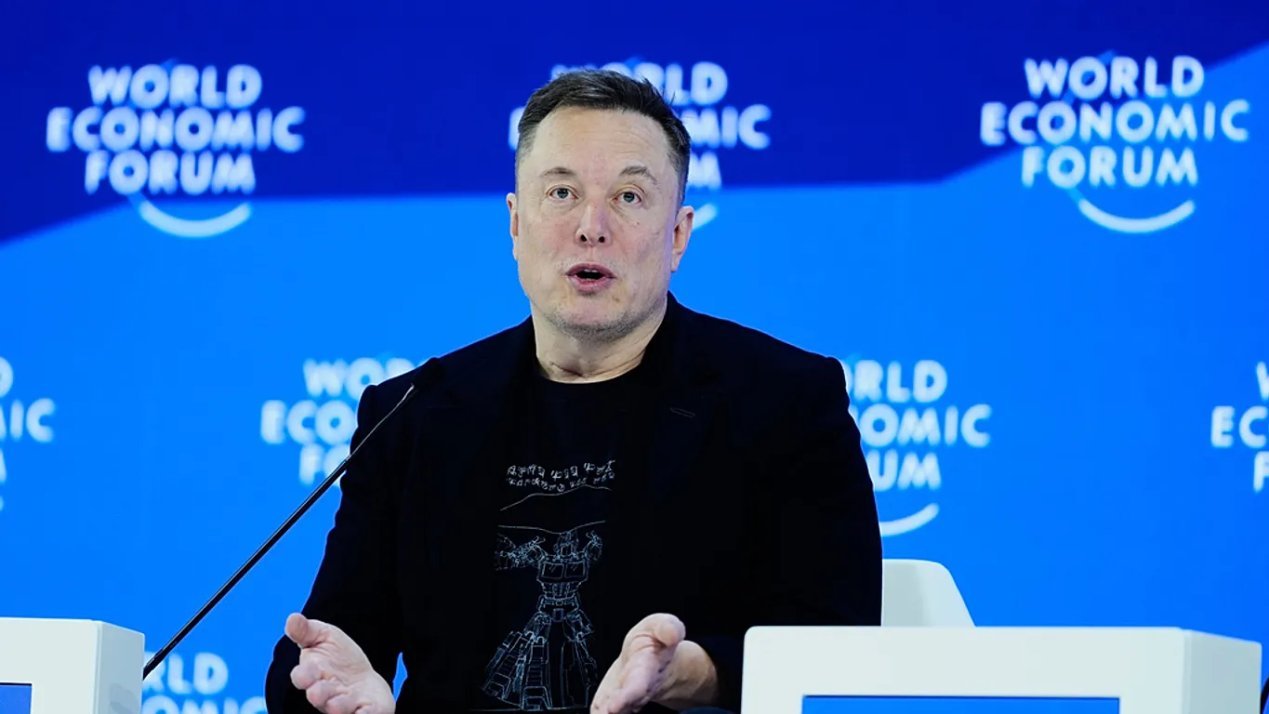
As operational efficiency and technological return on investment (ROI) dictate the agenda of corporate powers, Elon Musk, CEO, Tesla, envisions a transition that will lead to “abundance for all,” led by Physical AI.
“How do you give everyone a very high standard of living? I think the only way to do this is AI and robotics,” said Musk at the World Economic Forum’s (WEF) annual meeting in Davos.
The discussion, which in previous years focused on issues such as the COVID-19 pandemic, wars, humanitarian crises, and economic inflation, prioritized AI and robotics. Reports point to the evolution of technology toward new critical infrastructure. “I want to talk about AI and robotics, energy, space, and progress that ultimately comes down to engineering, the discipline of engineering, scale, and execution,” says Larry Fink, CEO, BlackRock.
Fink points to a disparity in capital returns between traditional sectors and AI leading companies, which can be seen in the cumulative net profits of just five Silicon Valley companies, which are close to US$420 billion. “Since Elon took Tesla public, its compound return is 43%,” says Fink. He contrasts this with BlackRock’s 21% and urges EU pension funds and citizens to integrate fast-growing assets into their sovereign portfolios.
In this scenario, Musk frames the transition to “Physical AI” not as a market option, but as a biological and technological imperative to ensure the continuity of consciousness in the face of possible natural or man-made disasters.
The “Economy of Abundance”
Musk’s concept of “abundance for all” is based on the widespread implementation of humanoid robotics and ubiquitous AI systems. Under this scenario, global economic production would be centered on a technical equation: average productivity per robot multiplied by the total number of operational units. Musk envisions a scenario where the cost of goods and services is drastically reduced due to the elimination of human labor constraints.
According to Musk, robots already perform simple tasks in industrial environments and are expected to perform highly complex functions by the end of 2026. “By the end of next year, I think we will be selling humanoid robots to the public,” Musk says. He assures that reliability and safety will be the cornerstones for their integration into homes for the care of children, pets, and the elderly.
“There will come a point where you will not even be able to think of something to ask the robot to do,” says Musk, suggesting an expansion of the global economy without historical precedent.
Falling AI Costs and the Energy Bottleneck
A key factor in this transition is the systematic collapse of AI prices. Musk argues that the cost of processing and accessing language and vision models is falling monthly. This technological deflation is accelerated by the proliferation of open-source models, which lag just 12 months behind the most advanced private models.
However, this drop in prices and universal access pose risks of an “AI economic bubble,” where computing infrastructure could exceed its already high monetization capacity if issues of purpose and marginal utility are not resolved. Musk warns that “we need to be very careful with AI,” alluding to the fact that the ubiquity of nearly free technology could create imbalances in the value structure of human intellectual work.
Furthermore, the viability of this automated future faces a physical constraint: the supply of electrical power. While AI chip production is growing exponentially, the increase in global electricity generation capacity remains marginal (between 4% and 10% annually). Industry projections indicate that by 2030, data centers could account for up to 80% of energy demand in the United States.
To mitigate this deficit, Musk proposes a radical change in energy infrastructure, pushing for a focus on photovoltaic cells. Musk suggests that an area of 160km by 160km of solar panels in regions such as Utah or Nevada would be sufficient to supply the entire United States. Criticism focuses on tariff barriers that make the adoption of solar cells more expensive, especially in comparison to China’s production capacity, as the latter country deploys over 1,000GW of solar energy per year.
To expand the network at the required speed, Musk plans to launch AI data centers powered by orbital solar energy. This solution takes advantage of five times greater efficiency than on Earth, due to the absence of day-night cycles, weather conditions, or atmospheric attenuation. “The lowest-cost place to put AI will be in space, and that will be a reality in two or three years,” Musk says.
According to Musk, the timeline for the development of artificial general intelligence (AGI) is imminent. He estimates that by the end of 2026, AI will be smarter than any individual human being. “Probably by 2030 or 2031… AI will be smarter than all of humanity collectively,” said Musk during the session.
In the field of space exploration, success is measured by the “total reusability” of the Starship system. Musk predicts that this milestone will be reached in 2026, reducing the cost of access to space by a factor of 100, bringing it below the cost of conventional air freight (less than US$100 per pound).
The future projected by Musk does not contemplate a return to 20th-century economic models. The integration of Physical AI, the expansion of orbital solar infrastructure, and the total automation of manufacturing are ongoing processes with execution metrics set for the end of the decade. The evolution of human consciousness, in this context, depends on the successful transition from “science fiction to scientific facts.”
For Musk, the deployment of Physical AI by 2027 and the surpassing of the human population by robotic units represent “the most significant structural change in the history” of industrial engineering.
Leave a Reply