
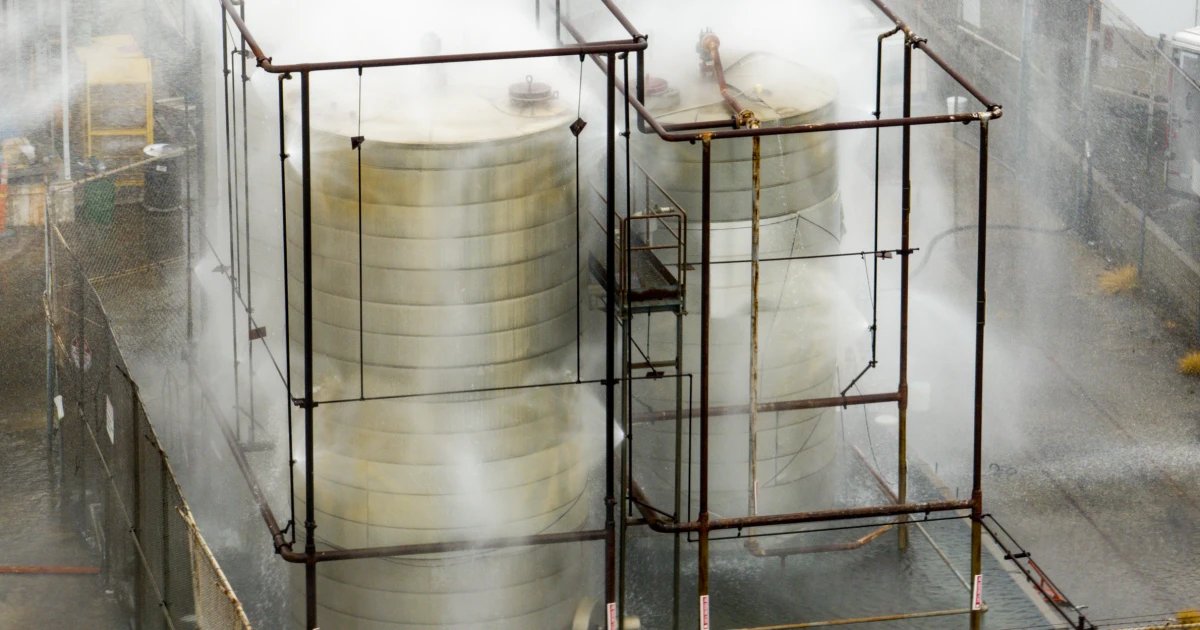
McGovern told NBC News that crews are looking to confirm that the crack is releasing pressure in the tank. If it is, it means “the potential of a BLEVE [boiling liquid expanding vapor explosion] is now off the table.”
In an update Sunday night, McGovern said crews would be conducting an “all-night mission” to confirm whether the pressure in the tank has been released. An update about that mission will come Monday, he said.
“There’s still a potential for explosion,” he said earlier, but if pressure is released, the threat of a BLEVE, which he described as “very, very dangerous, much worse than an explosion,” could be averted.
A White House official said Monday that the Trump administration “is engaged and monitoring the situation.”
The Environmental Protection Agency has enabled air monitoring at 20 locations around the area, the official said. The Federal Emergency Management Agency has deployed a local officer to coordinate with officials, sent a team to the State Emergency Operation Center and activated its Interagency Modeling and Atmospheric Assessment Center, which models airborne hazards.
If a BLEVE is still possible, the evacuation zone will be much larger, but if that concern is ruled out, the evacuation zone can be smaller and crews would then focus on cooling the tank, he said.
McGovern added that air monitoring has shown the possible fissure has not led to the release of toxic air.

The Orange County Fire Authority said early Monday that one of three tanks at the facility had been neutralized by introducing a compound into it, but that the other two — including the affected tank — have not.
The authority quashed reports that there may be more than one crack on the tank. “There is also peeling of the weather stripping on the exterior, but this is not an additional crack. There is currently no active leak, and continuous live atmospheric monitoring confirms there are no chemicals leaking,” it said in a post on X.
A spokesperson for GKN Aerospace said Sunday that the company is monitoring the condition of the “affected material” and that crews are working “around the clock to mitigate the risk of a leak.”
If the tank explodes, it could also set off a blast in a nearby 15,000-gallon tank and a 4,500-gallon tank that also hold methyl methacrylate, Division Chief Craig Covey, the Orange County fire incident commander, told NBC News.
Officials are also concerned the tank could rupture and release toxic material into waterways.
“We’re talking about possibly one of the worst chemical incidents in California history,” Covey said.
Officials say the blast radius, which stretches up to half a mile, would cause severe structural damage and most likely disperse toxic vapors into the air.
Shelters in Orange County are filling up with frantic locals as 50,000 people are under evacuation orders.
Lydia Green, who lives in Anaheim, about a mile from the facility, is one of them.
“I’m feeling nervous, scared, devastated,” Green told NBC News on Sunday at a shelter at John F. Kennedy High School in nearby La Palma. “I’ve been without my medication, my basic needs — food, hotels, we haven’t had a hotel. It’s been very hard.”

She and her partner, Eugene Smith, had been sleeping in their car. Smith described the ordeal as “like living in a nightmare,” and he fears a devastating explosion and its aftermath.
“Blowing up and then contaminating everything. Everything. That’s where we live at. That’s our home,” he said.
Jaden Gebeleinis was also at the shelter and said he was nervous, as he lives in the border of the evacuation zone.
“It’s a lot of anger. … I feel like why there are these facilities right next to a bunch of houses? And it makes me upset, too,” he said. “You hope that it gets managed well and then the worst-case scenario doesn’t happen, because those are people’s houses, and it’s probably going to affect a lot bigger of a radius than they let on.”

The American Red Cross said Sunday that six shelters scattered around the region for evacuees are nearing or at capacity for overnight stays.
McGovern said there’s no timeline just yet for when residents may be able to return home.
Concern first came up Thursday with a “vapor release” at the 7,000-gallon tank, Orange County fire officials said. Further investigation found that the tank’s temperatures were rising.
Firefighters have been using sprinklers and hose lines to cool the tank. McGovern said that during a team operation Saturday night, crews saw that the pin on the temperature gauge was displaying 100 degrees Fahrenheit, the highest level it shows, meaning actual temperatures in the tank could be higher.
Garden Grove is in northern Orange County, about 35 miles southeast of Los Angeles and 4 miles from Disneyland in Anaheim.
Gov. Gavin Newsom declared a state of emergency in Orange County on Saturday. On Sunday, he requested that President Donald Trump issue an emergency declaration to support response operations in the county.
McGovern said officials are working collaboratively and using “outside-the-box thinking” to come up with a solution and get families back in their homes.
“We have to get them back,” he said, “but I will assure you we will not get them back until it’s safe to do so.”
Steve Patterson and Shanshan Dong reported from La Palma and Marlene Lenthang from Los Angeles.
Leave a Reply