Tesla v. Waymo And More
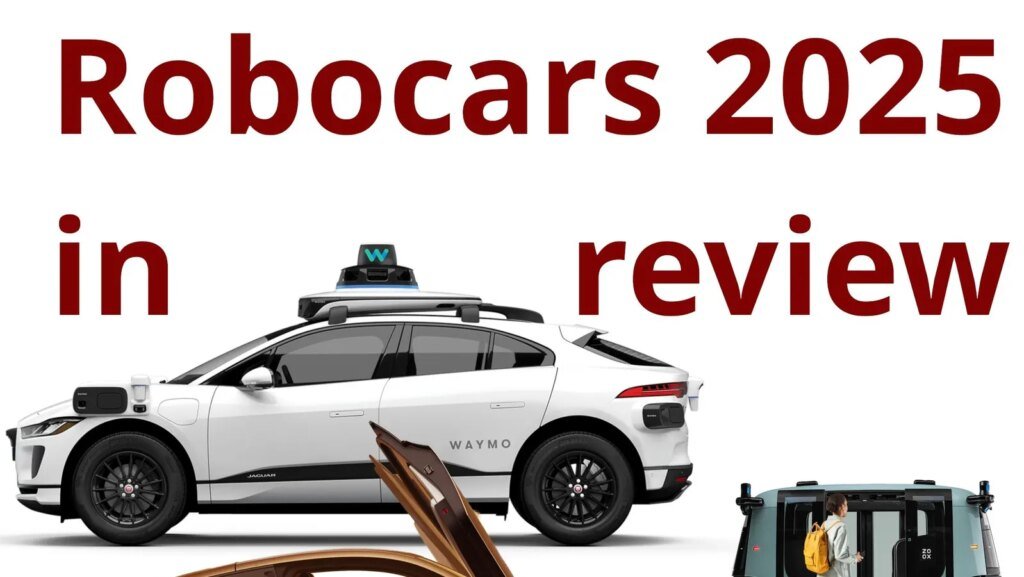

It’s time for the year-end review
Brad Templeton (Waymo/Zoox/Tesla)
It’s time to summarize the top stories of 2025 for Robocars. Never a dull moment.
11. Trucking Gets Real
Some trucking players died, and TuSimple was reborn as Bot Auto, but the big news was Aurora starting autonomous commercial freight operations. It’s fairly limited right now, and their partner Paccar has insisted on putting a safety driver in the vehicle, but Aurora has crossed that big line of putting out a vacant vehicle, though they are probably still monitored remotely–in fact you can look out a live camera of their drives on YouTube. Kodiak moved towards military contracts and Einride seemed in trouble but has bounced back and says it will go public via SPAC (often a risky route.) Meanwhile, fortunes have risen for Waabi with new financing, and it may soon be legal to have self-driving trucks in California.
10. Uber Hopes to Rule the Robotaxi
The robotaxi business is about selling rides, and Uber has the top brand in the western world in selling rides, which is good to have. But the companies building robotaxis, like Alphabet, Amazon and Baidu are some of the world’s biggest tech companies, much larger than Uber. They won’t build their tech just to “drive for Uber.” But Uber is making partnerships everywhere it can (even with Waymo) to broker rides. They have leverage over the small companies (like Nuro) but the big companies will be in charge of any deal. The long term fate of Uber, and Uber drivers, will be an interesting story.
9. Private Robocars Offer a Glimpse
Most players are trying to build robotaxis, and there are strong reasons to do that. But interest still remains in private robocars, and AutoX, which deployed robotaxis in China now wants to build a luxury private robocar which they hope to ship next year. Waymo and Toyota announced they will work on private robocars, and while Tesla has always said it will release “real actual unsupervised FSD” for private cars, they are starting with robotaxis.
8. Musk Goes Political
Elon Musk’s strange political journey was about far more than robotaxis, but it included him firing people at the federal regulator, and an anti-Tesla backlash after his famous salute that may well make it hard for him to get robotaxi customers after the novelty wears off. Robotaxi riders are all urban, and mostly vote blue.
7. Robotaxis make mistakes, but the public starts to accept them (a bit)
The headlines were full of stories of various vehicles, mostly Tesla and Waymo, making mistakes, normally harmless but often scary. The most attention came when a Waymo killed a cat in San Francisco that had crawled under the car before it pulled away. The well-loved cat triggered a lot of reaction, though it should be noted that Waymo has reportedly hit around 5 cats, but humans driving the same miles would have killed over 150
Surprisingly, San Francisco and other city governments have become more friendly, and Waymo is already taking employees on rides to SFO airport (and the public to San Jose airport.) In addition, while San Francisco’s Market Street was closed to private cars some time ago, Waymos (and Ubers) are now allowed to access it, while private cars still can’t. The public may be coming to understand that with this volume of driving, the vehicles will make many mistakes, but that the statistics are what matter, not the specific incidents, and data suggests the statistics are very good.
Tesla’s FSD and Autopilot for a long time avoided much blame for mistakes because it’s all on the supervising driver, but a recent $329M damage award may change that. In addition, Tesla was ordered to stop calling their system “Autopilot,” which it is argued confuses some buyers.
6. Nuro pivots to robotaxis, other players advance
In the USA, Waymo, Cruise, and now May and Zoox have operated vehicles with nobody in them. But a 5th company, Nuro, has done it as part of their delivery robot project. The delivery robots were smaller and lighter and slower, and had no room for a person, but they did it. Nuro decided to abandon this path and now is putting its technology into robotaxis, in partnership with Lucid and Uber.
5. Zoox starts operations in Las Vegas and SF, but barely
Zoox missed their promised deployment in 2024, but they got something going in Las Vegas in 2025 in Las Vegas, but the vehicles only operate a shuttle between 5 stops, with a 6th to be added soon. In San Francisco, they have a real point-to-point service, but only in a few neighbourhoods, and only for an approved group of riders. Still, it’s a big step, and we hope to see more general service from Zoox soon.
4. The Battle between Waymo and Tesla
No robocar discussion recently has avoided debate about the merits of Waymo and Tesla. This article, with accompanying video, gets into how to think about that comparison. We’ll keep doing that in 2026. Right now, Tesla has started two robotaxi pilots, but vehicles have safety drivers on board, so no meaningful comparison can be made between the services. Tesla has let a couple of cars out without safety drivers on board (but probably remotely supervised) so this may be about to change.
3. Baidu hits 250K rides/week
Most of the news we see here is about the USA, with Europe offering very little progress. But China is marching ahead, and Baidu now reports it is doing 250,000 paid rides/week (compared to 450,000. The other Chinese players (WeRide and Pony) are also giving rides and doing test deployments in the UAE, with plans for several other countries. In Europe, MOIA claims they will have a service in 2026, and Verne says they will start in Zagreb as well. Both use Mobileye, which has not yet demonstrated any ability to do unsupervised robotaxi, so these predictions are dubious.
2. Tesla begins a rocky start in Robotaxis
Tesla generates the most news and controversy. This year, Elon Musk declared they would start a robotaxi service in Austin in June, unsupervised with nobody in the car. They were unable to achieve that, and deployed with safety drivers, located in the right seat with an emergency stop button and the ability to grab the wheel like a driving instructor. Even so they had a series of minor crashes, but they don’t release statistical data on performance.
Musk promised at first that there would be large volumes of robotaxis deployed, but there are only about 20 for now in Austin, and a few more in the SF Bay Area. Most notable, however, is that there are a couple of cars testing with no human on board, but presumably remotely monitored (by a remote safety driver with a wheel and pedals.) Even so, it’s a big step, and we’ll see by year’s end if Tesla’s team can deliver on Musk’s promise to make it happen by then.
After many years of releasing highly misleading data on Autopilot safety, Tesla released some more usable numbers on FSD, which suggest that supervised FSD is not more dangerous than driving without FSD on city streets.
1. Waymo scales like crazy
Waymo had a banner year, scaling fast. They now have public, unsupervised robotaxi service in ten cities: Phoenix, SF, LA, Austin, Atlanta, Miami, Dallas, Houston, San Antonio, and Orlando. They have announced they will do several more next year. In addition, they recently expanded to most of the SF Peninsula and now take members of the public onto the freeways–removing a limitation which has made the service far too slow on some routes. They are rapidly building out their remaining Jaguars and testing their Zeekr and Hyundai next-generation vehicles. They announced doing 450,000 rides/week and 20 million total lifetime over 127 million fully autonomous miles. Only Baidu can claim to be close.
Waymo is currently alone in the “land rush” to open new territories in the USA. They are also doing tests in Tokyo and London. Ideally, they will be joined in 2026 by another company, though neither Tesla nor Zoox seems quite ready.
Predictions for 2026
It’s unwise to make predictions. All the robocar team leaders who have predicted when they would reach a stage have ended up embarrassed. Waymo is wise and rarely announces dates until they are on the verge of shipping. Elon Musk’s predictions that Tesla FSD will work unsupervised “this year” for 8 years in a row are legendary and have made everybody but Tesla Stans ignore them. So my first prediction is that most or all of those who have named dates more than a few weeks out will eat crow. Those who don’t name a date may surprise us.
We’ll see a lot of confusion about what autonomy is. Autonomy means no full-time supervision, in-car or remote. It’s not autonomous and it’s not a robotaxi if it has that, it’s a test project or prototype. The real deal is autonomous, takes members of the public on routes with their choice of origin and destination, though it’s OK if you have to take a short walk at either. But we’ll see people asking us to get excited about fixed route shuttles, or limited invite-only tests.
I don’t have any data on many of the teams because they won’t give it. But I predict that if they won’t disclose data on safety performance, then the data’s not great, and they are not going into production with an autonomous robotaxi any time soon.
Tesla might try. Elon Musk likes to push his teams hard, hoping they will deliver the impossible. He’s a bit like Hernán Cortés, who legend says burned his ships to force his crew to conquer Mexico. He’s giving them only one path out. That strategy did conquer Mexico, but we don’t hear the stories of the people who failed with it. Either way, I expect him and Tesla to be surprised at how hard it is to scale up a robotaxi service, even if they decide they have a working robotaxi. It was trivial for Uber to add a new city compared to deploying a robotaxi in a new city, but it took them many years to get into a lot of cities. 17 years later, they still aren’t in all of them.
Waymo will add a bunch of new cities. They’ll also have a series of embarrassing mistakes, but hopefully learn from them so they aren’t repeated. They just had a bad one on Dec 21 with a San Francisco power failure. But it is the need to have those mistakes and learn from them that is part of why it takes a long time to scale.
I also predict there will be few dull moments again.