
This is read by an automated voice. Please report any issues or inconsistencies here.
WASHINGTON — The curtain started to come down for President Trump at the Kennedy Center on Saturday.
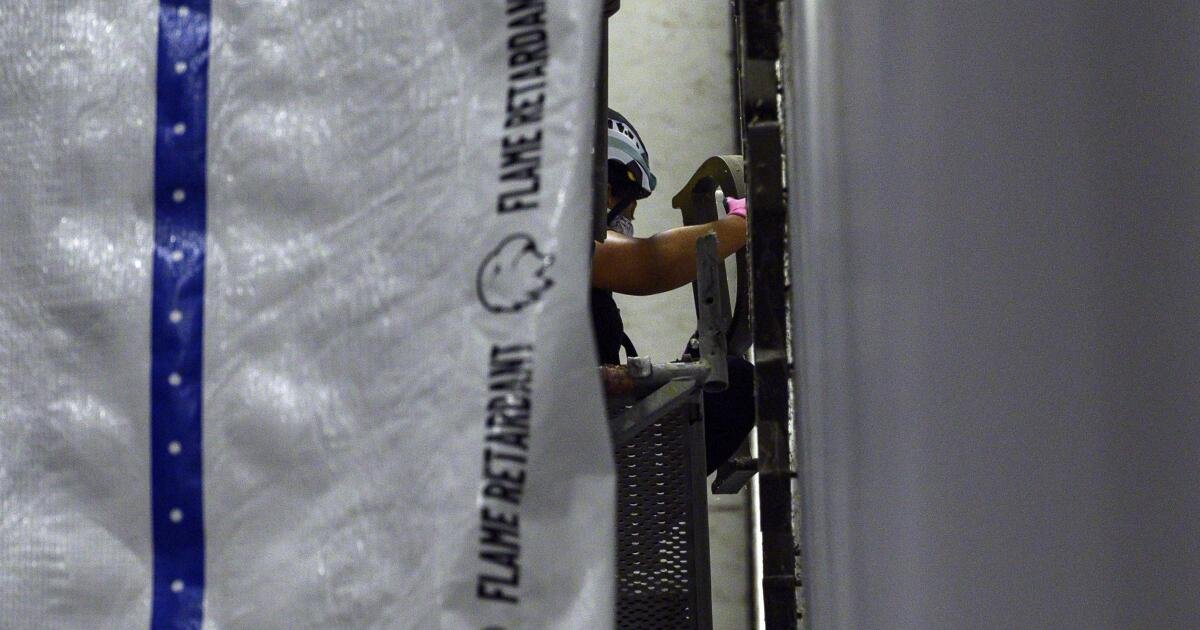
After a day of legal maneuvers and thunderstorms, workers began the process in the early morning hours of removing the letters spelling out Trump’s name from the facade of the performing arts venue. They were a few hours past a court-ordered deadline and did their work shrouded by a tarp, much to the frustration of onlookers who had gathered for hours hoping to witness a dramatic moment symbolizing the limits of Trump’s power.
As the sun rose over Washington, the tarp remained in place, leaving it impossible to determine whether all the letters had been removed. Shortly after midnight, the Kennedy Center asked a judge to extend the deadline until noon Eastern time, citing the storms for delaying the work. The court agreed to that request Saturday morning.
The removal of Trump’s name closes one of the more unusual chapters in the history of the Kennedy Center, which began construction in 1964 and was dedicated to the memory of the slain president, John F. Kennedy. At what is typically one of the few relatively nonpartisan spaces in Washington, Trump has exerted unprecedented executive influence over the congressionally created venue during his second term.
Though he rarely discussed the Kennedy Center during his 2024 campaign, Trump moved quickly to oust the institution’s leadership when he returned to office in January 2025 and replaced it with a board of trustees that named him chairman. It rebranded the venue the “Donald J. Trump and John F. Kennedy Center for the Performing Arts” and his name was quickly added to the building’s exterior, though an official name change would require an act of Congress.
While the removal of his name marks a setback for Trump, he is moving forward with other plans to reshape the physical landscape of the nation’s capital in ways that have few modern parallels.
He demolished the East Wing of the White House and is building a controversial ballroom in its place. He remodeled the Lincoln Memorial Reflecting Pool and plans extensive renovations of a golf course in East Potomac Park, moves that could significantly reduce the public’s access to running and biking paths. He is also moving forward with a triumphal arch that would sit near Arlington National Cemetery across the Potomac River in Virginia.
Indeed, as Trump’s name is being removed from the Kennedy Center, the South Lawn of the White House has been transformed into a venue for a UFC match intended to celebrate the 250th anniversary of American independence but also coinciding with Trump’s birthday on Sunday.
Back at the Kennedy Center, there are many questions about the institution’s future. The same May court decision that ordered Trump’s name to be removed from the building also blocked a planned two-year closure for renovations that was set to begin next month.
The Kennedy Center’s calendar for the weeks ahead include performances of “Moulin Rouge! The Musical” and “Bluey’s Big Play.” Comedian Bill Maher is to be awarded the Mark Twain Award for American Humor during a ceremony on June 28.
But little is scheduled for the stages beyond that and, after the Kennedy Center substantially reduced staff, it is unclear how quickly it could build out a robust performance list. Trump, angered by the court’s order to remove his name, has said he would turn the Kennedy Center over to Congress and has suggested it might simply shutter because of public safety concerns.
In its unsuccessful appeal Friday seeking a pause on the order removing Trump’s name, the Kennedy Center’s leadership argued, in terms similar to the president’s use of language and framing of the argument, that the lower court was interfering with needed renovations.
“The District Court is not allowing us to close in order to properly fix up and repair the Building, including potentially life threatening structural damage like beams and parking garage ceilings that are rusted, and in serious danger of falling onto people below,” according to the appeal. “Indeed, total collapse!”
The institution also suggested that the president’s name could return to the building if the Kennedy Center later wins its appeal.
If the court denied the venue’s request for a pause, the Kennedy Center argued that it would “be forced to squander time and money — by both removing the signage and then potentially returning it after appeal.”
Sloan writes for the Associated Press.
The most important California stories and recommendations in your inbox every morning.
By continuing, you agree to our Terms of Service, which include arbitration and a class action waiver. You agree that we and our third-party vendors may collect and use your information, including through cookies, pixels and similar technologies, for the purposes set forth in our Privacy Policy such as personalizing your experience and ads.
Politics
World & Nation
World & Nation
World & Nation
It turns out you can burn down a neighborhood and not destroy a community. We’ve seen evidence of this all across L.A. and so we will head back to one neighborhood that’s a good example of that bond: West Poppyfields Drive in Altadena.
Today we discuss one of the pivotal events of the 1960s: the assassination of Robert F. Kennedy. Though the gunman was caught at the scene, confessed at trial, and even bragged about the shooting, his motives have largely been forgotten.
Modern LA earned its first smoggy nickname 450 years ago, as the “bay of smokes.” At the La Brea tar pits, we take a short walk through a long history with curator Regan Dunn, who explains how and why the first Angelenos would have set fires that filled the broad bowl of LA and foretold the curse of smog.
World & Nation
World & Nation
World & Nation
World & Nation
Subscribe for unlimited access
Site Map
Follow Us
MORE FROM THE L.A. TIMES
Leave a Reply