
The US has confirmed it has lifted its naval blockade of Iranian ports, as the Iran deal comes into effect
Meanwhile, Iran's supreme leader, in a written message, says he initially disagreed with the deal, but allowed it to go ahead after assurances from the Iranian president
Mojtaba Khamenei also says that US President Trump came to the agreement "out of desperation"
Earlier, US Vice-President JD Vance said the 60-day period to reach a final agreement with Iran had begun
He defends the deal, saying that Iran will not receive money or sanctions relief unless it meets obligations set out in the agreement
The 14-point memorandum of understanding says the Strait of Hormuz will reopen and sets out a $300bn plan for Iran's "reconstruction" – here's what's in the deal
Edited by Tinshui Yeung and Craig Hoyle
Donald Trump says he expects a ceasefire to take effect "on all fronts", including between Israel and Iran-backed Hezbollah in Lebanon.
In a new post on Truth Social, the US president says he expects countries in the Middle East to "maintain their commitment to allowing our negotiations" to take place.
"We expect a complete ceasefire on all fronts, including Lebanon, Hezbollah, and Israel," he adds.
As a reminder, the first point of the US-Iran agreement declares the "immediate and permanent termination of military operations on all fronts, including in Lebanon".
But Israel has said it has no plans to withdraw its troops from Lebanon, and it launched attacks in the south of the country today, according to Lebanese state media. Ghoncheh Habibiazad
Senior reporter, BBC Persian
Reading between the lines of the message attributed to Iran’s supreme leader, which was read aloud on state TV, there are several key points beyond his apparent initial disagreement with the memorandum of understanding.
He referred to "in-person negotiations in the future" between Tehran and Washington, which seems to signal further talks between the two countries for now.
At the same time, he stressed that this "will not mean acceptance of the enemy’s position".
He also spoke about "safeguarding the rights of the Iranian nation and the Resistance Front" – Iran’s allies and proxy groups in the region. Tehran has said any agreement with the US to end the war must also address the conflict in Lebanon, and this is reflected in the memorandum.
When it comes to implementing the agreement, he appears to place himself alongside the Iranian people, while implicitly assigning responsibility for its success to Iran’s president, the only official mentioned by name.
President Masoud Pezeshkian has supported the agreement, calling it a "historic document".
Some Iranian officials, state media and pro-establishment figures have hailed the 14-point memorandum with the US as a victory, while hardliners and some in the diaspora opposition have remained critical.
Here is the full message from Iran's Supreme Leader Mojtaba Khamenei published on Iranian media.
"As you have been informed, a memorandum of understanding was signed between the presidents of Iran and the United States of America.
"In the course of reaching this stage, the officials in charge, out of sincere concern and goodwill, made extensive efforts—and of course, it was the American president who, out of desperation, used all kinds of leverage to bring this about.
"I, as a matter of principle, held a different view; however, out of the commitment that the esteemed [Iranian] president—as the head of the Supreme National Security Council—gave to me on his own behalf and on behalf of the other members regarding the safeguarding of the rights of the Iranian nation and the Resistance Front, and his explicit acceptance of that responsibility, I granted my permission.
"He [Pezeshkian] also explicitly stated that if the American side seeks to make excessive demands, they will not submit to them. From this moment on, we—that is, you, the proud nation, and this humble servant—will await the realization of the aforementioned conditions.
"However, it's self-evident that the in-person negotiations in the future will not mean acceptance of the enemy's position. We hope the blessed prayers of our Master (may God hasten his noble reappearance) will bring all kinds of victories & triumphs to honorable Iranian nation."
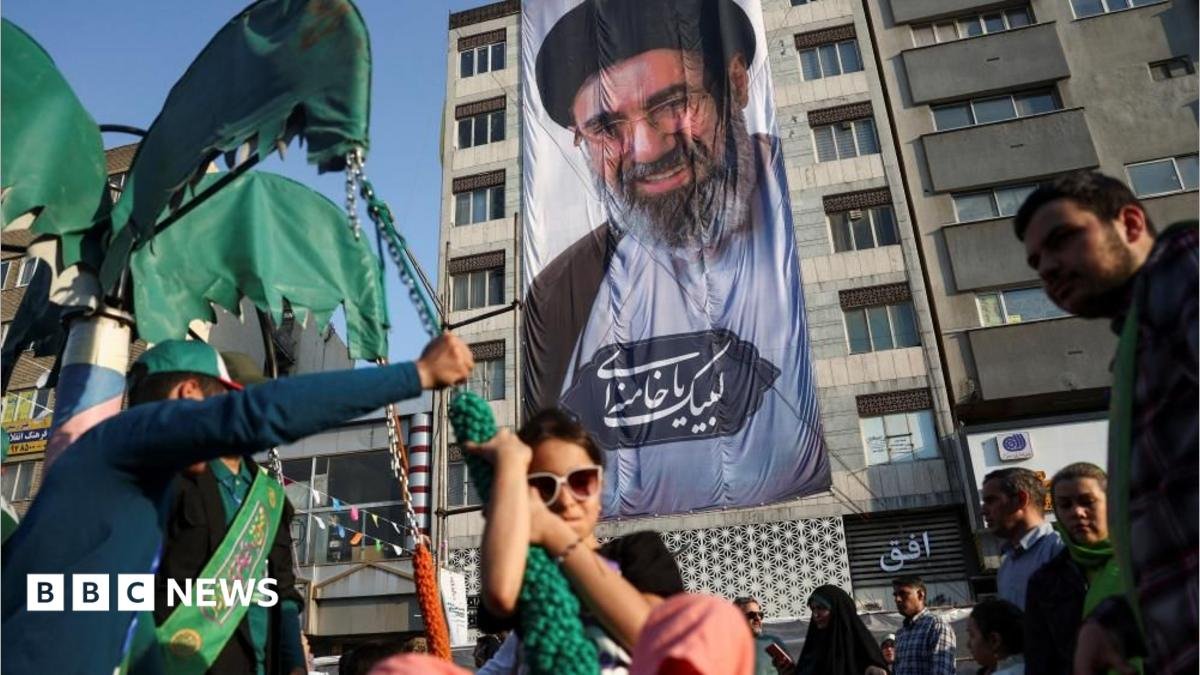
Mojtaba Khamenei, now the Supreme Leader of Iran, pictured attending a meeting in Tehran in October 2024
We've now seen a message from Iran's Supreme Leader Mojtaba Khamenei, published on state media.
He says he initially disagreed with the memorandum of understanding, but allowed it to go ahead after assurances from Iranian President Masoud Pezeshkian.
"I, as a matter of principle, held a different view; however, out of the commitment that the esteemed [Iranian] president—as the head of the Supreme National Security Council—gave to me on his own behalf and on behalf of the other members regarding the safeguarding of the rights of the Iranian nation and the Resistance Front, and his explicit acceptance of that responsibility, I granted my permission."
We'll bring you more on this soon.Ghoncheh Habibiazad
Senior reporter, BBC Persian
Mojtaba Khamenei, 56, has not appeared in public since becoming supreme leader on 8 March, reportedly due to security concerns.
However, several written messages attributed to him have been published by Iranian outlets since then.
Iranian president Masoud Pezeshkian was the first official to speak publicly in May about a face-to-face meeting with Mojtaba Khamenei since his appointment as successor to his father, Ayatollah Ali Khamenei.
Ali Khamenei was killed in a US-Israeli air strike on his compound on 28 February. Mojtaba Khamenei was reportedly injured in the same strike.
Iran will hold funeral processions and burial for Ali Khamenei in early July.
Ali Khamenei said publicly weeks before his death that negotiations with the US were not "wise" and would not "resolve" the country’s problems.
It remains to be seen whether Mojtaba Khamenei will attend his father’s funeral.
Iranian state media say Supreme Leader Mojtaba Khamenei will deliver a "very important message" about the deal to Iranians soon.
It's the first time Khamenei has responded to the agreement. We’ll bring you the latest as soon as we have it.
US Central Command (Centcom) has confirmed that the naval blockade on all maritime traffic entering and leaving Iranian ports has been lifted.
In a statement, it says "all US military blockade enforcement efforts have ceased" and that US forces are no longer "impeding the transit of vessels to or from Iranian ports" in the Gulf.
"Our great Naval Ships will remain in the general area to make sure that all aspects of the agreement are adhered to, obeyed and in full force and effect," the statement concludes.
US President Donald Trump says there "is no 300 Billion Dollar payment to Iran by the US" in the agreement signed by the two countries.
"That’s Fake News!" he writes on Truth Social.
"All there is for the US is Success, Lower Oil Prices, and Victory. Check out the Stock Market. Dumocrat propaganda at play!!!" he adds.
For context: The text of the agreement states the US will work "with regional partners to develop a definitive, mutually agreed plan with at least USD 300 billion for the reconstruction and economic development of" Iran. However, it does not say the US will contribute to the fund. Daniel Bush
Washington correspondent
The administration’s messaging strategy around the Iran deal came into clearer focus at the news briefing on Thursday, where Vice-President JD Vance defended the memorandum of understanding amid growing criticism from Republicans in Congress.
Vance spent the 47-minute news briefing insisting again and again that the MoU doesn’t give Iran any benefits until the country proves it will be a good actor in the Middle East. That includes Iran following through on a commitment in the MoU to destroy its stockpile of enriched uranium, and showing it will not fund proxy groups in the region, Vance said.
Iran will see sanctions relief and other economic benefits only "if they comply fully and change their behaviour", Vance said. The remarks echoed the way White House officials have been framing the deal for days, calling it a "performance-based" agreement.
That may be how the White House views the deal it signed this week. The US will certainly push Iran to make major concessions in the negotiations that are now under way to reach a final peace deal over the next 60 days.
But the messaging strategy – that the US played hardball, and Iran will only get rewarded for good behaviour – is not resonating inside the Republican Party. GOP lawmakers in the last 24 hours have been increasingly vocal in criticising the terms of the interim deal, a sign they view it much differently – and aren't buying the White House sales pitch.
It will be interesting to see if Vance and other senior US officials stick to their initial argument over the coming days and weeks, or shift gears and search for other ways to frame the MoU as a win for the American people.
Gary O’Donoghue
Chief North America correspondent, reporting from Washington DC
The memorandum of understanding between the US and Iran has now come into effect, triggering a 60-day period of further negotiations, JD Vance has told reporters at the White House.
The US vice-president had been due to travel to Switzerland for a formal signing ceremony and talks on the next phase of the deal tomorrow, but he suggested those plans were still up in the air.
"Our plan is to go to Switzerland. I don't know exactly when," he said.
Throughout the briefing, Vance repeatedly stressed that Iran would not receive any money or sanctions relief unless it met the obligations set out in the memorandum.
The vice-president also said he didn’t know the precise value of Iran’s frozen assets, but said they were worth "a lot", citing a figure of "north of $200bn (£151bn)".
Vance also hit out at some members of the Israeli government who had criticised Donald Trump over the deal.
He said that President Trump was "the only head of state in the entire world who is sympathetic to the nation of Israel at this moment in time, and he happens to be the head of state of the world's superpower".
It is clear that the vice-president is placing himself front and centre in this agreement with Iran, making himself very much the public face of it.
There is much speculation that he wants to succeed Donald Trump as the next president, and he is tying that ambition closely to the success of this deal.
Finally, Vance is asked about a report by the US news site Axios that Israeli Prime Minister Benjamin Netanyahu is "fuming" over the US-Iran deal.
The vice-president says that's not reflective of his conversations with Netanyahu, but adds that what "does bother me" is criticism of the deal and of Trump by Israeli cabinet members.
He says his message to them is that "Donald J Trump is the only head of state in the entire world who is sympathetic to the nation of Israel at this moment in time".
"The problem for Israel is not Donald J Trump; and anybody in Israel who thinks their biggest problem is the president of the United States needs to wake up and smell the reality of the situation that the country is in," he concludes.
Vance says the plan is still to go to Switzerland for the Iran deal, but adds: "I don't know exactly when."
He says the negotiation is highly technical, so it's important to have people on the ground to get into the "nitty-gritty" of talks.
"We think these technical negotiations are going to start sometime this weekend," he says.
As a reminder, the official signing ceremony for the memorandum of understanding was set to take place in Switzerland on Friday. However, mediator Pakistan has told the BBC that the ceremony was cancelled because the deal has already been signed remotely.
US and Iran representatives are still expected to meet in Switzerland for further talks.
Vance is continuing to take questions from the press.
He’s asked whether Iran could make "tens of millions of dollars" by selling its oil – and if that would give the country a "lifeline".
Vance replies that Iran’s economy is in "freefall" and it has "sky high inflation".
He adds that the idea that Iran selling "a few million dollars worth of oil" is "going to fundamentally transform" their economy is "not true".
"We can slap everything back on if the Iranians don't make the deal we expect," Vance says.
Vance is asked about the differences between Barack Obama's Iran deal and the one negotiated by Donald Trump, and why he thinks Trump's deal is "superior".
He says the first element is that the Gulf states "love this deal because they think it makes Iran weaker".
Vance also says Obama's deal "bribed" Iran with US money, which he says Trump's deal does not allow.
He adds that Obama's deal allowed enrichment, while Trump's deal "will lead to the destruction of enriched material".
For context: In his first term, Trump scrapped the 2015 Obama-era nuclear accord known as the Joint Comprehensive Plan of Action, which took several years to negotiate and was in force between 2016 and 2018. You can read more about the Obama deal in a post from BBC Verify.
Next, Vance is asked about Donald Trump's attitudes to Israeli Prime Minister Benjamin Netanyahu, referencing Trump's recent criticism of Israel's actions in Lebanon.
Vance says he does not want to withdraw Israel's right to self-defence – but adds that Israel, "just like everyone else, has to defend this peace process".
"We seem to be right on the cusp of a major breakthrough in the agreement and then all of a sudden there's a major explosion that goes off in a civilian population centre in Beirut," Vance says, explaining Trump's frustration. "That's not acceptable," he adds.
Vance says he wants closer co-ordination with Israel and a "regional framework" that can cut off money going towards Hezbollah and stop Hezbollah attacking Israel.
At the news conference, Vance is asked about the possibility of Iran imposing tolls on the Strait of Hormuz.
He says international waterways should be free of tolls and that he doesn't want the strait to be used as a "choke point" for the global economy again.
Vance says the final negotiations of a peace deal will set the terms for what happens next, adding that Gulf states will "figure out a proper security framework" for the strait in the future.
He adds that the US has "all the cards" in negotiations and Iran will have to "give us the things that are necessary" to get the benefits of the peace deal. Bernd Debusmann Jr
White House reporter
As can be expected, Vance is framing the agreement with Iran as a victory – and putting it in terms that the Trump administration hopes will soothe a domestic audience that is keen on petrol prices going down.
Notably, Vance was quick to point to the 12.5 million barrels of oil, he says, went through the Strait of Hormuz, and petrol prices dropping below $4 (£3) a gallon for the first time since Operation Epic Fury began on 28 February.
"And more importantly, they're going to keep falling," he added.
While the president himself has been largely dismissive of the domestic pressure he was facing in the US, administration officials and senior Republicans are keenly aware that Americans were growing increasingly exasperated with high petrol prices.
Those concerns, polls show, dwarfed wider concerns about regional geopolitics and security issues in the Middle East – and could have potentially been damaging to the party in the midterm elections.
Critics of the Trump administration will point out that the Strait of Hormuz was open before the president chose to initiate military operations. Petrol prices were also lower.
The main question for many here in Washington then becomes whether the administration can ultimately convince Americans that something was gained from this war and that it was worth short-term economic unease.
Vance is asked when the 60-day negotiation period begins, and he says it starts today.
He is then asked how the conflict between Israel and Iran-backed Hezbollah in Lebanon relates to the peace deal.
"This is about regional peace," Vance says, adding that the US expects Hezbollah to stop firing at Israel, and that the Israelis "are not going to be going wild in Lebanon".
He explains that "sometimes these ceasefires are a little messy", saying there has been "radical progress" in bringing the conflict to an end, but admits there will be "little flare-ups from time to time".
Vance concludes by saying the US wants to see the Lebanese government policing the south of the country, so that Hezbollah is not "taking over the country" and Israel is "not attacking southern Lebanon or Beirut either".
Vance is asked what is stopping Iran from getting a nuclear weapon in the future.
The vice-president says Iran would need "a lot of money" after the US destroyed "billions of billions" of nuclear infrastructure. He says the US has Iran in an "economic chokehold" that "we're not going to release until they fundamentally change their behaviour".
"What would that look like? That would mean a real inspections regime. That would mean a real enforcement regime," he says, adding that the change in behaviour would also mean the destruction of the enriched uranium stockpile.
He says only if Iran shows and "verifies" a change in behaviour will it be able to get money and integrate into the global economy.
Vance says there are "real divisions" within Iran about how to proceed.
He says the "pragmatists" in Iran are "winning the argument", which is what the US wants.
Asked about the possibility of the Iranian leadership changing its behaviour, Vance says Iran "recognises the leverage the United States has over them".
He adds that he doesn't know if this will lead to a change in behaviour, but says, "isn't it worth trying?"
Copyright © 2026 BBC. The BBC is not responsible for the content of external sites. Read about our approach to external linking.