

Brian Stauffer
Pick any Trump-imposed crisis over the last year, and you’ll find prominent Democrats decrying the president’s actions with an all-too-familiar word. California Gov. Gavin Newsom said Trump’s “hypocrisy knows no bounds” after he pardoned fraudsters while throwing “baseless allegations” of “massive fraud” at the Golden State. It was “beyond hypocritical,” California Sen. Alex Padilla said, for Trump to invoke the Insurrection Act in Los Angeles after provoking an actual insurrection in DC. The Daily Show’s Jon Stewart responded to the president’s attack on a judge who blocked the deportation of Venezuelans—after previously saying it should be illegal to criticize judges he appointed—by straining his voice like a demon doused with holy water: “The hypocrisy! It burns!”
“Hypocrisy,” like democracy, was passed down to us from the ancient Greeks. Hypokrites was a word for stage actors—different people entirely, beneath their masks. But allegations of two-faced dealing are endemic to American politics. Benjamin Franklin took over his brother’s newspaper after he was sanctioned for printing an “Essay against Hypocrites” about the Puritan minister Cotton Mather. (“It is far worſe dealing with ſuch religious Hypocrites, than with the moſt arrant Knave in the World.”) Thomas Jefferson later lamented, in Notes on the State of Virginia, that the spread of Christianity and other religions imposed upon people through violence had made “one half the world fools, and the other half hypocrites.” Abraham Lincoln, in 1854, asserted that the existence of slavery “enables the enemies of free institutions, with plausibility, to taunt us as hypocrites.”
Then, as now, allegations of “hypocrisy” are often infused with a note of spiritual censure. Jesus, after all, condemns the Pharisees as “hypocrites” in the Gospel of Matthew. In recent decades, the term has become a favored pejorative for the grifting preachers and fallen “family values” politicians of the religious right. There’s something both powerful and irresistible about that critique. It highlights the danger and the fallacy of puritanism: How can you demand that a society conform to a standard that its advocates do not even maintain?
“Hypocrisy” has been a useful framework for deconstructing an insidious strain of American life. But it can also be a bit of a trap. “Hypocrisy” assumes that the imposition of values is really about the values. Sometimes it’s as much about the imposition.
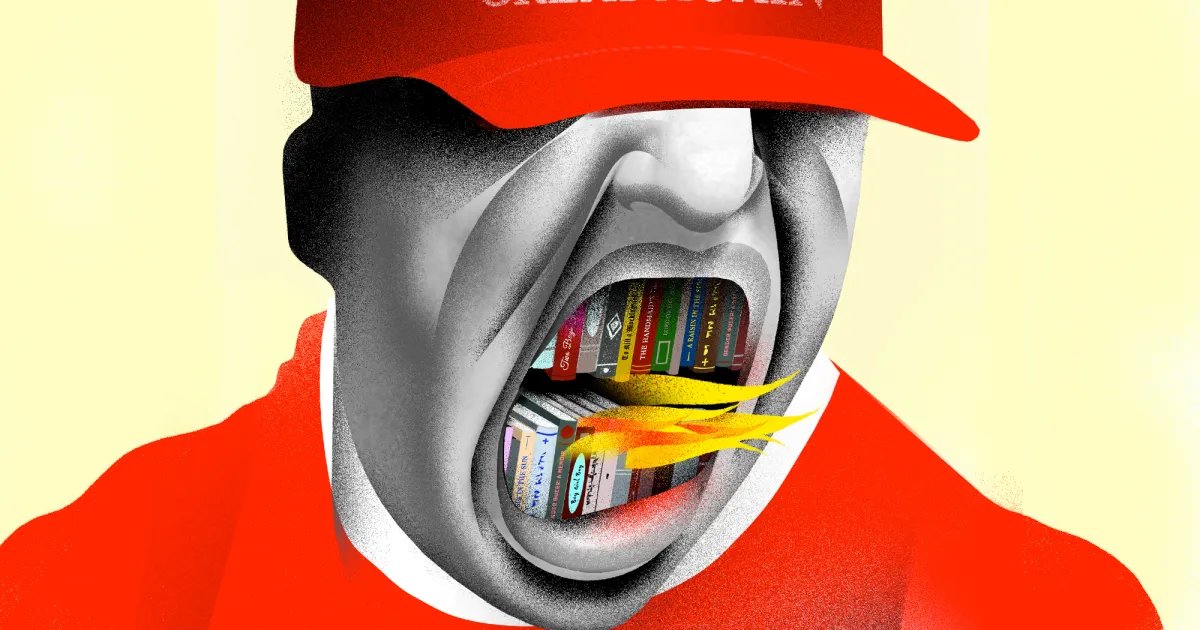
Trump’s conduct has helped dispel these illusions—or at least it should have. His “hypocrisies,” sketched out in late-night Truth Social rants and meandering answers to misunderstood questions, reflect a worldview that is as disturbing as it is coherent. He and his acolytes are telling you who can wield power, and against whom power can be wielded. You have not caught the president and his supporters off their line by noting that they attack others for conduct they themselves engage in; you have captured their essence—a desire for dominance and impunity, and an avowed illiberalism that has been incubating in the conservative movement for generations. Hierarchies of citizenship are the rule. Exulting in “justice for me and pain for thee” does not necessarily make someone a hypocrite; it might just make them a fascist.
Show me a case of Trumpian hypocrisy and I will show you a president living his values, with the unpleasant but predictable belligerence of a mob boss protecting his turf. Take the weaponization of the federal bureaucracy against broadcasters and the targeting of ordinary citizens for protected speech. His administration has threatened to suspend the licenses of broadcasters whose coverage of the Iran war is insufficiently flattering, leaned on Disney to fire Jimmy Kimmel for comments about the Charlie Kirk assassination, and attempted to deport a Turkish grad student for expressing support for Palestine in a student newspaper—after previously condemning “federal censorship,” and declaring that liberals were “driving people from their jobs, shaming dissenters, and demanding total submission from anyone who disagrees.” It is a reminder that the earlier backlash to purported liberal censoriousness—like the corresponding demand to replace “DEI” with “meritocracy”—was always about which voices were sacrosanct and which were an affront. It is the uncensored frustration of having to share space with the kinds of views (and the kinds of people) they considered illegitimate. Free speech, as the Atlantic’s Adam Serwer has written, means “they can say what they want and you can say what they want.”
Republicans are not roiled by contradictions when they spread conspiracies about mail-in voting by Democrats while casting mail-in ballots themselves. They are manifesting a deep-seated belief about who America is for and who it is not. It’s all right there in the racist Department of Homeland Security memes and the appeals from Vice President JD Vance for a “homeland” free of neighbors who aren’t like you. Say what you want about the tenets of National Socialism—it’s an ethos.
It is not even hypocrisy to complain about election fraud and then attempt to commit election fraud by, say, telling an official in Georgia to “find 11,780 votes,” as Trump did in 2021. They are both attacks on democratic systems by someone who never truly subscribed to them—that’s the important part. Hypocrisy is a distraction that reduces core questions of power and ideology to a meta-commentary.
There is something overly familiar about seeing a Republican politician accused of hypocrisy. “It’s so blatant, the hypocrisy,” The Daily Show’s Stewart said during an episode covering Trump’s censorship of free speech. “It’s so old-school Daily Show gotcha.” For a late-night host, it’s an easy punch line. But as a broader criticism, it flattens the exceptional and discourages you from thinking deeper about the structures of power. It’s precisely because “hypocrisy” is a tag that you could lob at so many political figures over the last quarter century that it feels so insufficient to describe our current leaders. In a weird way, it’s almost not cynical enough.
I confess: I’m a hypocrite, when it comes to hypocrisy. I’ve written plenty of these stories in the past. I’ll write them again. There is still value in laying out the ways in which public figures deviate from their professed identity—to establish, for the record, that someone is full of it. Sometimes it just feels cathartic to fire up an old C-SPAN clip and say: Can you believe this guy?
But I often find “hypocrisy” stories limiting because they substitute the deep for the superficial. It feels less like a critique of a particular set of values than a way to talk about politics without having to talk about what politics is about—a language for discussing matters of consequence in inconsequential ways. “Hypocrisy” functions as a kind of political scrip, a facsimile of conflict that can be traded back and forth in perpetuity without ever being exchanged for the real thing. Shouting about it is an impulse in place of an analysis. It blurs the anodyne and the profound. Everyone is a hypocrite, but not everyone is cruel.
Leave a Reply