

As the United States marks its 250th birthday, Straight Arrow is taking a fresh look at the institutions, systems and social contracts that shaped modern America — and the pressures now testing them.
When the gates opened to the Ultimate Fighting Championship bout on the White House lawn in June, one man who would not have been in Washington if it were not for President Donald Trump hardly noticed.
He stood across the street, telling influencer and journalist Rod Webber he was not in Washington to celebrate Trump’s 80th birthday, but rather to “crash his party.”
He declined to give his name but said he considered himself “anti-Trump.” His reasons included the administration’s handling of government documents about the convicted sex offender Jeffrey Epstein, the U.S. war in Iran and Trump’s endorsement of Rep. Byron Donalds for governor of Florida. (He was “totally against it,” the man said, because Donalds is Black.)

Download the SAN app today to stay up-to-date with Unbiased. Straight Facts™.
Point phone camera here
That led Webber to ask: “You came all the way up here to start some s- -t with Donald Trump?”
Webber’s question became even more striking after the interview. Through online records, Webber determined the man was Ryan Yates — one of the more than 1,500 Trump supporters whose convictions related to the riot at the U.S. Capitol on Jan. 6, 2021, were pardoned or commuted upon Trump’s return to the White House. (On April 24, Yates was among the people arrested in a Florida prostitution sting.)
Even though Trump delivered on his promise to free what he called Jan. 6 “political prisoners,” it did little to stop Yates from returning to Washington with a list of what he considered the president’s failures.
Yates appeared to be motivated less by what Trump gave him and more by who Trump was no longer fighting — bureaucrats shielding Epstein documents, military interventionists and people who are not white.
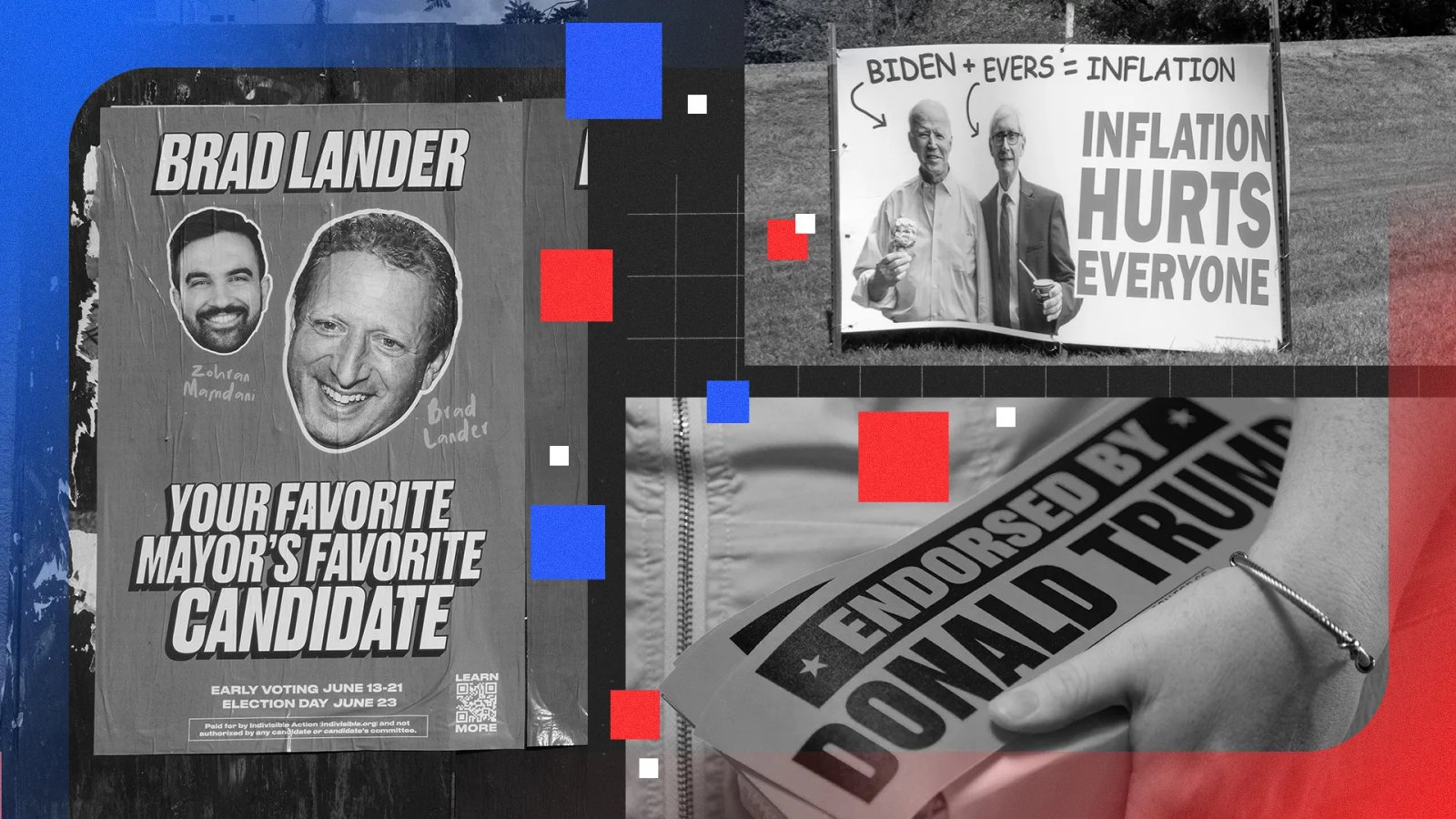
His grievances reflect the curious state of American politics as the nation turns 250 years old. Many no longer identify with a party or even a politician. Their primary political motivators are their enemies, real or perceived. And the people who run political campaigns are responding with messages that reinforce those feelings, undermining any sense of national unity created by the communal birthday celebration.
The politics of who you hate
A couple of decades ago, when candidates ran for office, there was “much much less focus on who you’re associated with,” according to Travis Ridout, a political scientist and professor at Washington State University. Campaigns, he said, were more about “‘I’ve done this for the district. I’m going to lower your taxes. I’m going to improve your schools.’”
Ridout is a co-director of the Wesleyan Media Project, which tracks political campaign advertising. The 2026 midterm election cycle exemplifies the change.
It “is all about Donald Trump,” the Project announced in June when it released findings showing that more than half of all broadcast television ads in House and Senate races this cycle have mentioned the president. In pro-Republican ads that figure jumps to 70%, compared with 50% in pro-Democratic ads.
Ridout pointed out a couple of ads in which Trump, or artificial intelligence versions of him, made cameos.


In Oklahoma’s Republican primary for governor, Trump endorsed Mike Mazzei. But a super PAC still used an AI-generated image of Trump to attack Mazzei, claiming he was insufficiently aligned with the president. Another ad from a different super PAC also used an AI-generated image of Trump and former Secretary of State Hillary Clinton to attack Mazzei as a “Clinton Lover, Trump Hater.”

In South Carolina, a super PAC ran an ad that featured AI-generated images of Lt. Gov. Pamela Evette, Trump’s choice for the Republican gubernatorial nomination, walking arm-in-arm with a drag performer and Rep. Alexandria Ocasio-Cortez, D-N.Y.

And in a New York Republican primary for a House seat, one candidate ran an ad featuring an AI version of his Trump-backed rival, Mike LiPetri, wearing a blue Democratic campaign T-shirt and surrounded by campaign signs for Democrats Joe Biden, Kamala Harris and Hillary Clinton.
Ridout called the Project’s findings a “good example” of how there is “less campaigning on taxes and education and the economy and bread-and-butter issues,” and more of the “I’m on Team Trump, and my opponent isn’t sufficiently on Team Trump” variety.
The shift in focus away from making promises and toward vilifying opponents has been decades in the making, he said.
Other data collected by the Project, at Straight Arrow’s request, shows a sharp rise in the amount of attention campaigns place on moral issues.
A little more than 1% of ads in 2002 and 2012 mentioned moral, family or religious values. But about 7.5% did in 2022.
A more pronounced jump can be seen in ads about immigration. As a topic of campaign ads, it went from less than 0.5% in 2002 to 1% in 2012 to nearly 11% in 2022, according to the research. (By 2024 Republicans had framed the issue of immigration in terms of an “invasion,” The New York Times noted.)
In December 2015, just as first-time candidate Trump was shaking up the Republican Party with his name-calling of rivals and crude attacks on perceived enemies, a Ph.D. candidate at the Graduate College of Bowling Green State University in Ohio observed how naming-rather-than-solving rhetoric could, in fact, be eloquent.
“Republican language speaks beautifully about unvirtuous bad actors,” the student wrote, “but it is vague on causality beyond naming villains and pointing to a time before these villains existed when the current system worked for everyone.”
‘Naming villains has ascended’
In recent years, Democrats have embraced the same strategy.
California Gov. Gavin Newsom, a potential Democratic presidential candidate in 2028, drew attention last month when he said his party should be “calling out the villains on the tax code, calling out the villains as it relates to monopolization of capital,” The Hill reported. The chair of the Progressive Caucus in Congress, Rep. Greg Casar, D-Texas, echoed that sentiment.
“Everyone goes negative now. Everyone,” said Evan Roth Smith, a campaign consultant and pollster who works with Democrats. “They sometimes go negative against their opponent, but they do negative against someone.”
“There’s been a revolution in Democratic messaging,” he said, because campaign advertising and messaging nowadays is about “naming villains.” That might include “classes of people, or specific people. ‘I’m going to take them on.’ That’s not just, ‘I’m going to make things more affordable.’”
The strategy is viewed as more effective than any positive message from a Democrat.
“Naming villains,” Smith said, “has ascended.”
That was not always the case. In the 1928 presidential election, on the eve of the Great Depression, Republican Herbert Hoover defeated the popular Democratic governor of New York, Al Smith, in part, after voters saw Republican campaign ads promising “a chicken in every pot and a car in every garage.”
But the power of naming villains has also long been on display in American politics. Wisconsin Sen. Joseph McCarthy created a national uproar in 1950 when he claimed, “I have here in my hand a list of 205 … as being members of the Communist Party and who nevertheless are still working and shaping policy in the State Department.”
McCarthy never made the list public, and he sometimes cited a different number of names it purportedly contained. Nevertheless, it was effective messaging.

As a campaign adviser to George H.W. Bush, Lee Atwater appealed to racial prejudice in a famous 1988 ad. (Photo by Cynthia Johnson/Getty Images)
More than three decades later, Lee Atwater, the Republican operative who helped George H.W. Bush win the 1988 presidential campaign, centered the conversation about crime and safety around Willie Horton, a Black man who raped a white woman. Atwater later apologized.
More recently, the business community’s backlash to New York City’s Democratic Socialist mayor, Zohran Mamdani, reached new heights after he recorded a tax-the-rich video outside the Manhattan building where billionaire Ken Griffin had earlier bought what The Wall Street Journal called “America’s most expensive home.”
Whether it is Washington, which is driven by seniority and leadership, or local legislatures and City Councils, where favor-trading among neighbors can be expected, Smith said pivoting away from policy-specific ads and messaging may actually be “a reversion to reality.”
“Writing laws by how you cast your ballot is a little slapdash and rarely yields that new law,” Smith said.
“Political reality often prevents them from being implemented in the way they are sold during the election,” he added. But, he noted policy specifics can be “useful signaling devices to voters to say, ‘Here is where my focus is.’”
Hank Sheinkopf, a veteran political consultant who worked on Democratic campaigns around the country for decades, eschewed this values-based advertising.
“It obviates the responsibility of candidates to take any forward view, or forcing them to take a position on anything,” Sheinkopf said in an interview. Rather than talking about themselves, Sheinkopf said candidates in ads “talk about sinister forces in the world. If you look at this stuff, it’s as if there’s a paranoid conspiracy going on in every political campaign, and that’s not necessarily the case.”
Sheinkopf is a moderate Democrat who long opposed the party’s progressive wing, particularly as it grew more critical recently of U.S. support for Israel, a position he described broadly as antisemitic.
“In the true paranoid style of American politics, people are looking for common enemies,” Sheinkopf said.
It is, he said, a “constant battle to defy truth.”
Leave a Reply