
You May Also Like
Rivian just threw down the gauntlet in the autonomous driving wars, but it’s playing a different game than Tesla. The EV startup’s new Autonomy+ system promises hands-free driving that rivals Tesla’s Full Self-Driving capability – with one crucial difference. While Tesla bets on fewer restrictions, Rivian’s adding extra safety layers that could reshape how regulators view autonomous tech. For drivers caught between these competing visions of self-driving’s future, the choice isn’t just about features anymore.
Rivian is making its most aggressive move yet against Tesla in the autonomous driving race. The company’s new Autonomy+ system, now rolling out to R1T and R1S owners, promises true hands-free driving on highways – but the real story is what Rivian’s doing differently under the hood.
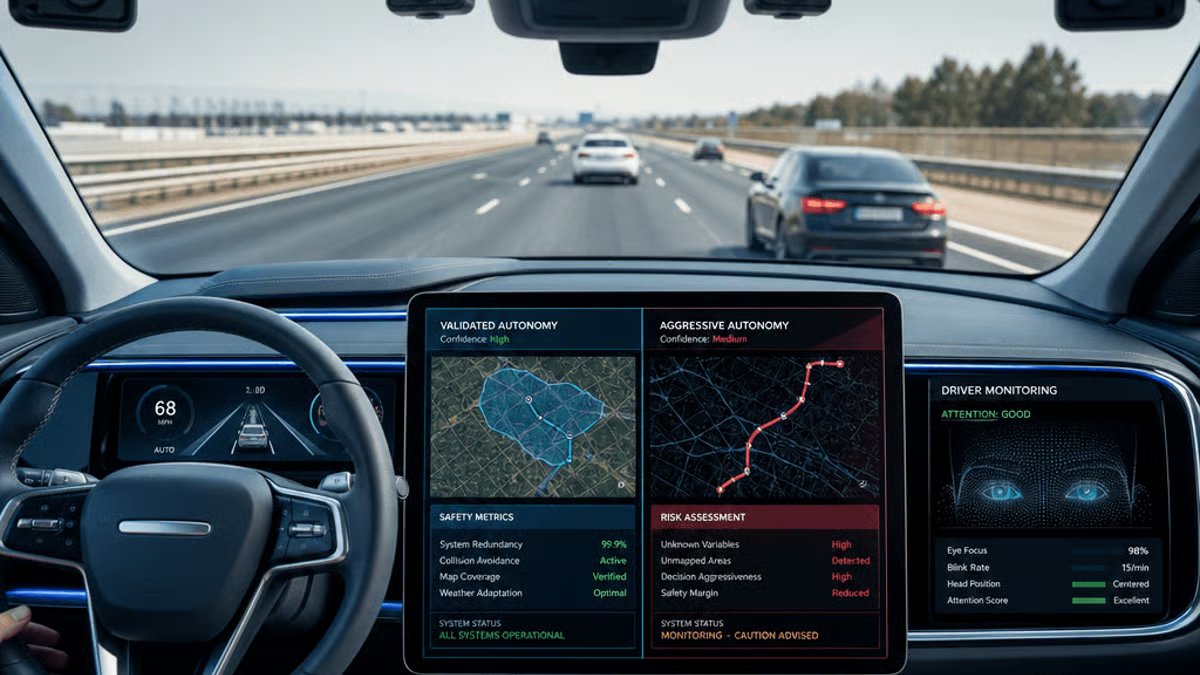
According to hands-on testing from CNBC, Rivian’s approach includes driver monitoring systems and geographic restrictions that Tesla famously abandoned years ago. While Tesla’s FSD lets drivers take their hands off the wheel almost anywhere the system is active, Rivian’s geofencing the technology to pre-mapped highway sections where the company has validated performance.
The technical gap between the two systems is narrowing fast. Both use camera-based perception – Tesla with eight cameras, Rivian with eleven – and both handle lane changes, highway exits, and traffic navigation without driver input. But Rivian’s adding redundancy layers that Tesla’s pure vision approach doesn’t include. The R1T tested by CNBC featured eye-tracking technology that disables Autonomy+ if the driver looks away for more than a few seconds, a safeguard that Tesla removed from its vehicles in 2021.
“We’re not trying to win the feature list comparison,” a Rivian spokesperson told reporters during a demonstration drive. “We’re optimizing for the experience customers will actually use every day.” That’s a direct shot at Tesla’s strategy, which has prioritized capability expansion over conservative safety boundaries.
The competitive dynamics are shifting fast in the ADAS market. Tesla has roughly 400,000 FSD subscribers paying $99 monthly or $8,000 upfront, generating an estimated $500 million in annual recurring revenue. Rivian’s pricing Autonomy+ at $85 monthly or $6,500 as a one-time purchase – undercutting Tesla while the technology is still catching up. For a startup that delivered just 57,000 vehicles last year, every subscription dollar matters.
But the real battleground isn’t pricing – it’s regulatory credibility. Federal safety regulators have opened multiple investigations into Tesla’s FSD following crashes where the system was active. Rivian’s betting that its more conservative approach will avoid similar scrutiny and potentially win favor as the National Highway Traffic Safety Administration develops new autonomous vehicle guidelines expected later this year.
The technical execution reveals Rivian’s different priorities. During highway testing, Autonomy+ handled construction zones and sudden lane closures more cautiously than FSD, slowing earlier and requesting driver takeover more frequently. Tesla’s system, refined through billions of miles of fleet data, executes maneuvers with more confidence – sometimes too much, critics argue. Rivian’s collecting similar fleet data but processing it through more conservative decision-making algorithms.
Tesla CEO Elon Musk has long argued that excessive safety restrictions slow the development of truly autonomous vehicles. His company’s approach – release features broadly, gather data aggressively, iterate rapidly – has produced the most advanced consumer-facing autonomous system on the market. But it’s also drawn lawsuits, regulatory investigations, and questions about whether beta testing should happen on public roads.
Rivian’s calculated gamble is that there’s a market for customers who want advanced driver assistance without the controversy. The company’s marketing materials emphasize “responsible autonomy” and “validated performance” – language designed to appeal to safety-conscious buyers who might be Tesla-curious but regulatory-wary.
The timing couldn’t be more critical for both companies. Tesla’s betting its robotaxi future on FSD technology, with Musk promising a dedicated autonomous vehicle reveal next month. Rivian, burning through cash as it scales production, needs Autonomy+ to become a meaningful revenue stream before its next capital raise. Neither company can afford to lose this race.
What’s emerging is a fundamental philosophical split in how autonomous driving should develop. Tesla’s approach – move fast, break things, let real-world data drive improvement – mirrors Silicon Valley’s traditional playbook. Rivian’s strategy – validate extensively, restrict carefully, prioritize trust over features – looks more like traditional automotive industry thinking. The question is which philosophy regulators, insurers, and ultimately customers will reward.
The autonomous driving wars just got a lot more interesting. Rivian’s not trying to out-Tesla Tesla with aggressive feature releases and bold autonomy claims. Instead, it’s betting that a more measured approach – one that prioritizes validation over velocity – will win over customers, regulators, and insurers in the long run. Whether that strategy can compete with Tesla’s massive data advantage and rapid iteration cycles remains the billion-dollar question. But for the first time, Tesla’s facing a credible challenger that’s learned from its missteps while building something genuinely different. The next 12 months will show whether safety-first autonomy can catch up to move-fast-and-break-things innovation.
