
You May Also Like


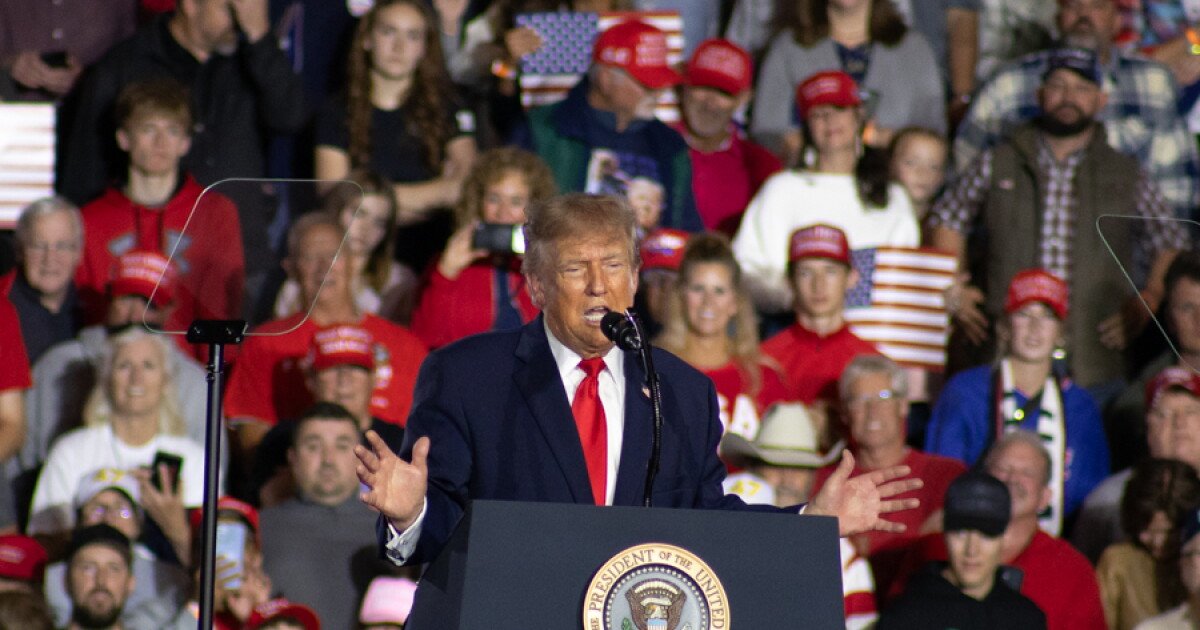
President Donald Trump predicted major Republican victories Sunday, urging supporters to turn out for Iowa candidates two days before an election that could reshape control of Congress.
Trump praised Republican U.S. Senate candidate Ashley Hinson and gubernatorial candidate Zach Lahn, pairing promises of prosperity with warnings about Democratic control.
“But we’re going to have a much bigger win on Tuesday,” Trump said after congratulating the Iowa Hawkeyes on their football victory over Wisconsin.
The rally brought together candidates navigating competitive races in a state Trump carried by 13 percentage points in 2024. Hinson faces Democrat Josh Turek for Senate. The 1st, 2nd and 3rd congressional districts are competitive, while Democrats see an opportunity to win the governor’s office.
Republicans are counting on a roughly 180,000-voter registration advantage to withstand an election shaped by concerns about living costs, gasoline prices and the Iran war.
Republican Party of Iowa Chair Jeff Kaufmann urged attendees to bring others to the polls.
“This is now a turnout election,” he said. “The power is in your hands.”
It was Trump’s second Iowa appearance in less than two weeks, following an Oct. 22 rally in Sioux City. The Dubuque event was canceled Thursday and replaced with a telephone rally before being restored about a day later. Trump said Iowa Republicans asked him to return.
Trump praised Hinson’s commitment to Iowa but diverted into comments about her weight.
“I knew Ashley for a long time, and she was a little bit heavier,” he said.
After protesters interrupted, Trump returned to the subject, praising her for losing weight “the old-fashioned way” and saying Hinson had put herself in shape for voters.
“She went on a regiment. She put herself in shape. She’s in perfect shape. She was good. I thought she was great the other way, but she put herself in shape, and she did that for you,” Trump said.
“Me, I put on a couple of pounds,” he said.
Hinson stresses Senate stakes
Hinson emphasized her identity as a minivan-driving mom and framed the race as a choice between common sense and what she characterized as Democratic extremism. She urged supporters to turn out Tuesday to keep Democrats from taking control of the Senate.
“So common sense versus crazy is on the ballot. We need to defy Chuck Schumer. Are you going to show up and help us get that done on Tuesday?” Hinson said.
Lahn, meanwhile, cast Trump’s visit as evidence of his commitment to Iowa and pointed to the proposed $15 billion steel mill in Lee County as an investment in the state’s future.
He also focused on Christianity and cultural issues, arguing Republicans should preserve the state’s identity.
“There is no western civilization and there is no United States of America without Christianity,” Lahn said. “The central tenet of western civilization is this radical idea that every single one of you… have so much worth because you were created in the image of God.”
Lahn portrayed opposition to voter ID, efforts to defund police and calls for open borders as attacks on Iowa’s culture. He also cast his primary victory as a rejection of special interests and the Republican establishment.
He urged supporters to match Trump’s commitment by voting Tuesday, emphasizing younger voters and the stakes for the next generation.
“We have to go out and show that we are dedicated to the next generation. That we are not going to let this place fall to socialism, communism, whatever it might be,” Lahn said.
Trump warns against Democratic control, touts economic agenda
Trump’s closing argument portrayed Democratic victories as a threat to his agenda.
“So, a vote for any Democrat anywhere in the country is a vote to put a deranged group of extremists into power, and it could really hurt us,” he said.
House Speaker Mike Johnson warned against Democrats presenting themselves as moderates, urged supporters to dismiss unfavorable polling, and said this is a contrast election of “common sense versus crazy.”
Trump’s nearly two-hour speech moved between Iowa races, attacks on Democrats elsewhere and descriptions of White House renovations.
Protesters were escorted out three times after interruptions.
Trump accused them of being paid plants, complaining that “they always do it right in the middle of my punchline.” He called one protester “a stupid person,” as she flipped the double bird on the way out.
He defended the Iran war and blamed Democrats for affordability problems, promising lower fuel prices.
He highlighted $8 billion in farmer fuel assistance and a proposed $15 billion southeast Iowa steel mill, potentially creating 1,750 permanent jobs with roughly $1.4 billion in state tax credits.

Gavin McGough
/
Iowa Public Radio
Nunn, Miller-Meeks join Trump after breaks over Iran war
Some Iowa Republicans have sought distance from Trump as his approval ratings have fallen, even while campaigning for voters who support him.
Reps. Mariannette Miller-Meeks and Zach Nunn, seeking reelection in the competitive 1st and 3rd congressional districts, recently broke with most Republicans to support curbing Trump’s war powers and ending the Iran war. Both previously opposed those efforts.
Neither appeared at Trump’s Sioux City rally, but both took the stage in Dubuque.
Nunn, who faces Democrat Sarah Trone Garriott, cast the 3rd District as “the tip of the spear” in deciding control of Congress while emphasizing both cooperation with Trump and congressional oversight.
“It will decide whether we have a majority in Congress who stands with the president, who works with the president, and candidly, who will hold the president accountable in a pragmatic way,” he said.
Nunn has emphasized his bipartisan credentials as Democrats portray him as an enabler of Trump’s agenda.
Miller-Meeks described leaving home at 16, pursuing an education, serving in the military and becoming a doctor. She presented her experience as a reason to preserve opportunities she accused Democrats of threatening.
“When you work that hard for something, you want to preserve it, you want to protect it, and you want to cherish it,” she said. “You see, just like I believe in me, I believe in you. But the Democrats don’t believe in us anymore. They don’t believe in the story of America. They believe socialism is the way to go.”
Other Republicans attending included congressional candidates Joe Mitchell and Chris McGowan and Iowa Attorney General Brenna Bird.
Rally attendees back Trump’s policies, urge Republican unity
For attendees interviewed at the rally, Trump’s visit reinforced confidence in his policies and the Republican ticket.
Cynthia Diercks, a Republican activist from Bettendorf, said canvassing had left her optimistic despite her distrust of polling coverage. She contrasted Iowa’s taxes with neighboring Illinois and credited Lahn with addressing water quality, an issue she considers important.
As a tree nursery owner, Diercks said she still faces costs for fertilizer and other supplies but has seen demand improve substantially.
“Now, I don’t know if I’m going to be able to complete all the jobs I have this year. So, what Trump is doing is working, and I’m extremely excited for next year,” she said.
She attributed customers’ willingness to spend to Trump’s policies and urged Republicans to retain control of Congress.
Keith Stein, a Republican from De Witt, said Trump was working to bring out his base for candidates who had not consistently supported it.
Stein backs Trump’s approach to Iran, reducing government waste and bringing manufacturing jobs back. Rising costs and fluctuations in farming have not changed his support.
“Bringing jobs back to this country is a big deal, and for so many years, both parties let those jobs go and laughed at people for even taking those jobs,” he said.

Gavin McGough
/
Iowa Public Radio
Supporters entered the rally through a maze of closed streets and barricades in Dubuque’s downtown.
Many cited Trump’s immigration policies, his patriotism, and his opposition to a “radical” left wing in the Democratic party for motivating their support.
Maria and Bill Kuper live in Dubuque and dressed in Trump swag to support the president. Bill Kuper said Trump’s signature policies continue to earn his vote, including border security and tax cuts. He said tariffs are beginning to have a positive effect.
“They’ll help bring jobs back to the country,” he said, “And I’m all for the people in this country having the jobs. I think that’s a good thing.”

Gavin McGough
/
Iowa Public Radio
Maria Kuper said she was a more “independent” voter before Bill turned her on to Trump. She was excited to see the president speak, and felt his appeal went beyond politics.
“He’s funny and he’s energetic. He’s energetic in front of people,” she said. “I like that, and I like his little dance he does.”
Even as they continue to embrace Trump, rally-goers recognized his time in the top office is coming to an end. Bill Kuper said he believes in free elections and the Democratic process.
“Trump has got two more years after this, and then to me, if things don’t get better and more people don’t think that his policies aren’t right, well, then we’ll go different direction,” he said.
Protestors resist the presidential visit
As a steady stream of supporters made their way into the event, protestors gathered a block away to resist the president’s appearance in Dubuque.
The crowd booed at Republican political candidates entering the event and called out protest chants.
Local artist Emily Cram was holding a sign depicting the president as a pig. She recognized political issues are “complicated” in the city.
“Dubuque – or Iowa – it’s a rural place, and there’s a big, divided gap between us,” she said.
Despite that gap, Cram said most Iowans agree on core issues.
“I’m actually pretty friendly with some Republican neighbors and Republican family members. I think a lot of people care about the same things. I think most people want to feed their children, and I think most people want people to afford cancer treatments,” said Cram.
She attributed the president’s continued popularity amongst his base to an “incredible” level of misinformation amongst Republicans.
Local Democrats hope for midterm gains
A few hours before the event, a small group of local leaders and political organizers gathered in Cleveland Park. Speaking in a bluff neighborhood above a commanding view of downtown they discussed healthcare access and championed Democratic candidates on Iowa’s ballot.
Among them was Democrat Pam Jochum, who represented Dubuque in the state legislature for decades, serving as Senate President from 2013 to 2017.
Jochum said Trump’s appearance in Dubuque two days before the midterms is evidence that Republican candidates are struggling to connect with voters this election cycle. She included Rep. Ashley Hinson, who is running for the Senate.

Gavin McGough
/
Iowa Public Radio
“Trump thinks this rally is somehow going to help breathe new life into her race and the other Republicans running in this area,” she said. “It’s not going to work. I think people have caught on, and [candidates are] distancing themselves from Trump now.”
She urged Iowans to examine candidates based on their past voting records, not their campaign rhetoric.
Ron Healey, a veteran and Dubuque resident, said despite Trump’s past popularity in Iowa – including a 13-percentage-point win margin over Democrat Kamala Harris in 2024 – his message is waning.
“They got a pretty good playbook, but I think they played it too many times,” Healey said of the Republican party.
Healey said after ten years of Trump, voters are unlikely to turn to him, and his allies, again.
“I was out knocking doors, talking to people, and you hear what’s going on at their kitchen tables…People are struggling every single day, and they need help,” he said.
Farmers Union pushes back on Trump ag policies
In response to Trump’s rally, the Iowa Farmers Union hosted a news conference on Friday to call out federal policies that the grassroots organization says are destructive to farmers and rural communities.
The organization’s president, Aaron Lehman, also criticized Iowa’s congressional delegation, saying they’ve sat on the sidelines rather than push back on Trump.
“While the Iowa Farmers Union hasn’t endorsed a federal candidate in years, today’s realities on our farms and our rural communities meant that had to change,” Lehman said.
The organization has thrown its weight behind Democratic candidate Josh Turek for U.S. Senate, along with the whole Democratic slate for U.S. House.
“We need more Iowa Democrats in Congress right now to rein in the excesses of the Trump administration,” Lehman said. “Josh Turek is right for Iowa farmers, for our rural communities and for our nation.”
High input costs and rising health care rates are squeezing farmers, Lehman said. Tariff chaos continues to damage trade relationships many Iowans worked to build, and reductions in U.S. Department of Agriculture staff have made it harder for farmers to navigate resources, he added.
Earlier this month, Trump and U.S. Secretary of Agriculture Brooke Rollins announced $8 billion will be available for one-time payments to farmers “to provide relief during temporary market disruptions and increased input costs.”
Combined with other ad hoc aid and traditional Farm Bill programs, direct payments to farmers are expected to hit a record $55.4 billion this year, contributing nearly a third of 2026 net farm income. The federal funding far exceeds the previous high of $45.6 billion in 2020 during the COVID-19 pandemic.
“Make no mistake, farmers are in a situation of real need,” Lehman said.

Rachel Cramer
/
Iowa Public Radio
Total U.S. farm production expenses are forecast to reach a record high of $493 billion this year.
Diesel prices are double what they were last year during harvest, Lehman said. On a busy day in the field, this can result in Lehman spending an additional $300.
The administration “dug a deep hole” with the war in Iran and threw farmers in it, he said.
“If you’re stuck in a hole, the first thing you need to do is to stop digging. But seven times, Rep. Ashley Hinson said, ‘Mr. President, keep digging,’” Lehman said.
Hinson called for an “immediate and successful” end to the war in late September after voting seven times against resolutions directing the president to pull back.
Lehman also criticized the administration’s cuts to USDA staff and programs, including two designed to help schools and food banks purchase food from local producers. The USDA workforce has shrunk by roughly 20,000 employees since January 2025, according to the U.S. Office of Personnel Management. Lehman said farmers in Iowa feel the acute effects of this at the county level.
“Staffing shortages have hit our local [Farm Service Agency] offices hard,” Lehman said. “My local FSA office, for instance, is now open only one day a week.”
Farm Service Agency staff help farmers and ranchers navigate federal resources and apply for loans, disaster relief and conservation programs. Reduced hours and staff at local Farm Service Agency offices are harder on beginning farmers who need more assistance, he added.

Madeleine Charis King
/
Iowa Public Radio
Family farms and rural communities are also feeling the effects of changing health care policies, Lehman said.
“Our farm here relied on the Affordable Care Act for access to reasonable health insurance, but at the beginning of this year, my family health insurance costs more than doubled,” Lehman said.
Without an extension passed by Congress, enhanced tax subsidies for Affordable Care Act plans expired at the end of 2025, which significantly raised out-of-pocket costs for insurance. The Congressional Budget Office estimated 4.2 million Americans will become uninsured as a result.
Not all farm groups in Iowa are backing Democratic candidates for the U.S. House and Senate. The political arms of Iowa Corn Growers Association and Iowa Farm Bureau have endorsed the Republican roster, saying they support the organization’s policies and issues that impact farm family and Iowa’s agricultural economy.
Hinson, incumbent 3rd District Rep. Zach Nunn and incumbent 1st District Rep. Mariannette Miller-Meeks have pushed for nationwide, year-round access to E-15, a higher ethanol fuel blend. The Iowa Corn Growers Association and Iowa Renewable Fuels Association both say this would expand markets for Iowa farmers and boost corn prices.
The three candidates also voted in favor of the One Big Beautiful Bill Act (OBBBA) passed into law last year. Along with extending some tax cuts and making others permanent, the massive legislation is expected to increase agricultural spending by nearly $66 billion over the next decade.
Most of the funding will go toward programs that help farmers make up losses from natural disasters and when commodity prices and revenues dip below certain thresholds.
But groups like the National Sustainable Agriculture Coalition have been critical of the legislation, saying it “resorts to cannibalization” of other safety nets.
OBBBA is expected to carve out nearly $186 billion from the Supplemental Nutrition Assistance Program through 2034 and slash roughly $900 billion for Medicaid over 10 years.
