
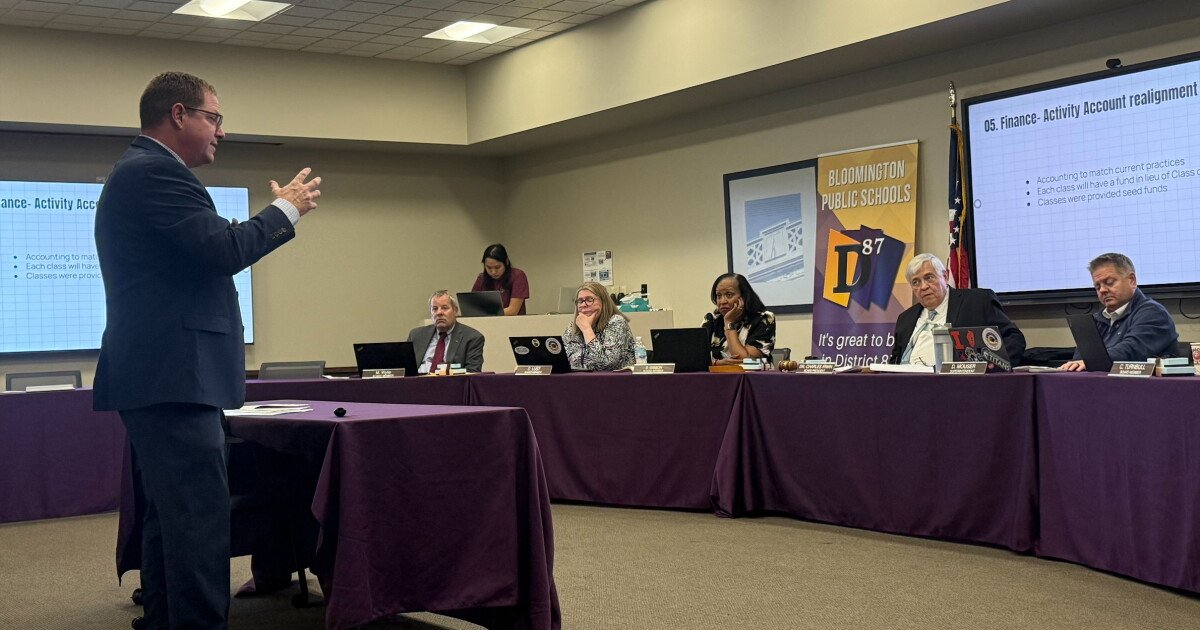
Bloomington District 87 is now one of more than 335 school districts across 11 states suing the companies behind Instagram, TikTok, Snapchat and YouTube, after the school board voted Wednesday to join litigation filed by Frantz Law Group.
The lawsuits accuse Meta, TikTok, Snap and Google-owned YouTube of designing their platforms to keep young users hooked, contributing to mental health and behavioral problems that schools are left to manage. Thousands of cases have been consolidated in federal court in Oakland, California, where U.S. District Judge Yvonne Gonzalez Rogers is overseeing the school district claims.
Frantz Law Group will file an individual action on District 87’s behalf. Under the fee agreement in the school board packet, the firm keeps 25% of any recovery and the district pays nothing if the case is lost. Other Illinois districts, including Elgin U-46, have signed on with the same firm.
“Our attorneys actually reached out to us asking if we were interested in being part of this national lawsuit,” Superintendent David Mouser said after the meeting.
Mouser said the decision was an easy one. Because of the contingency arrangement, joining won’t cost the district, adding the goal isn’t a big payout.
“I can tell you there’s not a school out there that’s going to tell you that social media has not drastically impacted their school,” he said.
District staff deal with the fallout daily, he said, from cyberbullying to mental health crises to students becoming addicted to the platforms.
“I think what we are hoping for is a statement to be made, and I think we’re standing up for kids, which is what we try to do on a daily basis in all facets of what we’re dealing with,” Mouser said.
As the case moves forward, attorneys will ask District 87 for records showing the toll, such as how much time counselors, social workers and family facilitators spend on cyberbullying and related issues. Mouser said the district already tracks that information.
The district hasn’t been shy about limiting technology in school. The board approved a cellphone ban at Bloomington High School in April 2025, and it took effect that fall. Gov. JB Pritzker signed a law in July 2026 requiring every Illinois district to adopt a “bell-to-bell” phone ban by the 2027-28 school year.
Mouser said the bans at the high school and Bloomington Junior High School have changed the feel of both buildings.
“Kids talk to each other,” he said.
Data presented to the board Wednesday shows office-managed behavior incidents at BHS fell between 23% and 65%, depending on grade, from the first quarter of 2025 to the first quarter of 2026. Mouser credited students learning to work out conflicts face to face. Students and staff told WGLT last year the policy was cutting down on classroom distractions.
“We set out board games at lunch at the junior high and these kids are fighting over board games on a daily basis to play board games and card games like Uno at lunch,” Mouser said. “I didn’t think at this stage in my career I’d ever see that kind of thing again.”
Mouser, who once encouraged phones in class as a high school principal in another district, said he has changed his mind.
“It feels like what school used to feel like,” he said. “I think that we need less technology in schools, and we need more social interaction and kind of back to the basics in terms of what we expect.”
Tax levy
The owner of a $250,000 home in District 87 could pay about $20 less to the district next year if the property value held steady, or roughly $350 more if it rose with the market, according to estimates by Chief Financial and Facilities Officer Michael Cornale.
On Wednesday, the board approved a resolution estimating a 2026 tax levy of about $62.3 million that would fund the district’s 2027-28 budget. That’s an 8.51% increase over the $57.4 million last year’s levy brought in.
A public hearing and final vote are set for the board’s Dec. 16 meeting.
The roughly $5 million increase comes from rising property values — not a higher tax rate. County assessors estimate the district’s equalized assessed value, or EAV, will grow about 8.26% this year, to nearly $1.27 billion.
Cornale said the district expects to collect about $61.8 million at that growth rate.
The district deliberately asks for a bit more than it expects, setting the levy around 8.65% growth. Because the tax rate for most funds is capped by state law, Cornale said padding the request lets the district capture all the revenue it’s entitled to if values come in higher once the county certifies them in the spring, without raising what taxpayers would owe otherwise.
“We always ask a little more than what we expect because we can only get what we’re entitled to,” Mouser said after the meeting. “Most of it goes to the education fund, which pays for our teachers and our staff and all of those folks that work on a daily basis with our kids directly.”
Of the roughly $62.3 million requested, $39.7 million is for the education fund. Property taxes make up about 60% of the district’s revenue.
Even with the higher levy, the district expects its tax rate to drop slightly, to about $4.88 for every $100 of a property’s taxable value, Cornale said. That’s close to the district’s rate in 2014.
Part of the reason is the countywide school sales tax: District 87 promised in 2025 to use some of that money to cut property taxes, and this year it will put $2 million toward a bond payment taxpayers would otherwise cover.
Because each homeowner’s assessment is different, Cornale said, there’s no single answer to how the levy will affect any one tax bill. Mouser acknowledged the falling rate doesn’t always show up in people’s wallets.
“A lot of people get upset when administrators say, well, our rate has gone down, and it has, but if your home value goes up, you’re not going to see necessarily a difference in your pocketbook,” Mouser said.
One board member asked about Eastland Mall, District 87’s largest single source of tax dollars from the property. An East Peoria developer, Cullinan Properties, is under contract to buy the mall, and the Bloomington City Council is considering measures to boost its redevelopment.
“At this point, I don’t have enough information to specifically discuss that,” Cornale said. “We know some things, some conversation that’s been happening, but nothing is formal yet.”
Cornale said the district’s goal is to make sure it suffers no loss. Mouser said he, Cornale and district representatives met with city officials last week.
“I’ll be honest, I’ve been very impressed with how the city has worked with us at this point,” said Mouser, adding the district has asked to be kept whole on its tax base and to be told if new development brings in families with school-age children.
Enrollment cliff
District 87’s enrollment has fallen from 5,000 students in 2022 to 4,414 this fall, a drop of nearly 12%, according to the district’s annual fall housing report presented Wednesday. The district projects 4,315 students next year.
The decline shows up at most schools. Bloomington High School has dropped from 1,515 students in 2022 to 1,235 this year. Sheridan Elementary has seen the steepest decline with a drop of nearly 40% over five years.
Mouser said the decline isn’t unique to District 87 — districts across the county are seeing it. He pointed to falling birth rates, a lack of affordable housing and families moving in and out of the district.
“I mean, obviously we’re tracking that, and it’s just less,” he said. “I think affordable housing is a very, very big deal. I think our families can’t afford housing.”

The U.S. general fertility rate hit a record low in 2025, with about 3.6 million births, according to provisional data from the Centers for Disease Control and Prevention. Locally, Bloomington-Normal has struggled with a housing shortage that leaves employers with more workers than the area can house, and home sales fell in 2025.
At Sheridan, Mouser said, families moving in and out midyear is common, and the school has lost 30 to 40 students in the past year alone.
“We get quite a bit of mobility at Sheridan,” he said. “So we’re really watching that closely.”
As for what the district can do about the decline, Mouser said it’s complicated, adding the district’s job is to plan ahead.
“What we’re trying to do right now is to forecast what that enrollment is going to look like in two and three years from now to be able to make sure that we right-size our staff accordingly and take full advantage of the opportunity to look at attrition and retirements and things like that,” he said.
When a teacher leaves, administrators now look closely at whether to fill the position, he said.
“I think it’s our job to be proactive about planning for it and recognizing it and not being in a situation where we’re caught two or three years from now in a situation where we have a lot less kids and we’re staffed a certain way,” Mouser said. “Then you’ve got to make really rash decisions that kill culture.”
Other business
Students are using the newly renovated tunnel at Bloomington High School, with ceiling tiles still to come. Work on the BHS south gym is on schedule, Cornale said, with about 20 contractors on site and a final timeline running into mid-January. Wrestlers and coaches have moved into the renovated upstairs space while locker room work continues. The district also is redesigning the BHS concession stand and adding new graphics at Sheridan Elementary’s secure entrance.
