
You May Also Like

The group set to work, and within a few months it had identified two viable options that can be easily acquired in the U.S. and manufactured on an industrial scale. A full report on their findings can be found here .
The project focused on one part of the eDNA collection device: the plastic and rubber housing around the filter. The first step in the process was to develop a short list of alternatives, each of which was bio-based to some degree. Some of the candidate materials came from what Hubbard called the MDF’s “library of thermoplastics.” Others were provided by the MDF’s extensive network of industry contacts. One was a wood-polymer composite material that Hubbard and Clarkson created at the lab.
To be successful, the materials had to excel in two very different venues: during eDNA collection in the field and on the production line of a factory floor. To properly preserve the eDNA and avoid contaminating the sample, the materials had to be self-drying. The materials also needed to have a certain amount of tensile strength and had to be manufacturable via injection molding.
Initial testing was done at the MDF, where researchers assessed the performance and manufacturability of the materials. Hubbard and Clarkson subjected the materials to moisture uptake analysis, assessed their ability to withstand heat distortion and evaluated their hardness.
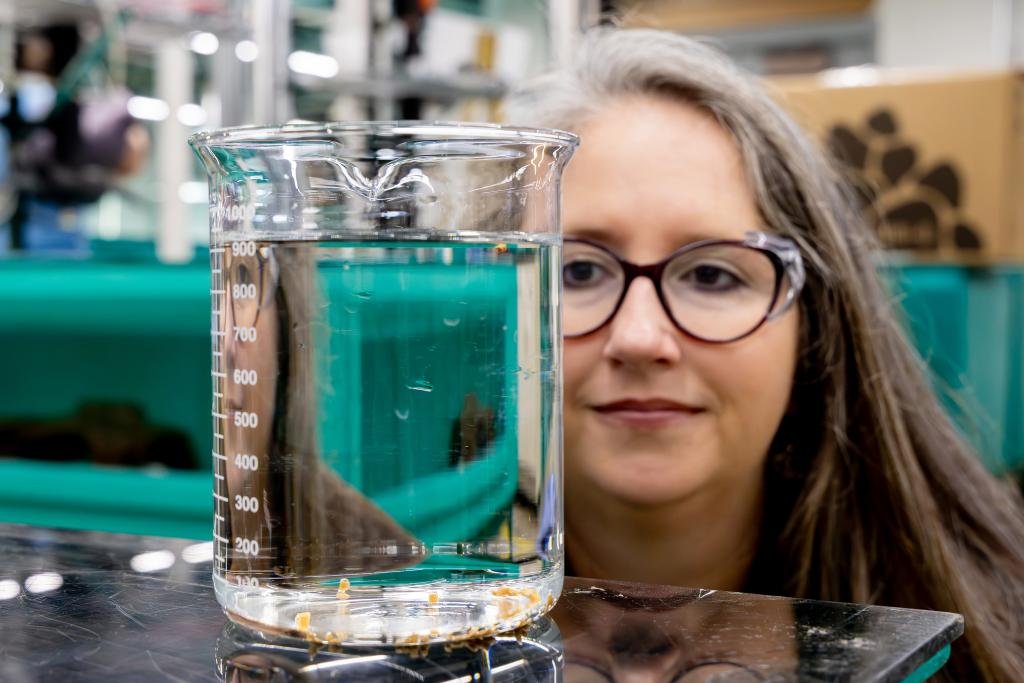
Then Moody tested the candidate filter housing materials in ORNL’s aquatics lab. She dropped pellets of each material into beakers with water containing eDNA from an albino catfish to see if the materials would alter the eDNA results in any way. Some of the materials caused the properties of the filter membrane itself to change. In one sample, the membrane became too tough to cut in half. In another, the pellets became denatured and melted onto the membrane, ruining the sample. These materials were quickly struck from the list of contenders.
For materials that passed the first round of evaluations at the aquatics lab, Moody then tested whether their presence would impact the sampler’s ability to accurately detect the eDNA signal from fish, without allowing the growth of extraneous microbes that could degrade the sample.
“We found a subset of candidates that worked really well,” Moody said. “They interacted with the water well, they retained the eDNA well, and they gave us a better fish signal versus microbial signal.”
Advancing domestic manufacturing
The two materials that made the final cut are cheaper than the current material, met or exceeded performance requirements and are readily available in the U.S. One was the wood-polymer composite created by ORNL, which could be used for the top part of the filter housing. It performed well and is equally manufacturable when compared to the material it may replace. A second material for the bottom housing improved the filter’s self-drying function by 81 percent and is 100 percent bio-based and compostable. Both materials can be sourced domestically.
“It was a pleasure as a scientist to work with the staff at ORNL,” Thomas said. “Being able to bounce ideas off of them was a real benefit to us.”
Smith-Root and ORNL plan to advance the project by testing the materials’ manufacturability through scaled injection molding trials of demonstration parts. Smith-Root will also do further testing on the materials’ performance in the water with fish, assessing it at a hatchery where they can compare how the materials function in water at a variety of temperatures and salinities.
This project was conducted as part of the Water Power Technical Collaboration Program and leveraged the capabilities of the DOE Manufacturing Demonstration Facility at ORNL.
UT-Battelle manages ORNL for the DOE’s Office of Science. The Office of Science is the largest supporter of basic research in the physical sciences in the United States and is committed to addressing some of the most pressing challenges of our time. For more information, visit energy.gov/science . – Clare Kennedy
