
You May Also Like


Companies entering or expanding across the Asia Pacific increasingly find that understanding Taiwan’s role in global technology, trade, and geopolitics is essential to doing business in the region. As the Taiwan arm of The GR Company — an APAC-focused government relations and public affairs consultancy with established practices across Japan and South Korea — GR Taiwan was launched to help multinational corporations and global organizations navigate the evolving operating terrain.
Taiwan sits at the intersection of several industries critical to the global economy. At the same time, its policy framework often poses significant challenges for international businesses. Many regulatory practices, which date back to the Japanese colonial era or the post-war Martial Law period, were developed for a different time and remain deeply out of step with modern international best practices. Helping clients overcome this complexity and gain clear insight into stakeholder dynamics is central to GR Taiwan’s approach, supported by rigorous policy analysis, stakeholder mapping, government outreach, advocacy, and intelligence gathering.
Locating where a client’s value fits within Taiwan’s policy and commercial landscape is a key task undertaken by GR Taiwan’s team, whose members’ backgrounds span diplomacy, corporate affairs, journalism, political advisory, legal practice, academia, and international business. The team’s combined experience across government, law, and business enables clients to clearly understand issues and evaluate their options from multiple perspectives.
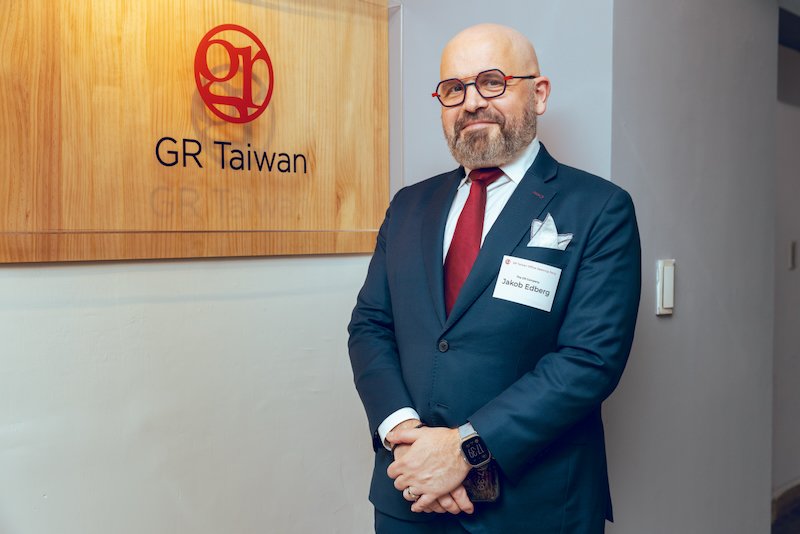
“You need to have a strong command of the subject matter, especially to read what’s not explicit,” says GR Taiwan President & CEO Jakob Edberg. “We speak their language, keep up with political trends, and understand what the government is trying to achieve.” Translating highly technical or politically sensitive subjects into language that different audiences can readily understand without sacrificing accuracy or nuance is critical, he says.
That approach has been applied across a diverse client base, which includes major U.S. pharmaceutical companies, hospitality, consumer services, and startups developing advanced drone systems. Each benefits from GR Taiwan’s tailored engagement strategies and deep local expertise. The results are tangible, from successful disease-awareness advocacy and operational launches to strategic market repositioning.
For Edberg, maintaining political neutrality is crucial. “We remain politically neutral and focus on helping clients understand policy developments,” he says. “That way, engaging with stakeholders remains constructive — and it shows the value we bring to the decision-making system.”
He notes that policymaking, particularly within many Confucian societies, is often characterized by collective decision-making. “Taiwan is also not just two parties,” says Edberg. “Very few people knew about Taiwan 10 years ago, so the strength of its democracy is not fully understood.” The firm leverages its deep familiarity with how officials reach consensus to help clients engage more effectively with the government.
GR Taiwan also works to help clients understand how events in Taiwan connect with wider regional developments. “Taiwan is extremely important for global dynamics,” Edberg says. Few organizations have the time or resources to continuously track those developments, making timely analysis and practical insight a core part of the firm’s role.
Prior to launching GR Taiwan, its parent body, The GR Company, had set up practices in Japan and South Korea. Edberg says that after those offices were established, Taiwan represented a natural next step as the island assumed greater importance in international supply chains.
Compared to its Northeast Asian neighbors, “Taiwan may be smaller in population than some regional markets, but its influence in technology, healthcare, and advanced manufacturing makes it disproportionately important to global business,” says Edberg. That importance also raises the bar for companies seeking to enter the market. “You have to be able to show value,” he says.
That broader perspective also distinguishes government relations consultancies like GR Taiwan from other organizations operating in the policy sphere, such as think tanks or trade organizations.
“Think tanks are always a push — we’re always a pull,” Edberg says. Whereas think tanks typically seek to produce and contribute ideas and influence public debate, GR Taiwan begins with clients’ needs. And while business organizations help make sense of evolving political and regulatory environments, GR Taiwan identifies the issues most relevant to clients to provide tailored guidance. “We see ourselves as our clients’ eyes and ears, helping them navigate the turbulence created by global geopolitical shifts,” he says.
The key distinction is this: despite its expertise in the interplay of local politics, regulation, and business, its role is not to interpret Taiwan. GR Taiwan’s value lies in being a trusted business partner, providing clients with the clarity and context to understand their specific issues and translate complex policy insights into practical business decisions.
For Edberg, well-informed strategies naturally yield better business outcomes. “When they succeed, we’ve done our job.”
