
Now Reading: Trump administration claims executive privilege over White House conversations with private advisers – Reason Magazine
- 01
Trump administration claims executive privilege over White House conversations with private advisers – Reason Magazine

Trump administration claims executive privilege over White House conversations with private advisers – Reason Magazine
Log In
Create new account
Transparency
|
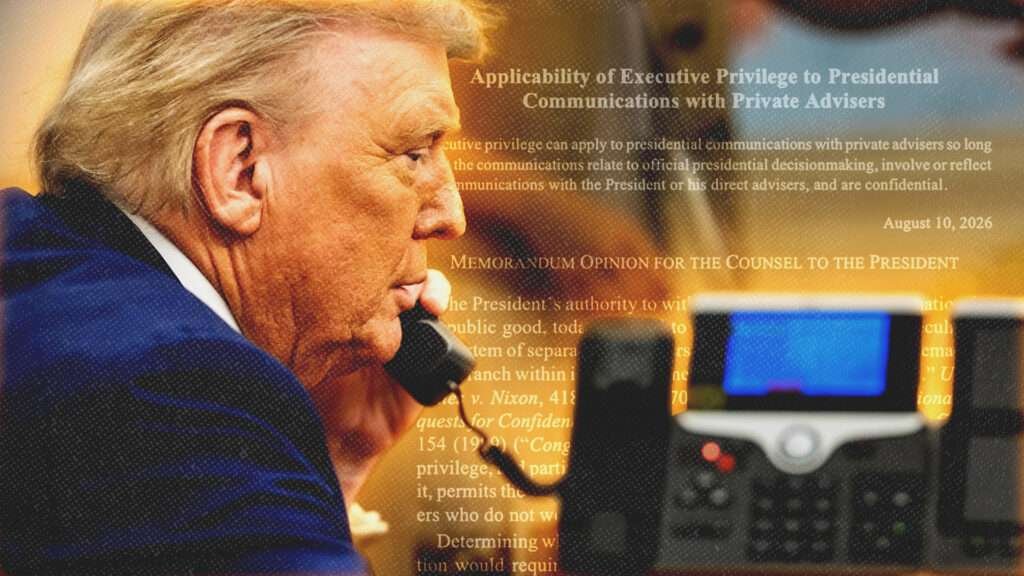
The Justice Department Office of Legal Counsel (OLC) released a memo Monday extending the president’s “executive privilege” to claim confidentiality over White House communications with private advisers.
The memo says the White House can withhold “communications with private advisers so long as the communications relate to official presidential decisionmaking, involve or reflect communications with the President or his direct advisers.”
The new policy would frustrate congressional Democrats’ attempts to investigate the White House if they win back the House in the 2026 midterm elections, which they are favored to do.
The memo also alarmed government watchdog and transparency groups.
“This is the latest attempt by this administration to reduce transparency,” Scott Amey, general counsel for the Project on Government Oversight (POGO), says. “The executive branch has cut resources that ensure public access to government information and taken down information from public websites. It has claimed that the Presidential Records Act is unconstitutional. And now it claims that presidential communications with people outside the government can be shielded as privileged. It’s hard not to read this as anything other than an attempt to gain cover if Congress conducts oversight hearings about the activities and decisions that have been made in the past two years.”
However, the OLC, which advises the attorney general and executive branch on legal matters, wrote that making private advisers’ communications nonconfidential would limit the president’s ability to solicit a wide range of advice.
“Restricting executive privilege to purely intragovernmental communications would foreclose the President from relying on an array of important sources that he may find necessary to the effective discharge of his responsibilities of office,” the OLC opinion said. “Such an outcome not only would impair the President’s Article II functions, but ultimately would harm the public itself.”
The OLC, as a part of the executive branch, frequently concludes that the law supports a more powerful executive.
Executive privilege is the legal principle that certain communications between the president and some senior staff members should be “privileged” and immune to public disclosure through subpoenas of records or staff members. The privilege has been invoked by presidents since George Washington, but its scope and limits have never been firmly defined by the Supreme Court.
In 1977, for instance, the Supreme Court ruled that ex-presidents do retain some right to invoke executive privilege. However, Richard Nixon and Bill Clinton’s attempts to invoke executive privilege in the Watergate and Monica Lewinsky scandals, respectively, were both rejected by federal courts, which have held that executive privilege is not a blanket protection against investigations into the Oval Office.
The Obama White House likewise lost a bid to use executive privilege to withhold records tied to the Fast and Furious scandal from Republican-led congressional committees.
Executive privilege has traditionally not extended to private parties, a point which the D.C. Circuit Court of Appeals and U.S. Supreme Court both noted in rulings in 2021 rejecting President Donald Trump’s request to issue an injunction blocking release of presidential documents to Congress related to the January 6 riot.
As George Mason University law professor Ilya Somin wrote at The Volokh Conspiracy in 2022, “Executive privilege would not give Trump the power to restrict the testimony of private citizens.”
“Executive privilege cannot extend to controlling people who aren’t part of the executive branch,” Somin explained. “If President Biden calls me up to discuss some issue (which he should do more often!), he can’t then use executive privilege to keep me from telling Congress about it.”
In any case, the imperial presidency that Trump occupies, and that past administrations worked to make possible, demands more public scrutiny and oversight, not more secrecy and privilege.
Start your day with Reason. Get a daily brief of the most important stories and trends every weekday morning when you subscribe to Reason Roundup.
Trump Promised To End Foreign Aid. Now He’s Giving Christian Groups Nearly $2 Billion.
is a reporter at Reason.
Show Comments (0)
|
|
|
|
|
© 2026 Reason Foundation | Accessibility | Privacy Policy | Terms Of Use
This site is protected by reCAPTCHA and the Google Privacy Policy and Terms of Service apply.
Celebrate your independence with a subscription to Reason magazine, your most trusted source of honest, insightful news and analysis.