
Now Reading: Toyota expands hydrogen fuel cell technology for heavy-duty transport
- 01
Toyota expands hydrogen fuel cell technology for heavy-duty transport

Toyota expands hydrogen fuel cell technology for heavy-duty transport
Toyota partners with Scania to supply its third-generation fuel cell technology for 40 heavy-duty vehicles to be deployed in real-world operations
Toyota partners with IVECO integrating its technology into new generation fuel cell trucks
Toyota commits to strengthening hydrogen ecosystems combining infrastructure development and technology
The Volvo Group, Daimler Truck AG, cellcentric and Toyota Motor Corporation signed a binding agreement for Toyota to join cellcentric as equal shareholder.
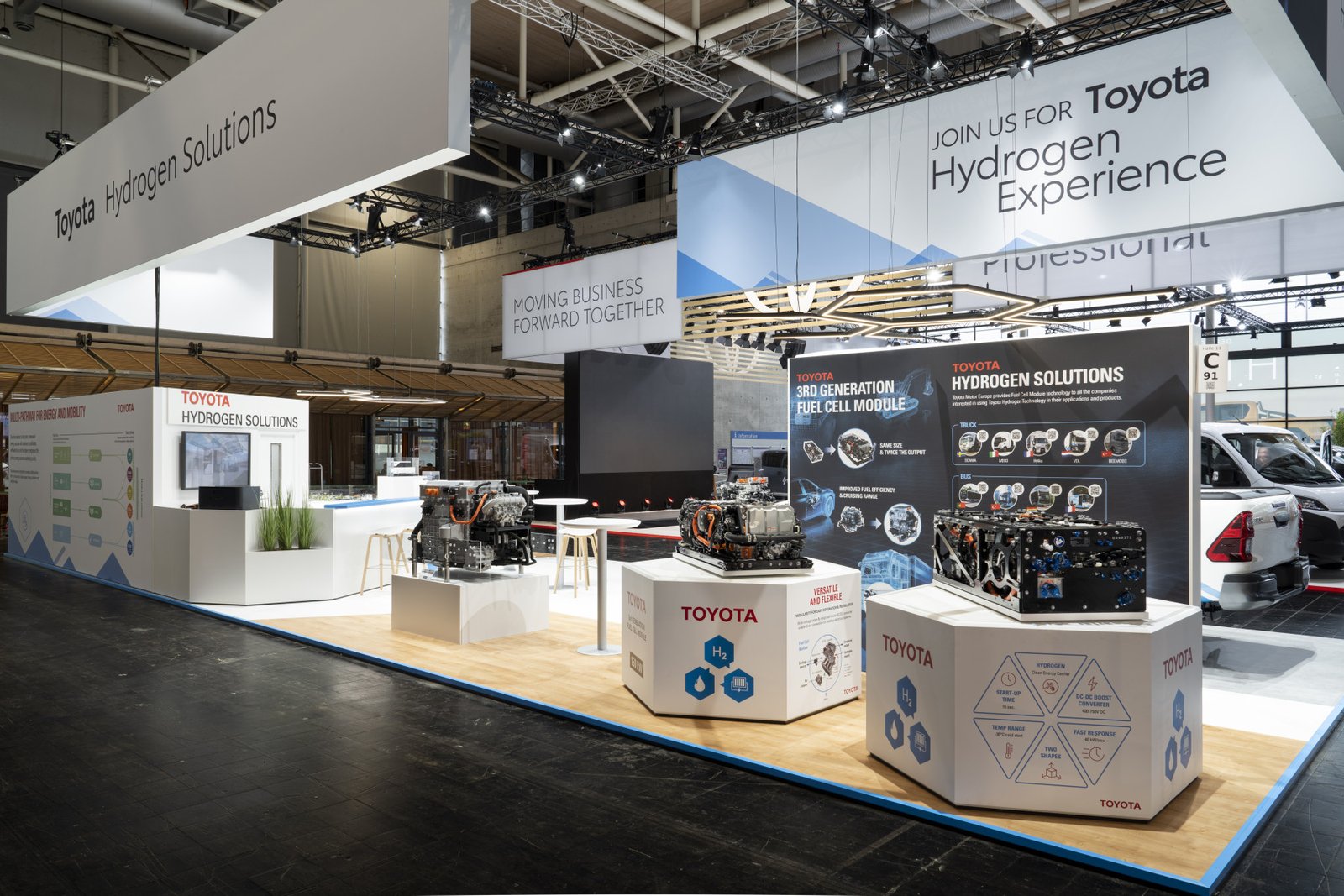
HANNOVER, Germany, 14 September 2026 – At IAA Transportation 2026, Toyota Motor Europe has presented the next stage of its hydrogen strategy, showcasing new advances in fuel cell technology and partnerships with industry leaders to accelerate deployment in heavy-duty transport.
Hydrogen is an important pillar of Toyota’s multi-pathway approach to carbon neutrality. It has particular advantages where long range, high utilisation, fast refuelling, payload and operational flexibility are critical – especially in heavy-duty transport, where vehicles run demanding routes with limited downtime.
Toyota’s third-generation fuel cell system has been developed specifically for the specific demands of commercial applications. Compared with the previous generation, it delivers twice the output, twice the durability, 20% better fuel efficiency and significantly lower cost, bringing fuel cell trucks closer to the performance and operating expectations of diesel fleets while producing zero tailpipe emissions.
Forging partnerships with leading OEMS
With Scania, Toyota will supply third-generation fuel cell systems for 40 heavy-duty vehicles in Scania’s Pilot Partner programme. Equipped with Toyota’s latest 300 kW fuel cell system in a highly compact design for heavy-duty applications and other use cases, the first trucks are expected to start operating in the first quarter of 2027, generating real-world insights into performance, operational efficiency and total cost of ownership for demanding long-distance and high-utilisation transport.
Toyota is also working with IVECO through EMPOWER, the EU-funded Horizon Europe project for zero-emission heavy-duty transport. Toyota will provide the fuel cell system for IVECO’s new-generation fuel cell electric vehicles, while IVECO leads vehicle development, integration and validation. Powered by Toyota fuel cell systems with a total output of 300 kW , the IVECO S-eWay Fuel Cell is designed for a driving range beyond 900 km and durability of more than 25,000 operating hours. Validation starts in the fourth quarter of 2026, with on-road trials planned for the first half of 2027.
Motor racing – the ultimate test
In addition, Toyota continues to test hydrogen technologies in demanding environments. Since 2017, Toyota has been using motorsport to improve performance, efficiency and reliability of hydrogen-powered internal combustion engines. Toyota will take its hydrogen innovation in motorsport a step further in 2027, when Toyota GAZOO Racing plans to enter a fuel cell Hilux in the Dakar Rally’s Future Mission 1000 category; in 2028, the Hilux Fuel Cell, targeting a driving range of more than 400 kilometres and towing capacity of up to 2.5 tonnes, is set for launch.
Commitment to developing infrastructure
Toyota recognises that vehicles alone will not be enough to scale hydrogen mobility. Infrastructure, hydrogen supply, customer demand and policy frameworks must develop together, creating local hydrogen ecosystems that can gradually connect into broader networks. In Europe, initiatives in Germany and the Netherlands show how vehicle deployment and refuelling infrastructure can progress together, supported by frameworks such as the Alternative Fuels Infrastructure Regulation.