
Now Reading: Trump administration faces 2 lawsuits for taxpayer-funded ads as midterms draw near
- 01
Trump administration faces 2 lawsuits for taxpayer-funded ads as midterms draw near

Trump administration faces 2 lawsuits for taxpayer-funded ads as midterms draw near

Listen to this article
Estimated 6 minutes
The audio version of this article is generated by AI-based technology. Mispronunciations can occur. We are working with our partners to continually review and improve the results.
Two lawsuits filed Wednesday challenged U.S. President Donald Trump’s recent series of federally funded television advertisements, which promote his political message while costing taxpayers millions of dollars.
The Democratic National Committee (DNC) was first to sue the Republican administration, alleging the ads are illegal government-sponsored propaganda and accusing Trump of personally directing them. Later Wednesday, a coalition including the non-partisan watchdog Common Cause filed a separate lawsuit, also alleging an illegal misuse of funds.
Both complaints asked federal judges to stop the use of federal funds to pay for the ads. The lawsuits represented the first legal challenges to the television spots, which have faced bipartisan backlash for glorifying Trump and promoting his campaign message with November’s midterm elections less than a month away.
The ads, which began airing in September and are often seen during weekend sports telecasts, already have cost more than $12 million US to run, according to the media tracking firm AdImpact. The Department of Homeland Security awarded a $20-million contract for the campaign to a Maryland company.
Responding Monday to the criticism, Trump defended them as “positive promotion for our Great U.S.A.,” but said he’d start paying for them using his MAGA Inc. super PAC going forward.
But on Tuesday, a fifth ad began airing with a notice it was paid for by the U.S. government. It promoted Trump’s military actions to capture Nicolás Maduro in Venezuela earlier this year. The same day, Trump made it clear he hasn’t committed to reimbursing any money that has already been spent, telling reporters “we’ll decide.”
‘Not going to take the president’s word’
DNC Chair Ken Martin said in a statement that Trump is misusing taxpayer dollars in “a last-ditch attempt to save Republicans in November.”
“Americans deserve better than to have their hard-earned tax dollars used for Trump’s illegal schemes,” he added.
A person familiar with the ad campaign who was not authorized to speak publicly said the ad buys placed prior to Trump’s pledge to start paying for them with his super PAC will end this week. Outside groups will begin to pay at that point, the person said.
Two Blocks from the White House28:54What a midterm loss could mean for Trump — and Canada
The second lawsuit was filed by the legal advocacy group Democracy Forward on behalf of Common Cause, a New York public employee union and a Democratic state legislative candidate in Alabama.
Taxpayers “shouldn’t have to foot the bill for the president’s politics,” said Skye Perryman, who leads Democracy Forward.
Omar Noureldin, senior vice-president of policy and litigation at Common Cause, said his organization doesn’t trust that Trump will stick to outside money for future ads. He cited Tuesday’s new ad as proof that the government-sponsored ads were still being scheduled.
“Even if he said that moving forward, he plans to have his super PAC pay for this, that’s not enough for us,” Noureldin said. “We are not going to take the president’s word for it.”
One ad mirrors 2024 presidential spot
Legal experts have suggested the ads run afoul of a federal statute against congressionally appropriated money being used for “publicity or propaganda” and potentially other federal laws. The Homeland Security money tapped for the ads comes from a $175-million package Congress gave to the department as part of Trump’s immigration enforcement agenda.
Trump’s pledge to use his super PAC to pay for the ads was also legally murky, as super PACs were conceived to operate independently in their decision-making from specific politicians they support.
Democrats in Congress have called on multiple watchdogs within the government to formally investigate, saying in a statement that “stealing taxpayer dollars to pay for Mr. Trump’s narcissistic ego trips is plainly illegal.”
The White House has defended the ads as public service announcements akin to what past administrations have done to promote various policies.

U.S. President Donald Trump was asked by a reporter about a new ad from Michigan Republican Senate candidate Mike Rogers that called for an end to the trade war with Canada. Trump said he ‘viewed it as though [Rogers] wanted Canada to make a deal’ and repeated his claim that Canada has been taking advantage of the U.S. for ‘many, many years.’
Federal Communications Commission Chair Brendan Carr, who has been accused by Democrats of policing talk shows and entertainment programs for political content in a partisan fashion, told reporters recently he didn’t think the ads merited review from the agency, saying, “it doesn’t strike me as anything at all out of the ordinary.”
But the recent ads differ from many past public service announcements because they aren’t aimed at helping members of the public benefit from specific government programs.
One of the ads is a near-replica of a 2024 ad that Trump ran during his presidential re-election campaign, which promises to “expel the warmongers from our government,” a reference perceived to be about the previous Democratic administration’s support for Ukraine and Israel military operations. Trump has been accused this year by the Democrats and a few Republicans of launching an unnecessary war, alongside Israel, in Iran.
Trump’s Republican Party has been forecast as likely losing control of the House of Representatives in the Nov. 3 midterms, while several races in the Republican-controlled Senate are also being closely watched.
Trump has offered to send direct payments to millions of Americans as the midterms draw.
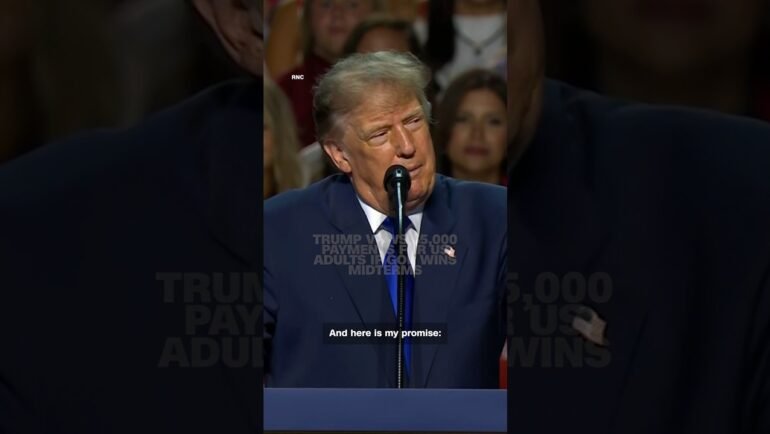
On Sept. 9, Trump promised a payment of $5,000 to all adults if his Republicans held onto Congress in November. However, that idea has gotten little traction in Congress, which would have to sign off on it.
The administration has also sent payments of $500 to 950,000 people who buy health insurance from the government-run healthcare.gov portal. Many of these people have seen their premiums rise sharply after the Republican-controlled Congress allowed a subsidy package to expire at the end of 2025, but the White House says the payments are a refund for what it describes as excessive fees set under former Democratic president Joe Biden.