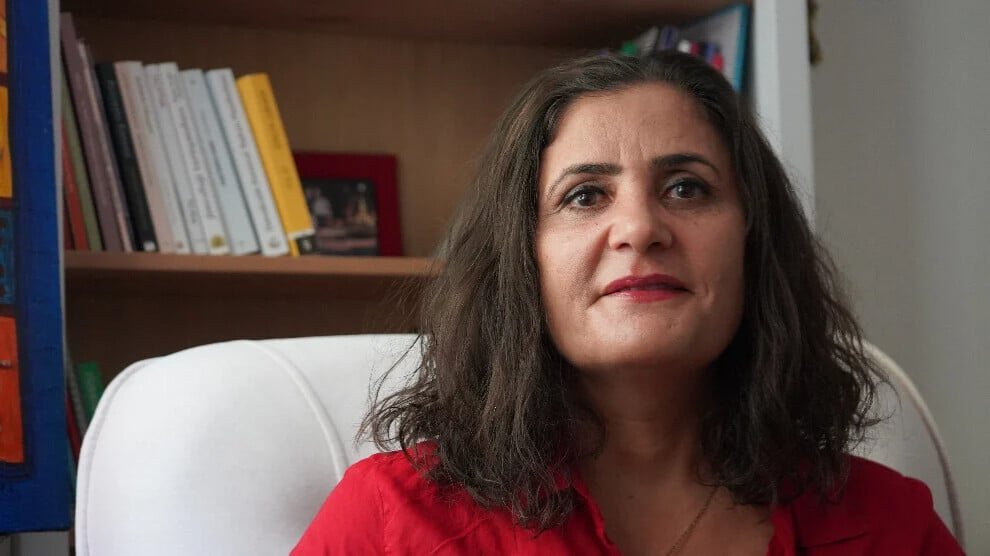
Dilan Dirayet Taşdemir said women’s hard-won gains in political representation show why their participation in democratic politics is essential.
Politician Dilan Dirayet Taşdemir said that the struggle of the Kurdish Women’s Movement in Turkey and Kurdistan has overturned conventional patterns of politics, stressing that genuine local democracy cannot exist in a system where women are excluded from decision-making mechanisms. The experience of the Kurdish Women’s Movement has brought questions of class and social transformation to the fore. Dilan Taşdemir, a sociologist, Kurdish women’s movement activist and former member of parliament for the Peoples’ Democratic Party (HDP), spoke to ANF about the co-chair system, equal representation and debates surrounding local autonomy.
You have been involved for many years in both local and national politics in Turkey, as well as in women’s organising. Based on this experience, do you think local democracy is possible without equal representation of women? If so, how? If not, why not?
As the Kurdish Women’s Movement, we seek to transform the existing position of women in Turkey and Kurdistan and ensure their equal participation in politics. We define the women’s question as a question of freedom; therefore, the question of women’s freedom is, in one sense, a question of participation. In other words, it concerns women’s participation in decision-making mechanisms and the extent to which they have a say, are effective and can act as a transformative force in decisions concerning their own living spaces.
In this context, women’s participation in democratic politics and, more broadly, in every sphere of life is both a serious challenge and a fundamental necessity. Unfortunately, women face similar problems across the world. Nowhere in the world have women yet achieved full and equal participation or inclusion in politics, economic life and society as a whole.
Turkey’s prevailing political culture, mindset and practices place men, the wealthy, and certain religious and identity groups at the centre. For this reason, women’s participation in politics, their ability to articulate their own voice and to become a transformative force pose a serious challenge to the established political order in Turkey. This has also become a major field of struggle within our own political tradition.
Although women make up half of the world’s population, they remain excluded from decision-making mechanisms, are unable to participate equally in economic life and do not enjoy equal opportunities. Budgeting processes are not shaped around women’s demands and needs. Women produce and contribute their labour, yet we are confronted with a social order in which they do not benefit equally from what they produce and do not have an equal say.
This social reality, in which women are excluded, has created a landscape where wars, massacres and injustice are deepening. If we are to make the world equal and just again, that process can only begin with the participation of women. We set out with this driving force. Although we have made significant progress, we still have a long way to go.
The Kurdish Women’s Movement succeeded in introducing women’s quotas and the co-chair system in both local administrations and political parties. In terms of the co-chair system and women’s equal representation, what have local and central administrations gained from this process?
There is a long history of immense effort and struggle behind the fact that women’s co-chairmanship and equal representation are being discussed today. Women did not gain these rights overnight; they are the result of 40 to 50 years of struggle marked by tremendous sacrifices. Thousands of women contributed to the journey from the demand for a 40 per cent quota in the 1990s to equal representation today. Women were imprisoned, lost their lives and were forced into exile for this cause. Despite all the difficulties and repression, the women’s movement continued to grow and transform.
Women’s participation in local government has not simply been a matter of representation; it has also brought about a transformation in the social mindset. In the early days of the co-chair system, we went through a period when, out in the community, the man was seen as the mayor and the woman as his deputy, or when the prevailing attitude was, ‘Can women govern too?’ Over time, the idea that women can engage in politics, make decisions and take the lead became rooted in society.
This transformation affected not only Kurdish society but Turkish politics as a whole. Our co-chair system and decisions on equal representation paved the way for changes to the Law on Political Parties. Although the Peoples’ Equality and Democracy Party (DEM Party) is the political tradition that effectively implements this system in democratic politics today, the pressure and debate it generated also spurred other political parties and the feminist movement into action. Other political forces were compelled to take steps to increase women’s participation as well.
Women’s involvement in politics gave rise to a distinct way of doing politics, shaped by their own experiences of oppression and different forms of socialisation. This gave women greater self-confidence and helped foster the idea that women and men are equal in the family, in politics, in society and in the economy.
Of course, there are still obstacles we have not overcome and difficulties that persist. We encounter mindsets unwilling to share power and authority, policies pursued by the state, and even resistance emerging within our own internal mechanisms. Turning the idea of equality into a social value and securing its acceptance requires an uninterrupted struggle.
Can we say that the Kurdish Women’s Movement and the Kurdish Freedom Struggle have broken with the traditional notion that “politics is for wealthy men”, enabling women from less privileged backgrounds to come to the fore and become mayors, co-chairs or members of parliament?
Absolutely. In fact, this is reflected in the personal experiences of all of us. My own experience is one example. I was born and raised in a village in Ağrı (Agirî). I do not come from a wealthy family; I grew up in what you would recognise as a traditional, patriotic Kurdish family. It was the struggle itself that made us part of this process. The transformation of the men within our families, together with our own involvement in the struggle, created both the driving force and the ground for our struggle for liberation as women.
Representation developed through this struggle, and we took our place within these structures. Otherwise, even today, it would be very difficult in other political parties for a young woman born in a village in Ağrı, who does not come from a wealthy family or have the backing of a tribe, to find a place within conventional political structures. In this respect, the Kurdish Freedom Movement brought about a profound rupture in terms of class, ideas and political mentality, and created powerful conditions for women to take their place in politics.
Women, in turn, waged immense struggles by taking their place in these spaces, assuming responsibility, paying a price and, at times, facing exclusion from society. Many of our women comrades had to struggle with their husbands, fathers and brothers, as well as with men within the party, simply to take part in politics, while at the same time becoming targets of the state. We have had comrades who were imprisoned, forced into exile and killed. Some of our women comrades have been in prison for nearly 30 years. In other words, women have played a major pioneering role in this call for freedom, embraced it and carried it forward.
Why do you think the European Charter of Local Self-Government, which is currently a subject of debate, is important in terms of women’s participation in local government?
The European Charter of Local Self-Government is not a mechanism solely for women; more broadly, it is a mechanism that protects local government from excessive central control. In highly rigid, status quo-driven and centralised systems such as Turkey’s, everything is decided in Ankara. Even when it comes to a project to be carried out or a decision to be taken on a street in Ağrı, local non-governmental organisations (NGOs), democratic forces, residents or even the municipal council are not in a position to have the final say.
Approval is required from a bureaucrat sitting in Ankara who may never even have seen that city. This is not only undemocratic; it also bogs down local problems in bureaucracy, makes the system cumbersome and amounts to a refusal to recognise local will.
We have experienced this repeatedly through the appointment of trustees, projects becoming mired in bureaucracy, and local administrators being left without safeguards against the central authorities. Although local elections formally exist, anti-democratic practices persist in the way the system operates. This Council of Europe charter, however, promotes recognition of local autonomy and encourages decisions to be made more actively and democratically by the people, groups and local actors who live there.
This is also extremely important for women because women are more organised at the local level and assume greater responsibility in everyday life. Problems involving water, roads or schools in a city affect women most. Because women organise everyday life and are directly affected by shortcomings in local services, their participation in local government and the ability to discuss and address problems locally are of great importance.
You recently spent time in the diaspora, travelling to countries including Belgium, Germany and Switzerland and meeting with women there. What picture did your observations in the diaspora offer you in terms of local democracy and women?
No matter where you are in the world, the reality is that women face discrimination because of their gender, are marginalised, do not receive equal pay for equal work, are inadequately represented in decision-making mechanisms and are exposed to violence. What differs is how these problems are addressed and the extent to which states assume responsibility for tackling them.
In Europe, as in Turkey, there is a strongly organised Kurdish Women’s Movement as well as feminist movements, and we come together around shared issues. There are, however, robust protection and support mechanisms here, along with judicial processes. Both the state and civil society have a responsibility to protect women economically and legally. In Turkey, by contrast, even existing rights are being eroded, practices that leave women at the mercy of men persist, and reductions in sentences for ‘good conduct’ continue to feature prominently in judicial proceedings.
Although Europe has its own set of problems, we can nevertheless speak of strong judicial and protection mechanisms that safeguard women.
Finally, how do you see the future of democratic, egalitarian and women’s liberation-oriented forms of governance in Turkey?
A substantial and solid body of knowledge, foundations and experience has been built up. Significant momentum has been created in politics, social relations and the cultural sphere. Of course, this is not a completed process. As women, we need to renew ourselves in response to changing global conditions, artificial intelligence and the new social realities emerging in the age of science.
There are differences between the demands of the 1990s or 2000s and the demands for freedom expressed by young women today. This should be seen as a process of empowerment and transformation.
Women today are building momentum not only in Turkey and Kurdistan, but across the world. Women are increasingly taking the lead in social movements and resistance. I believe this momentum will grow even stronger through solidarity and collective strength among women, and that women’s experience and perspectives will play a transformative role in the politics of the future.
Home | Contact | RSS Feed | Copyright © Ajansa Nûçeyan a Firatê 2026. All Rights Reserved