
Now Reading: Tesla FSD Explained – And What Can Go Wrong
- 01
Tesla FSD Explained – And What Can Go Wrong

Tesla FSD Explained – And What Can Go Wrong

The interior of a Tesla is seen during a test drive of TeslaÕs first Full Self-Driving (FSD) models to have been type-approved, in Antwerp, Monday 15 June 2026. BELGA PHOTO JONAS ROOSENS (Photo by JONAS ROOSENS / BELGA MAG / Belga / AFP via Getty Images)
BELGA MAG/AFP via Getty Images
Understanding Tesla autonomous driving systems can be confusing for the novice, especially in the wake of accidents like the one in Katy, Texas. My own experience shows why there are questions about the Katy crash.
TL;DR: Autopilot and FSD are not the same. FSD – the focus of the Katy, Texas crash – takes over all driving duties and aspires to be a robotaxi. FSD is now the principal autonomous technology that Tesla offers. Autopilot, at least under that banner, is being phased out. In the Texas accident, FSD was still engaged when the driver accelerated.
In the Katy crash, which is now under investigation by the National Highway Traffic Safety Administration, a Model 3 slammed into a home, killing a 76-year-old woman. The victim’s family has sued Tesla and the person behind the wheel. Tesla claims the driver overrode FSD by pressing the accelerator.
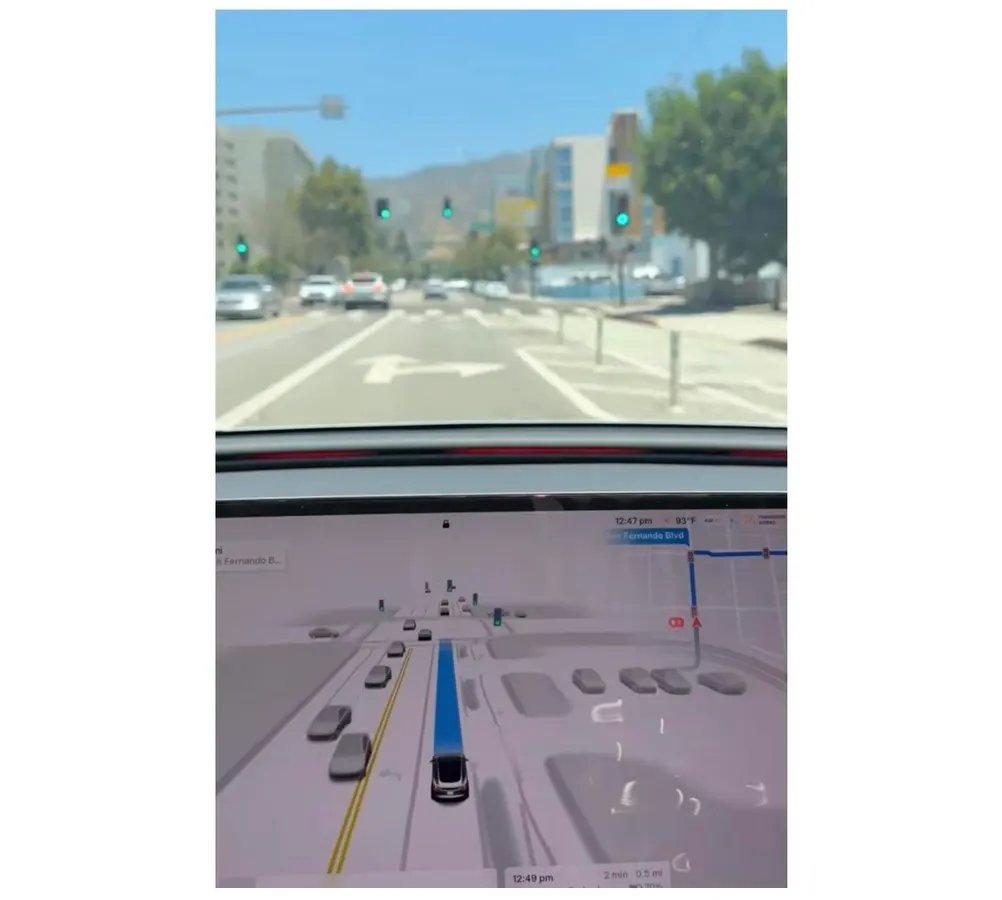
FSD 14.3.3. on a 2026 Tesla Model 3 in Burbank, California.
Credit: Brooke Crothers
How FSD May Have Played Out In The Crash
Tesla’s Head of AI, Ashok Elluswamy, confirmed that the vehicle logs show the Full Self-Driving (Supervised) software was active. “In this case, the driver manually overrode self-driving by pressing the accelerator all the way to 100% of the accel pedal in this residential area,” said Elluswamy, adding that the Model 3 reached a speed of 73 mph during the crash.
Pedal Misapplication?
The Katy crash scenario lines up with pedal misapplication—where a driver intends to slam on the brakes but mistakenly floors the accelerator instead. FSD mode allows the driver to use the accelerator. In other words, pressing the accelerator does not disable FSD. In the case of the Katy crash, the Model 3 accelerated, then slammed into the house.
There are four ways to disengage FSD – pressing the accelerator is not one:
- Press the brake pedal.
- If equipped, move the gear stalk upward.
- If equipped, press the right scroll wheel on the steering wheel.
- Take over (grab and jerk) the steering wheel and steer manually.
Tesla FSD 14.3.3.
Credit: Brooke Crothers
My Experience: Acceleration
I test FSD regularly and have done three tests over the last two weeks. I tested FSD this past week on a 2026 Model Y in Los Angeles, reproducing the sudden acceleration reported in the Katy accident – but under very different and very controlled conditions. (See video here*.) In the test, when I hit the accelerator to overtake a car, FSD stayed engaged. As long as the driver doesn’t press the brake pedal or apply too much torque to the steering wheel, FSD will stay engaged.
It’s important to note that other autonomous driving systems from other car manufacturers do the same thing, i.e., allow acceleration. As do more basic driver assist systems like cruise control and adaptive cruise control.
My Experience: FSD In Residential Areas
FSD will not accelerate on its own in residential areas, where the Katy accident took place (as Musk states above). Based on my experience, it does just the opposite. It decelerates and maintains an excessively slow speed. When FSD enters the residential areas where I live, it slows down, typically to 25 mph. But, again, you can override FSD by pressing the accelerator, which I have done in the residential area around my home.
I would suggest a guardrail that disables FSD or stops the car if the driver accelerates too much, too fast and hits high speeds like the Katy accident. So, capping acceleration in residential zones (let’s say, preventing the vehicle from exceeding the posted speed limit regardless of pedal input while FSD is engaged) would be a straightforward safeguard.
But there are arguments supporting Tesla. Those arguments claim when the driver mashes the accelerator (the foot is to the floor), the system is not driving anymore. The driver is. This is the same for cruise control (a very basic driver assist). If the driver on cruise control floors it, that’s human error.
Conclusion: FSD Makes Me A Safer Driver But Takes Practice
Getting the general car-buying public to understand FSD and use it safely is a challenge. I would suggest training so less-technologically-savvy drivers don’t just start “flying blind” with FSD. This would be beyond the limited training that Tesla store staff provide to prospective buyers doing test drives. The problem with FSD is, it is now so good that it has evolved into a supervised robotaxi, in my opinion. This can create driver complacency and inexperienced drivers may try to use it as an unsupervised robotaxi. FSD is very good but it’s not that good.
That said, FSD, when properly used, takes safe driving to the next level. FSD never gets distracted and has full attention on the road all of the time. The same can’t be said of human drivers. I would argue that the much bigger problem on U.S. highways is distracted drivers using digital devices – not FSD. (Not to mention DUI.) While it’s not perfect, FSD aspires to make U.S. highways much safer. I believe it does this in practice. Again, distracted human drivers are, by far, the bigger problem on U.S. highways, as these NHTSA statistics show.
*Note: In the video, I did not clear the “Why Did You Intervene” message from a previous intervention. That message will stay on the screen whether FSD is engaged or not. I intervened because I chose to reroute my return trip.