


On the dusty backroads of Radiator Springs, where Lightning McQueen and his pals live, a shower of meteors threatened to bring destruction upon the quarter-size cars in a scene that disaster movie king Roland Emmerich would endorse. Thankfully, Buzz Lightyear was on his way to save the day, driving Chase’s car from “Paw Patrol.”
As my toddler son and I played out his scenario with his toys, I was struck by a pang of guilt I didn’t see coming.
He’s just a toddler, and we’ve watched all of these cartoons together. That’s a lot of screen time.
I’m the harshest critic of my son’s screen time, allowing him to watch portions of his favorite movies or TV shows roughly twice a day. I walked into “Toy Story 5” with a pit in my stomach, convinced that somehow a movie meant to be watched on any and all screens was going to make me feel bad about my child’s penchant for kid-friendly intellectual property.
That wasn’t the case.
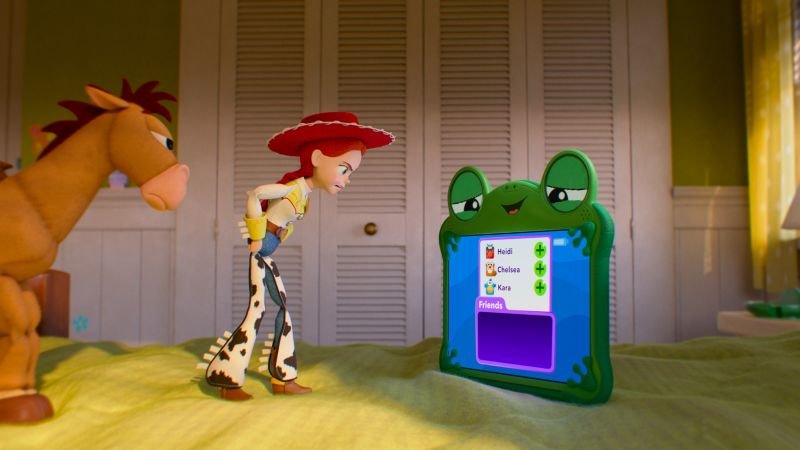
Technology is not the enemy in “Toy Story 5,” which opens Friday, but screens do throw some conflict into the mix. The latest installment out of imagination emporium Pixar finds Bonnie’s beloved toys despondent over the arrival of Lilypad. The tablet threatens to consume the 8-year-old’s every waking moment, leaving no time for making memories with her partners in pretend.
Indeed, a long-abandoned toy robot tells cowgirl Jessie (voiced by Joan Cusack) early in the film that “the age of toys is over” and screens have taken over. Lilypad comes leaping into Bonnie’s life and bedroom because her parents want to help their imaginative child make friends in real life, even if they begin in the digital world. Bonnie’s parents are a little desperate but at the same time deeply hesitant about introducing their daughter to screen time.
What unfolds is the kind of heartstring-pulling you’d expect, with a hearty acknowledgement of how hard — and downright heartbreaking — it can be to manage your child’s relationship with technology and screens when the world is increasingly dependent on them. But I found relief because the movie is not an indictment of parents who let their youths use tech; instead it’s an encouragement for them to participate in their children’s digital lives as actively as they can.
Our family may be years away from navigating the things Bonnie and her parents have to sort through in this fifth outing, but before we do, this is what I’ll be keeping in mind:
If a gaggle of toys entered your front door, ran the length of your home and exited out the other side, would you notice? Or would you, like one family in the film, be so consumed with your device of choice, face illuminated in a cool blue light, that you wouldn’t notice a thing?
The scene is minor but wordlessly highlights a major issue: Device use is a whole family issue. There is no examining your child’s relationship with screens without looking at everyone’s use in a household. That’s particularly because younger children model what they see and do so without nuance, according to Josephine Hunt, a longtime public-school teacher and children’s mental health advocate based in Park Ridge, New Jersey.
“We may be on a device answering emails or doing work, working on proposals or projects, but our children are seeing us on the screen and not really understanding that,” Hunt said.
Simple, age-appropriate conversations about device use could help children understand the difference between necessary engagement and recreation. Discussing screen time with your child can also help them recognize the symptoms of overuse — like tired eyes or neck pain — and give parents an opportunity to start a conversation about it.
The American Academy of Child and Adolescent Psychiatry estimated in 2025 that on average, children ages 8 to 18 in the United States spend 7.5 hours a day watching or using screens.
Limiting or reducing unnecessary device time across the family unit would be ideal, and involving children in discussions about those parameters can be the key to making them stick, Hunt added.
An open dialogue can also help children prepare for scenarios, such as how much device time is appropriate when their friends are over or what to do about cyberbullying — two scenarios Bonnie faces in the new film.
When Bonnie goes to a highly anticipated sleepover with the friends she longed to have, it turns into LilyPad Fair, with each girl glued to her device. The toys are crushed to see it happen, and it’s crushing to watch her disappointment turn into complacency. Later, the same supposed friends share mean words about her in their group chat.
Parents are reminded of the need to be virtual hallway monitors of sorts, but it doesn’t have to feel overbearing, according to Dr. Siggie Cohen, a child development specialist and author of “You Are the Parent: Move From Overparenting to Balanced Parenting and Become the Leader Your Child Needs.” Approaching your child with genuine curiosity in their interests can go a long way.
“First and foremost, stay connected to your children, even when they’re on the devices,” she said. “Know their world, understand it — not just because you’re watching like a watchdog, but because you really are present.”

Emphasizing that self-worth comes from internal sources instead of external will also help kids deal with a myriad of confidence-bruising situations that may arise online, Hunt said.
“We all got bullied, and kids will continue to get bullied, and it’ll continue to happen on the screens, but how do we teach our kids that we don’t value what other people impose on us?” she said.
A hearty spoiler alert — though, maybe you could have guessed there is a happy ending to the film: Bonnie and her parents figure it out on their own terms, aided, of course, by her toys’ intervention and a technology-aided connection with a new friend who shares her interests in creative play.
By the time the credits start to roll, the audience has learned right along with Jessie and Co. that creativity and tech can go hand in hand, an important point to remember as the virtual world becomes just as important of a peer-connection space as the playground, Cohen said.
“We focus on, ‘Let’s get away from technology. Let’s stop it. Let’s fear it, let’s put boundaries on it and so on.’ All of that adds so much more pressure, temptation, stress,” Cohen said. “I think what we want is, ‘What is our time together? What is the quality and the culture of our time together?’”
Because devices can play a part in that, she said, like co-viewing movie nights or games with virtual elements.

This advice is in line with what the American Academy of Pediatrics advises, which is that parents consider “the quality of interactions with digital media and not just the quantity, or amount of time.”
In the same way that many educators try to use technology as a supplemental tool and not as a foundational start, Hunt said that any time screens can be used to enhance multisensory learning and engagement, it’s a win.
In the first film, when Buzz Lightyear arrived in Andy’s room with buttons, lights and generally more dazzle than his simpler peers, Hunt said, that embodied a message Pixar has always gotten right.
“They don’t say, ‘This is bad’ or ‘Get rid of this,’” she said. “They show you how to work together and how to use it as a supplemental part of your learning and creativity and imaginative play.”
Helping children find that balance is a lesson that can truly take them to infinity and beyond.
Get inspired by a weekly roundup on living well, made simple. Sign up for CNN’s Life, But Better newsletter for information and tools designed to improve your well-being.
