

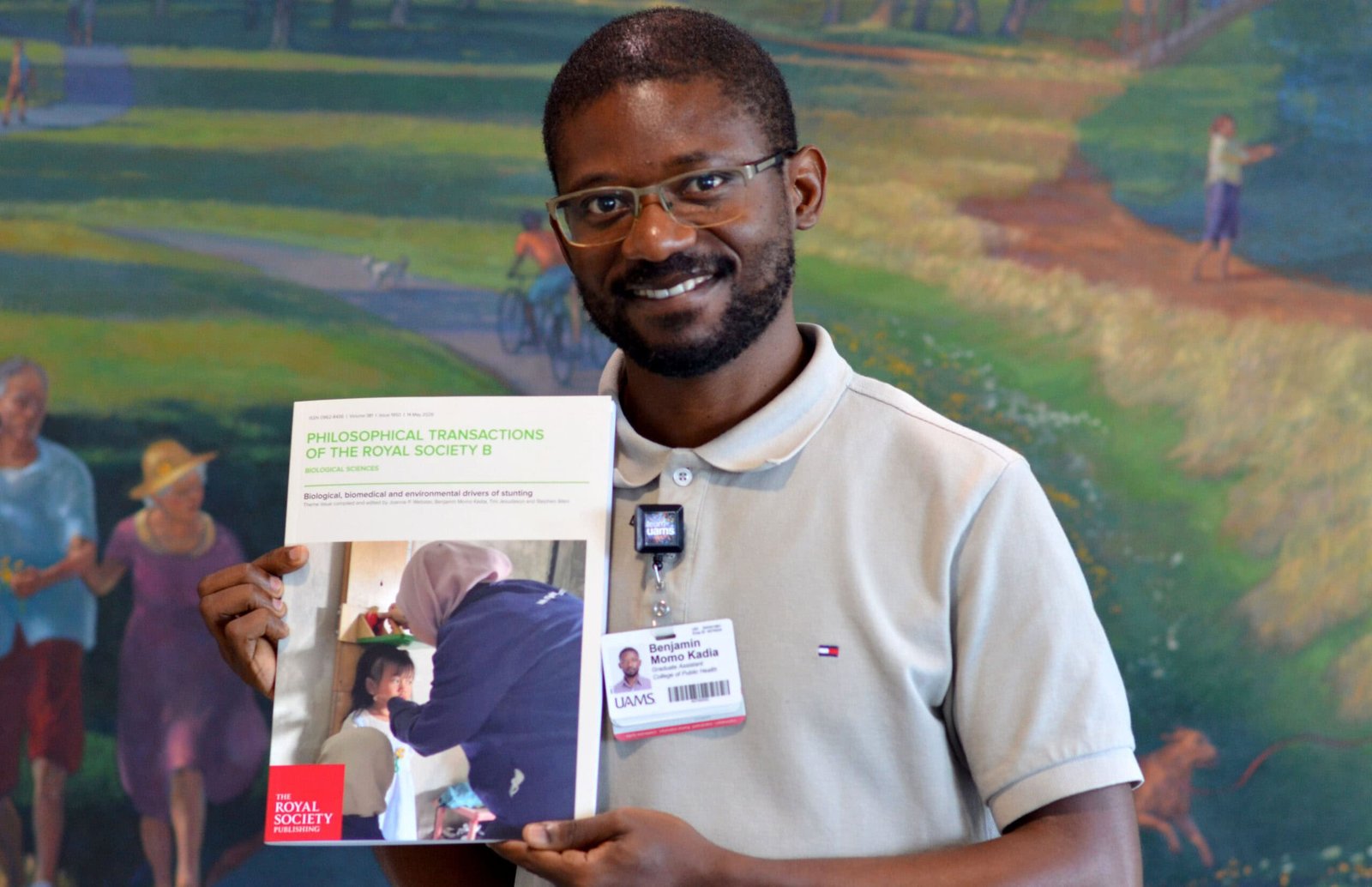
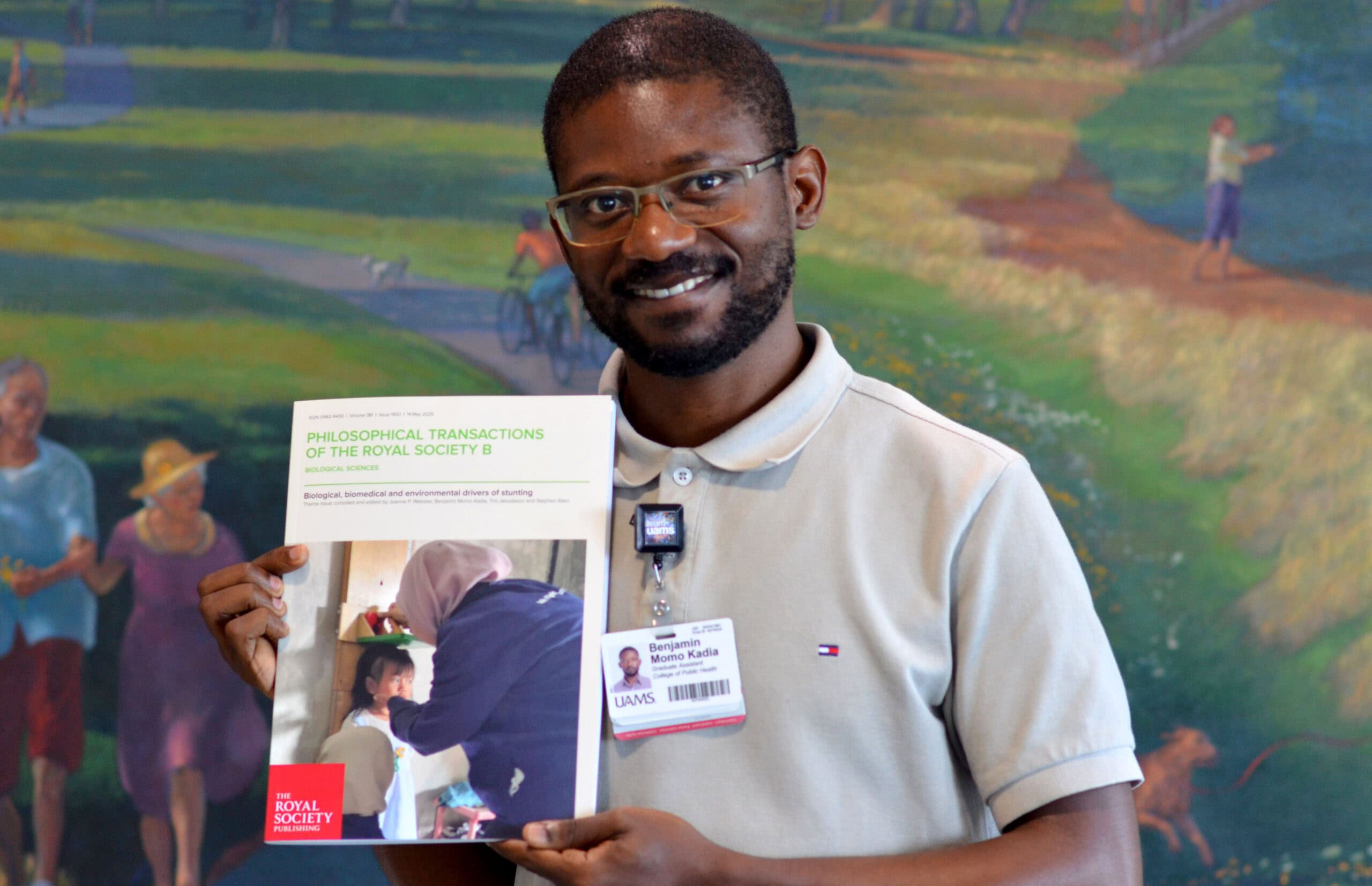
| Doctoral student Benjamin Momo Kadia strives to address the complex and interrelated biological and environmental factors that shape childhood growth, health and development.
Kadia’s dedication and contributions to solving those issues led to his involvement as an early-career researcher on the guest editorial team for a themed research collection focusing on childhood stunting — a condition resulting from longstanding undernutrition that severely impacts children’s physical growth and cognitive potential.
The collection, titled “Biological, Biomedical and Environmental Drivers of Stunting,” was published by The Philosophical Transactions of the Royal Society B, which is the world’s first and longest-running scientific journal.
A doctoral student in the University of Arkansas for Medical Sciences (UAMS) Fay W. Boozman College of Public Health epidemiology program, Kadia is proud to have participated in a themed collection published by the historic journal.
“The goal of the themed issue was to deepen the understanding of childhood stunting and the complex processes that contribute to it,” he said.
“The opportunity was particularly meaningful because the themed collection addressed childhood stunting, a subject closely connected to my research on child growth and development,” Kadia said. “It represented an important step for me, from contributing to individual studies to helping shape a broader scientific conversation.”
Childhood stunting is commonly identified when a child is substantially shorter than expected for their age. Stunting can reflect ongoing constraints on a child’s nutrition, health, and development.
“A diverse range of scholarly articles from various disciplines that examine stunting made the themed issue possible,” Kadia said.
As part of the guest editorial team, Kadia helped develop the collection, shape its intellectual direction, identified appropriate reviewers, evaluate reviewer assessments, and worked with contributing authors throughout the editorial and revision process.
Kadia’s role in the team grew out of his work with a United-Kingdom funded, international research collaboration. During that time, he worked with senior researchers on the editorial team on interdisciplinary research examining childhood stunting. Over the years, these partnerships helped Kadia gain an informed perspective on nutrition, intestinal health, infections, inflammation, and other early-life influences on child growth.
“I earned the opportunity to build on that experience as a guest editor — moving beyond contributing to individual studies to helping bring together and shape a broader scientific discussion on childhood stunting,” he said.
Kadia is grateful for how the assignment enhanced his abilities as a researcher. He noted how the duty forced him to look across multiple studies, consider how different bodies of evidence fit together, evaluate reviewer assessments, work with authors, and help maintain the intellectual coherence of a scholarly collection.
Additionally, Kadia said while stunted growth is primarily a crisis facing less industrialized nations, the core factors driving it — such as food insecurity, recurring infections and early-life environmental exposures — are challenges that resonate deeply with maternal and child health efforts in Arkansas. He believes the insights gained from studying the complex interactions between these factors can help inform local research aimed at improving child nutrition, growth and health outcomes across the state.
“Children’s growth may also be affected by infections, gut health, inflammation, environmental exposures, living conditions, and access to appropriate healthcare,” Kadia said.
Kadia embraced how his first ever guest editor assignment as a unique opportunity to represent UAMS on a global scholarly platform while aligning perfectly with his epidemiology doctoral training at UAMS. On a personal level, he’s confident the project will help him for years to come by deepening his data translation expertise, sharpening his scientific leadership, and laying a foundation of international collaborations for his future global health research.
“My research examines how biological, nutritional, environmental, infectious, and social factors interact during early life to influence child growth, development and health,” he said. “In the longer term, I hope to lead impactful maternal and child-health research, mentor future researchers, and contribute to improving health outcomes for children, particularly those living in disadvantaged settings.
“Ultimately, the aim is to give more children, particularly those living in disadvantaged environments, the opportunity to grow and thrive.”