
You May Also Like


Advocates for environmental and human health protections are seeking to challenge a decision by US regulators that they say will allow the continued use of atrazine, a commonly used herbicide linked to cancer and other health problems.
The April opinion by the US Fish and Wildlife Service (FWS) concluded that atrazine does not pose an extinction risk to threatened or endangered wildlife. The opinion has been met with outrage from environmental and health advocates, who say there is clear scientific evidence that atrazine poses risks to both wildlife and humans.
The decision marks the latest step in a years-long battle over the US Environmental Protection Agency’s (EPA) ongoing registration review of atrazine. The EPA was legally required to consult with the FWS to ensure that reauthorizing atrazine would not violate the Endangered Species Act. The FWS opinion will now be used by the EPA to determine if atrazine meets federal safety standards for continued registration.
“Most people agree that we need to make sure that we as a country aren’t poisoning ourselves, and protecting future generations from harm,” said Nathan Donley, environmental health science director at the Center for Biological Diversity. “If we have a chemical that is linked to so many different harms, the goal really should be to eliminate that exposure source.”
“Most people agree that we need to make sure that we as a country aren’t poisoning ourselves, and protecting future generations from harm.” – Nathan Donley, Center for Biological Diversity
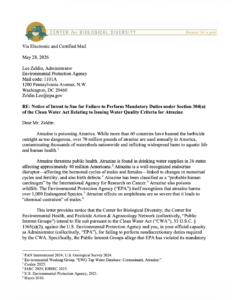 The Center for Biological Diversity, along with the Center for Environmental Health and Pesticide Action & Agroecology Network, last week notified the EPA of the groups’ intent to sue the agency over the atrazine issue.
“While more than 60 countries have banned the herbicide outright as too dangerous, over 70 million pounds of atrazine are used annually in America, contaminating thousands of watersheds nationwide and inflicting widespread harm to aquatic life and human health,” the May 28 letter to the EPA states.
The letter alleges that under the Clean Water Act, the EPA must publish national water quality criteria for atrazine. By not doing so, the nonprofits accuse the agency of allowing a “well recognized endocrine disruptor” into US drinking water supplies. Endocrine disrupting chemicals interfere with the functioning of the body’s endocrine system.
The EPA has acknowledged that atrazine is a surface water and groundwater contaminant that can enter waterways in agricultural runoff from row crops. In 2021, the agency determined that the weedkiller was likely to harm more than 1,000 protected species.
But in the April opinion, Fish & Wildlife officials took a different stance, determining that while chronic exposure of atrazine for animals “may lead to adverse effects (depending on the exposure),” there is no threat of extinction. The agency also included safeguards to protect wildlife, such as geographic restrictions of where people can spray and runoff prevention.
In a statement, an EPA spokesperson wrote that the FWS applies different standards in these assessments, and that EPA’s human-health safety determinations for atrazine are made separately, “designed to protect both human health and the environment with rigorous, gold-standard science,” the spokesperson wrote. “The biological opinion should not be read as reflecting EPA’s human-health conclusions, which are governed by a different statute and a different analytical framework.”
Cancer and hormone hazards
Environmental and health researchers have long sounded the alarm on health problems related to atrazine exposure.
A 2024 study conducted by researchers from the National Cancer Institute (NCI) and the National Institutes of Health (NIH) tracked over 53,000 farmers to evaluate the long-term effects of atrazine. The study found that long-term exposure to the chemical was linked to an increased risk of lung cancer, prostate cancer, and for those under the age of 50, non-Hodgkin lymphoma. Further, when looking at a 25-year exposure lag, researchers found strong links to kidney and throat cancers.
“One of the aspects that I think is very peculiar of atrazine is that the evidence that has been found for cancer or for other diseases, you have it in humans, you have it in animals, and you have also in vitro studies,” said toxicologist Daniele Mandrioli, secretary general of the Collegium Ramazzini, an independent academy of environmental health scientists. Mandrioli is a member of the World Health Organization’s International Agency for Research on Cancer (IARC) expert working group that last year categorized atrazine as “probably carcinogenic to humans.”
“One of the aspects that I think is very peculiar of atrazine is that the evidence that has been found for cancer or for other diseases, you have it in humans, you have it in animals, and you have also in vitro studies.” – Daniele Mandrioli, Collegium Ramazzini
Atrazine has also been linked to endocrine disruption in women. Researchers from Colorado State University compared women aged 18–40 living in the corn-growing regions of Illinois, where atrazine is used heavily, versus those in Vermont, a low-use region. The study revealed that women exposed to atrazine in Illinois were far more likely to experience menstrual irregularities than the women in Vermont.
“The first signs are generally symptoms that might be mild or might be recoverable,” said Mandrioli, “but these are early warnings, or sometimes per se, important diseases, and therefore in the case of atrazine, where many endocrine effects have been shown, this is one of the aspects that concerns the most from a public health standpoint.”
Regulatory divide
The EPA shrugged off the IARC classification, saying that it saw no need to act on the IARC assessment and asserting that IARC has a “long history of being severely misguided in its findings.”
IARC’s atrazine determination had seemingly little bearing on the current administration, who withdrew from the WHO in January.

In its statement, an EPA spokesperson wrote that atrazine has been extensively studied by EPA across multiple administrations. “The Agency’s 2003 registration eligibility decision and 2018 human health risk assessment concluded that atrazine is not likely to cause cancer when used according to label directions,” the statement read.
It’s a troubling disconnect according to Mandrioli, who sees IARC as the “gold standard” for cancer evaluations.
While a summary of the IARC assessment has been published, the agency says the full findings will be published in detail in late 2026 or early 2027. The EPA said it will “review the IARC monograph when it finally becomes available in the next couple of years to determine if there is any new scientific information that the agency should consider as EPA continues to review the safety of atrazine.”
Some supporters of the Make America Healthy Again (MAHA) movement are disappointed by the latest decision on atrazine. Kelly Ryerson, a leader in the MAHA movement and co-founder of the nonprofit American Regeneration, is particularly concerned about the issue of endocrine disruptions around the weedkiller. “Many of us have raised the issue of endocrine disruption around atrazine, and it has fallen entirely on deaf ears,” she said. “The fact that they’re willing to continue to sacrifice our fertility and our hormonal balance on behalf of GMO corn is atrocious.”
US Department of Health and Human Services Secretary Robert F. Kennedy Jr has previously campaigned for a federal ban on the herbicide, even releasing a report last year citing that exposure to atrazine can cause endocrine disruption and birth defects. “I think if he were president, we would have a ban on atrazine,” said Ryerson.
The “worst of the worst”
Atrazine is manufactured by Chinese-owned Syngenta, a major player in the herbicide’s production.
When asked about atrazine’s links to cancer and reproductive issues, a spokesperson from Syngenta responded with the following statement: “Activist claims that atrazine poses a carcinogenic or reproductive risk are wholly inconsistent with the scientific consensus held by close to 50 regulatory authorities and scientific expert bodies worldwide – including US EPA and other leading regulatory authorities globally. These authorities have concluded that atrazine does not pose any carcinogenic or reproductive risk and is safe when used in accordance with the registered label instructions.”
The company has a history of working to quash criticism of its products, including attempts to discredit a scientist whose work concluded that atrazine caused sex reversal in male frogs.
“Many of us have raised the issue of endocrine disruption around atrazine, and it has fallen entirely on deaf ears.” – Kelly Ryerson, American Regeneration
Since its commercial introduction in the late 1950s, the herbicide has helped eliminate the need for corn growers to till their soil to manage pesky weeds.
Tilling is detrimental to soil health because it destroys the soil’s fragile microbial ecosystem, making it vulnerable to erosion.
Paul Mitchell, professor of agricultural and applied economics at the University of Wisconsin-Madison, said the economic benefits of atrazine should also be considered.
“Weeds are the bane of crop production,” Mitchell said, pointing out that atrazine helps growers get a higher yield. “It’s a relatively low-cost weed control option that has a broad spectrum of control,” explained Mitchell. “If we lost that, not only would it be a cost increase in yield losses, it would also mean more tillage.”
The argument doesn’t convince Mandrioli, who pointed to countries in Europe who have made do without atrazine. “The argument that this is a necessary chemical and that we have no alternatives just doesn’t stand.”
Donley agreed. “We’ve got hundreds of herbicides approved in this country. This isn’t about banning everything, this is about getting rid of the worst of the worst.”
Featured image: Getty Images for Unsplash+