
Now Reading: Florence Harding Photographed Taught Me About Women Partaking in Politics – East Wing Magazine
- 01
Florence Harding Photographed Taught Me About Women Partaking in Politics – East Wing Magazine

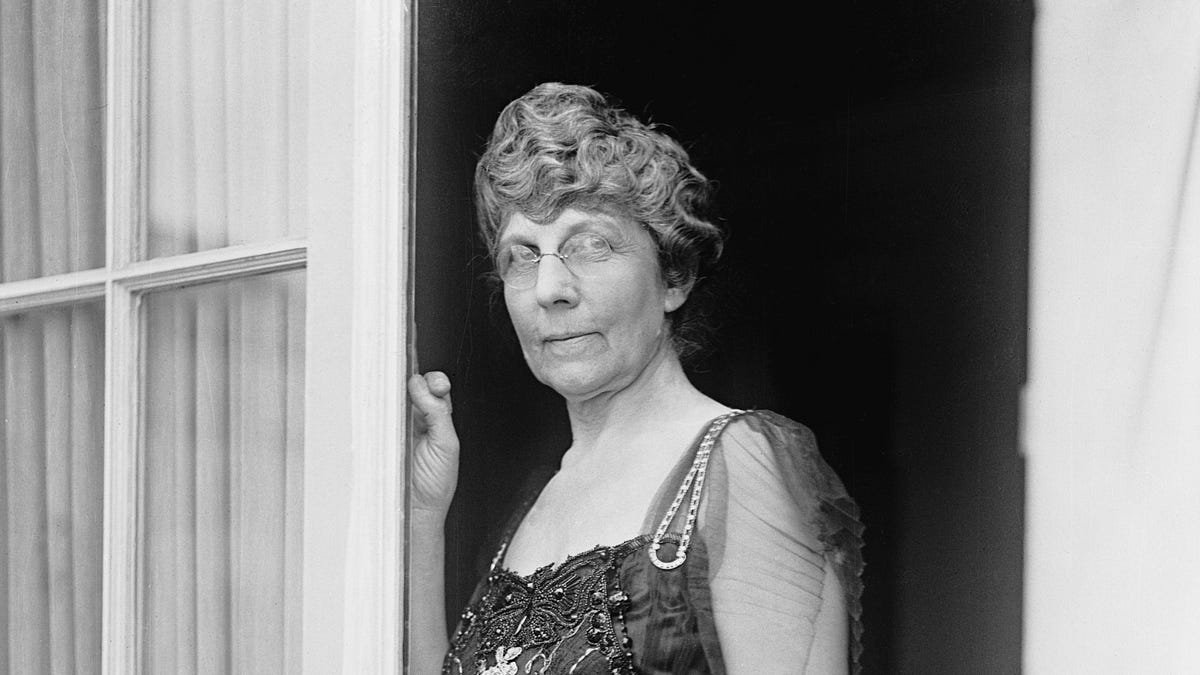
Florence Harding Photographed Taught Me About Women Partaking in Politics – East Wing Magazine
What would Florence Kling Harding think now?
A week or so ago when I cast my ballot at my designated polling place this thought crossed my mind.
I imagine the former first lady would be pleased about how routine voting has become for women in the United States. But perhaps she would not be satisfied.
Today, a published essay I wrote for In Pursuit spotlights a lesson in leadership demonstrated by First Lady Florence Harding. In my research, I discovered there’s a lot to be said about this strong female historic figure. But it was the blurry photograph capturing Mrs. Harding voting for her husband Warren G. Harding, one of two presidential candidates from Ohio, on Nov. 2, 1920—Election Day—that drew my attention. It was the first presidential election held in the United States after the ratification and certification of the 19th Amendment, granting women the right to vote. Its 106th anniversary was marked on Wednesday.
I remember thinking what a shame it was that her presence in the image was imperfect while the mostly men surrounding her were in sharp focus. Perhaps cynically I thought, “No surprise!” On further examination, though, the clear reaction of the people surrounding Mrs. Harding was equally important. In that snapshot of time, many of their expressions were serious. One man stood elevated above the rest with a slight smile as he caught a glimpse of history. Mr. Harding hovered over his wife’s shoulder closely observing the last seconds of her vote being cast. Their gazes were locked in on who would hours later become first lady.
The attention she drew is worth noting, mostly because, as I learned, Mrs. Harding understood the power her image could have on women across the country. She and I share in common a career in newspapers—hers the business side and mine on the editorial side. Nevertheless, it became clear to me as I write in the essay that she understood if she was seen voting, other women would follow suit.
That wouldn’t necessarily be the case in that 1920 election, though, Karen Kedrowski, the director of the Carrie Chapman Catt Center for Women and Politics at Iowa State University, explained to me. Florence Harding was a suffrage advocate. But, suffrage was a contentious issue and women were far from united at the time of the election. In fact, a substantial number of women and active anti-suffrage organizations thought women participating in elections was a “bad idea and antithetical to their roles in the private sphere as mothers and homemakers,” Kedrowski said, adding that women were also viewed as the moral compass for their husbands and sons. If women got involved in politics they would become contaminated by it. Suffragists, on the other hand, wanted to bring that moral presence into politics to help clean things up.
Only about 30% of women voted in that 1920 presidential election. That was a start.
More than 100 years later in the 2024 presidential election, 66.9% of eligible women voted (91.3 million), compared to 63.7% of men who voted (82.6 million), according to the League of Women Voters.
Yes, Florence Harding would be pleased.
That imperfect Election Day image was important symbolism about women’s potential during what was known as the “Modern Woman” era and the growing public role women were taking in the 1920s.
I imagine Florence Harding might agree with other succeeding first ladies when it comes to gender equality and the importance of the vote.
Like Michelle Obama when she said in her memoir Becoming, “We all play a role in this democracy. We need to remember the power of every vote.”
Or Hillary Clinton during her unsuccessful run for president in 2016 when she remarked on International Women’s Day:
“We celebrate the progress we’ve made to advance the full participation of women in economies and societies. And most importantly, we recommit to finishing the unfinished work that remains …”
I hope if you are reading this, you will also read my essay on Florence Harding’s leadership lesson for In Pursuit. And perhaps that will move you to dig deeper and read more about Florence Harding’s life circumstances in biographies like First Lady Florence Harding: Behind the Tragedy and Controversy by Katherine A. S. Sibley.
No, I do not think Florence Harding would be satisfied despite how far women have come from that day she first entered her polling place. She once wrote to the Camp Fire Girls, “The part that women play in the world has been greatly changed … It has been broadened and enlarged …”
It has. And as women continue to engage in civics it continues to be.
I imagine Florence Harding would want women to keep meeting the moment.
Read the In Pursuit essay
Watch on C-SPAN
Share
East Wing Magazine is a reader-supported publication. To receive new posts and support our work, consider becoming a free or paid subscriber.
No posts