
Now Reading: Great Salt Lake meteorite lands in a new home – @theU
- 01
Great Salt Lake meteorite lands in a new home – @theU

Great Salt Lake meteorite lands in a new home – @theU
Four years ago, a rock from space tore through the atmosphere over Utah’s Wasatch Mountains, exploded into numerous pieces that sped straight west over Salt Lake City in a fiery trajectory before crashing into the playa along Great Salt Lake’s south shore.
For the last 4.5 billion years, basically since the birth of our Solar System, the rock had been cruising beyond the orbit of Mars, until Aug. 13, 2022, when it was pulled into Earth’s gravitational field and landed in Utah, according to Jim Karner, the University of Utah’s resident meteorite expert.
Now the largest fragment from that cosmic event is on display in the U’s Sutton Building, home of the Department of Geology & Geophysics.
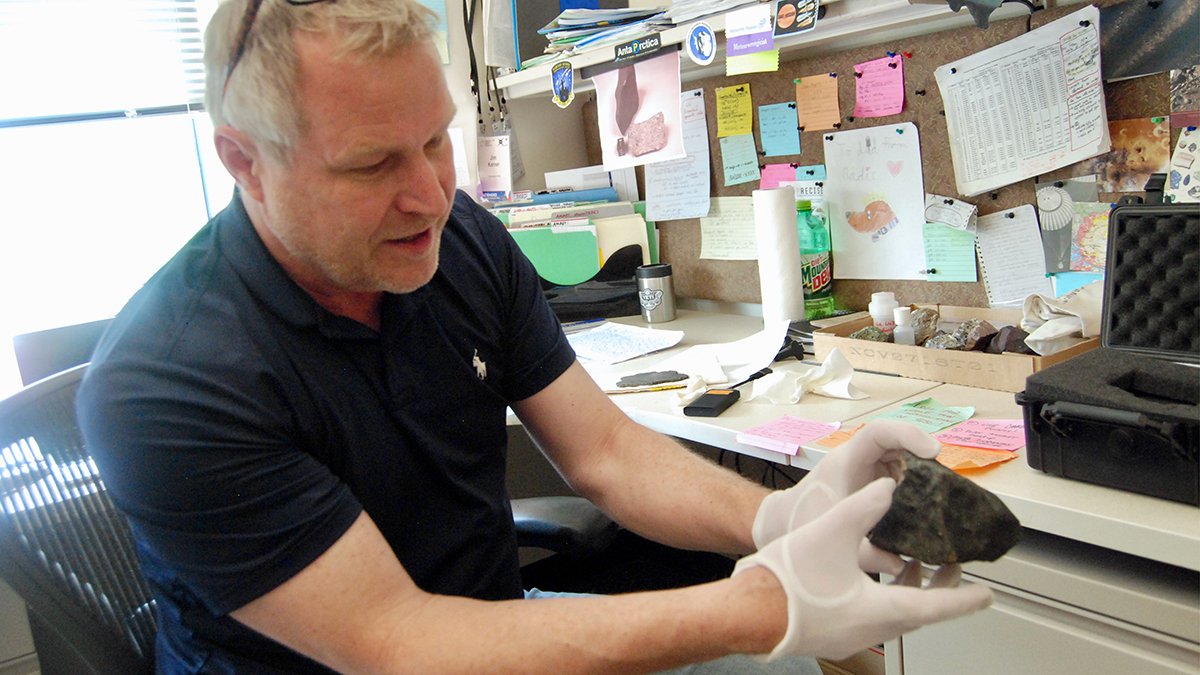
“All these components, the iron-nickel metal, the sulfide grains, the chondrules, the matrix material all came together in the early solar system and then were accreted to form a bigger body, such as an asteroid,” said Karner, a research associate professor, while handling the rock with gloved hands recently. “These are coming in at cosmic velocities, 20 kilometers per second.” (That’s about 45,000 mph.)
The friction generated from contact with the atmosphere causes the rock to become extremely hot.
“They’re incandescently glowing, plus they’re emitting gases and the electrons are interacting with the atmosphere,” Karner said. “The consequences of this burning and glowing are that they are seen as a fireball coming through the atmosphere.”
The space rock is now the centerpiece of an exhibit that includes video and interpretive materials telling the story of Utah’s second known “fall” meteorite, that is, a meteorite whose plummet to Earth was witnessed by people. The first occurred in 1950 near the town of Garland in the Cache Valley. Sixty-two years later, thousands heard and then saw what became known as the Great Salt Lake meteorite when it detonated over Utah’s most populous region. Its trajectory was recorded by Doppler radar, providing a map for finding its pieces.
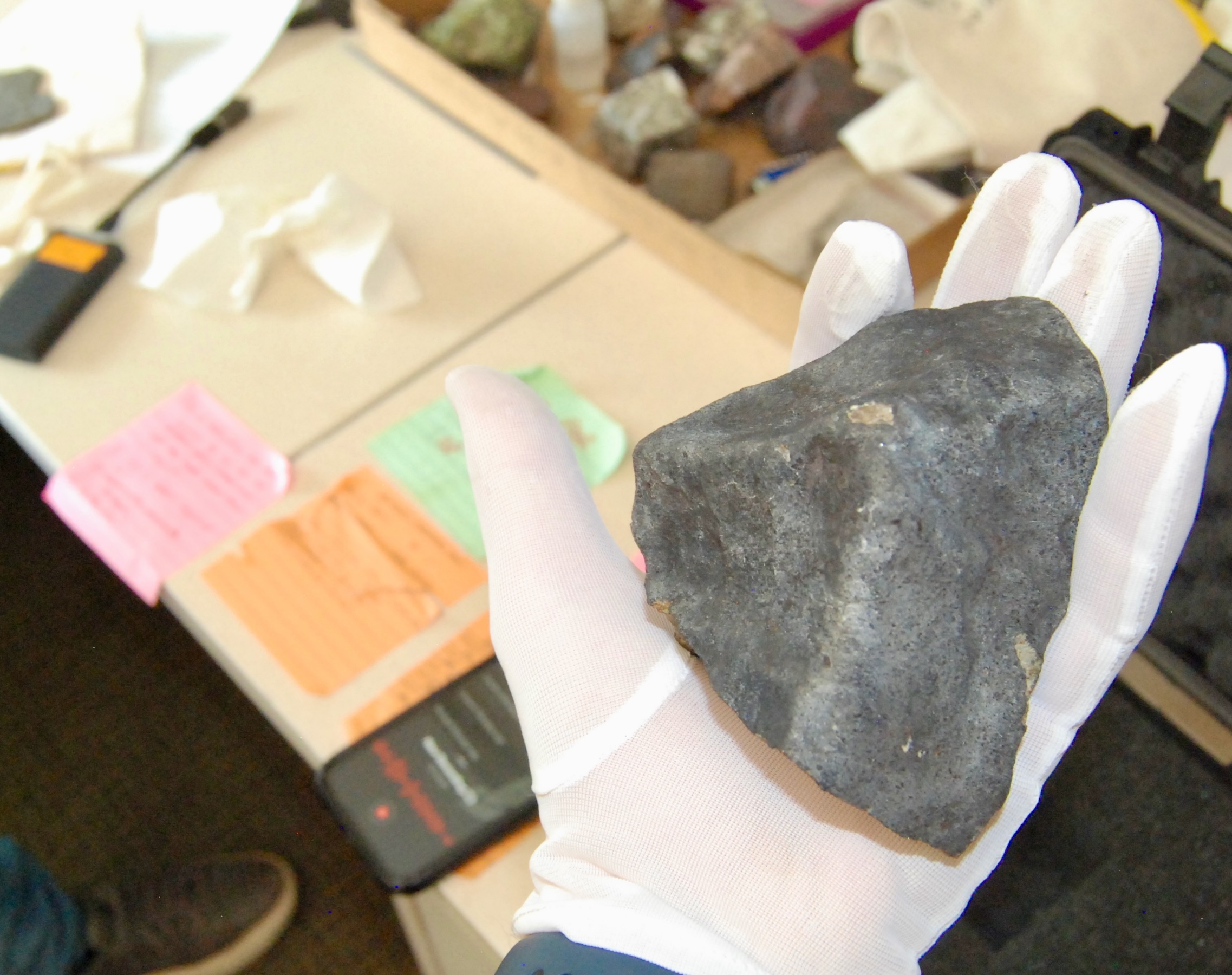
The largest recovered, a fist-sized object weighing 774 grams, was donated to the U by Arizona-based meteorite hunter Robert Ward, one of several who quickly responded to the widely witnessed meteorite fall in search of its remains.
This particular meteorite is a H5 chondrite, according to Karner, who is leading the U’s curation of the meteorite. The H indicates that it’s rich in iron, which comprises 15 to 19% of the meteorite by volume. It is completely blackened on the outside except on one section where a chunk had broken off on impact, revealing the black and white grainy silicate material, called chondrules, that the rock is made of.
“All these components, the iron-nickel metal, the sulfide grains, the chondrules, the matrix material, all came together in the early solar system and then were accreted to form a bigger body, such as an asteroid,” Karner said. The meteorite broke up and burned as it pierced Earth’s atmosphere.
“The drag of the atmosphere is basically melting a very thin layer of the exterior of the meteorite. When that lands on Earth, it quickly quenches to a glass, called a fusion crust. That crust is like an eggshell around these rocks. It’s very thin, like 100 microns,” Karner said. The outside is also covered in tell-tale thumbprint-like indentations, called regmaglypts.
“That’s also a consequence of the meteorite coming through the atmosphere, burning on select sides,” he continued. “It’s melting, and parts are being sloughed off, and it gets this nice smooth crust and regmaglypts.”
The Department of Geology & Geophysics unveiled the meteorite exhibit on Monday inside its main office, where there is an existing display containing other meteorites recovered over the years. A video display and other interpretive materials are to be added to the exhibit.
The office is located just off the Sutton Building’s second-floor lobby, known as the Confluence, a mini-museum in itself. That space, filled with displays of geological curiosities, is worth a visit for anyone interested in paleontology and Utah geology.
Banner photo: Jim Karner handles a piece of the Great Salt Lake meteorite now on display in the U’s Sutton Building. Photo credit: Brian Maffly.