
Now Reading: Magic: The Gathering Paid For Hasbro’s $56 Million Video Game Write-Down
- 01
Magic: The Gathering Paid For Hasbro’s $56 Million Video Game Write-Down

Magic: The Gathering Paid For Hasbro’s $56 Million Video Game Write-Down
Two Hasbro stories landed in the same week in July. Magic: The Gathering delivered the biggest quarter in its history. Hasbro wrote off $56 million tied to cancelled video games.
They were treated as separate developments. They belong in the same story.
Both numbers sit inside Hasbro’s Wizards of the Coast and Digital Gaming segment. Magic’s record quarter did not erase the failure of those digital projects, but it gave the division enough earnings power to absorb the charge without derailing its results.
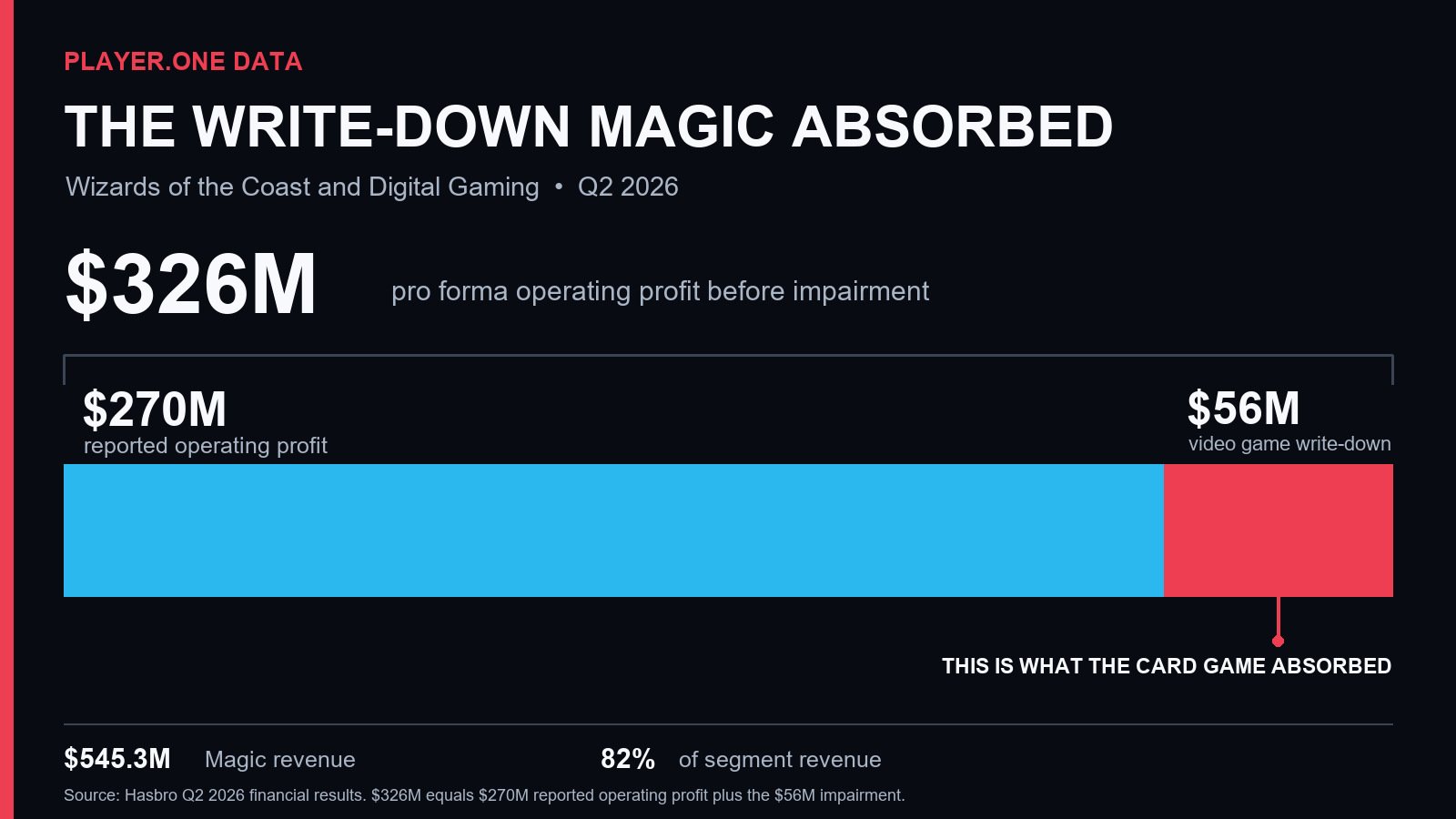
The segment reported $663.8 million in second-quarter revenue, up 27%, and $270 million in operating profit, up 12%. Hasbro said that profit figure included a $56 million non-cash impairment tied to its refocused digital-games portfolio for 2028 and beyond.
Magic supplied $545.3 million of the segment’s revenue. That means roughly 82 cents of every dollar in the division came from the card game. Hasbro’s filing contains the complete segment results.
What the charge obscured
The segment’s reported operating margin fell to 40.7%, from 46.3% a year earlier. On its face, that looks like deterioration.
But the impairment accounts for the decline.
Adding the $56 million charge back to reported operating profit produces approximately $326 million. On $663.8 million in revenue, that implies a margin of about 49.1%—nearly three percentage points above the prior-year result.
That is a simple pro forma calculation, not a company-reported adjusted figure. Hasbro left the impairment inside its segment results. Still, the calculation shows what happened underneath the charge: the division’s operating performance strengthened enough to absorb an eight-figure write-down and still report year-over-year profit growth.
That is what Magic provided—not immunity from failure, but the capacity to absorb it.
What Hasbro cancelled
Hasbro said it cancelled several games scheduled for 2028 and beyond after reviewing its digital portfolio. It did not identify every affected project.
The company is now concentrating spending on fewer titles with stronger franchise potential while reducing its overall digital cost base. Exodus and Warlock, both planned for 2027, remain in development. CEO Chris Cocks described them as Hasbro’s next major owned-game releases and said they meet the company’s new standard for audience potential, genre fit and opportunities beyond the initial game.
That distinction matters. Hasbro is not abandoning owned development in favor of licensing alone. Its stated strategy combines a smaller number of internally backed games with what management calls “partner-led economics.”
The company’s clearest recent successes support the partnership side of that model. Larian developed Baldur’s Gate 3. Scopely developed Monopoly Go!, which contributed $44 million to Hasbro’s second-quarter revenue. Meanwhile, Hasbro recorded a $56 million charge against capitalized costs for games it no longer plans to release.
The write-down does not prove that Hasbro cannot build or publish successful games. It does show what the company’s portfolio review cost—and why management is raising the bar for the projects that remain.
Where the money came from
Magic exceeded $500 million in quarterly revenue for the first time in its more than 30-year history. Revenue rose 32%, fueled by Secrets of Strixhaven and what Hasbro called the record-breaking debut of Marvel Super Heroes.
“The Magic flywheel is firing on all cylinders,” Cocks told investors.
Hasbro raised its full-year constant-currency revenue forecast to growth of 5% to 7%, from 3% to 5%. It also increased its adjusted EBITDA outlook to between $1.45 billion and $1.50 billion, from $1.40 billion to $1.45 billion.
A licensed cardboard crossover helped produce the record quarter in which Hasbro acknowledged that part of its video-game slate no longer justified continued investment. The two developments appeared in the same earnings release because they affected the same division.
Magic did not literally fund the cancelled projects, and an impairment is not a current-quarter cash payment. But Magic’s scale gave the segment room to recognize the loss without surrendering revenue or operating-profit growth.
The fair objection
Segment reporting is an accounting convention, not a record of which product paid which bill. Hasbro did not formally allocate Magic’s profits to the cancelled games. The businesses are grouped together because Wizards has housed the company’s digital-gaming operations for years.
Cancelling lower-conviction projects can also be evidence of discipline. The relevant costs had already been incurred, and continuing to spend money on games management no longer believed in would not have recovered them.
The charge is also modest beside Hasbro’s full-year EBITDA target. The company probably would have raised guidance even without it.
All of that is true. None of it eliminates the concentration risk.
Magic generated 82% of the segment’s quarterly revenue. Hasbro itself identifies the increasing concentration of its sales and profits in Magic as a business risk. Digital and licensed gaming grew 17% during the quarter, but at $135.5 million, it remains far smaller than the card game.
If Magic slows before the remaining digital portfolio produces another durable revenue source, future write-downs will be harder for the segment to absorb.
What would change this read
The next evidence will come from Hasbro’s third-quarter report, covering the first full quarter of Marvel Super Heroes on shelves.
If the Wizards and Digital Gaming segment sustains a strong margin without another impairment, the July charge will look like a contained portfolio cleanup. If Hasbro records additional charges, the refocus is still working its way through the slate.
The more important test arrives in 2027. Exodus and Warlock are the first major owned releases under the strategy Hasbro defended after taking the write-down. Their performance will show whether the remaining digital bets can become a second source of strength—or whether Magic must continue carrying the division.
Magic did not pay for Hasbro’s cancelled games in any literal accounting sense. It made the failure small enough to absorb.