

The map that makes neurons playable
Now Reading: Play a Video Game Against a Dish of Living Neurons: Intactis Bio Launches “Biostack”
1
- 01
Play a Video Game Against a Dish of Living Neurons: Intactis Bio Launches “Biostack”
Play a Video Game Against a Dish of Living Neurons: Intactis Bio Launches “Biostack”
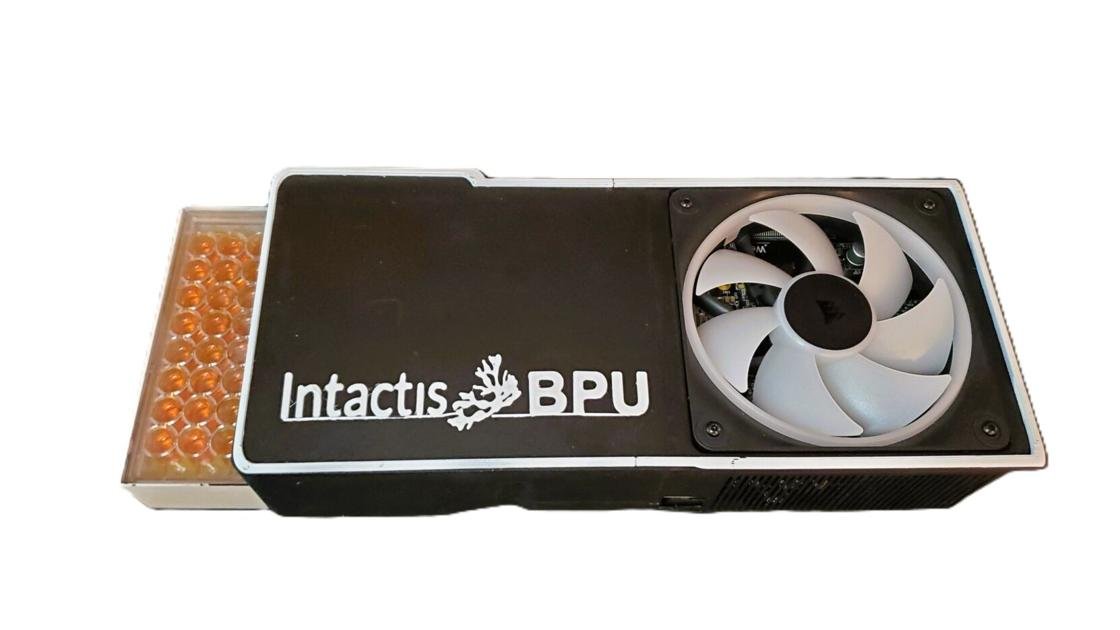
What makes the tissue controllable is a computational neuroscience model. Intactis ran a comprehensive screen to map how electrical stimulus drives neural outputs, cataloguing more than 150 statistically significant relationships and accounting for up to 96% of the tissue’s response. “Biocomputation is not a black box. We have the actual equation,” said Daniel Rodriguez-Granrose, PhD, Founder and CEO of Intactis Bio. This design space lets the company map neural responses onto specific game controls, so the biocomputer can directly learn the Biostack board state and ideal responses in a closed loop.
How a dish of neurons plays
Each turn, Biostack compresses the board (the current piece, the height of every column, and any gaps) into a compact code and delivers it to the tissue as a timed sequence of electrical pulses. The neurons respond, and the system reads their answer as a six-bit placement: four bits choose one of ten columns, two bits choose one of four rotations. Together this represents over 1000 unique electrical inputs to encode the board space and up to 40 possible destinations for every piece. Intactis has successfully transmitted this information to the neurons, and mapped their response back to the live game. In this demo, game performance held and even improved across overnight gaps between sessions. The living network is genuinely shaped by use.
The stakes reach well beyond the screen. AI’s appetite for electricity is on track to outrun global electricity production. A supercomputer can draw on the order of 20 megawatts; a human brain runs on about 20 watts. The company projects energy-cost reductions around 95%, total-cost reductions around 90%, and data center footprint reductions around 88% versus exaflop-scale silicon.
Related Posts



Previous Post
Next Post


Loading Next Post...