
Now Reading: The NFL’s Latest Offensive Trend Was Hiding in Plain Sight As It Swept the League in Week 1
- 01
The NFL’s Latest Offensive Trend Was Hiding in Plain Sight As It Swept the League in Week 1

The NFL’s Latest Offensive Trend Was Hiding in Plain Sight As It Swept the League in Week 1
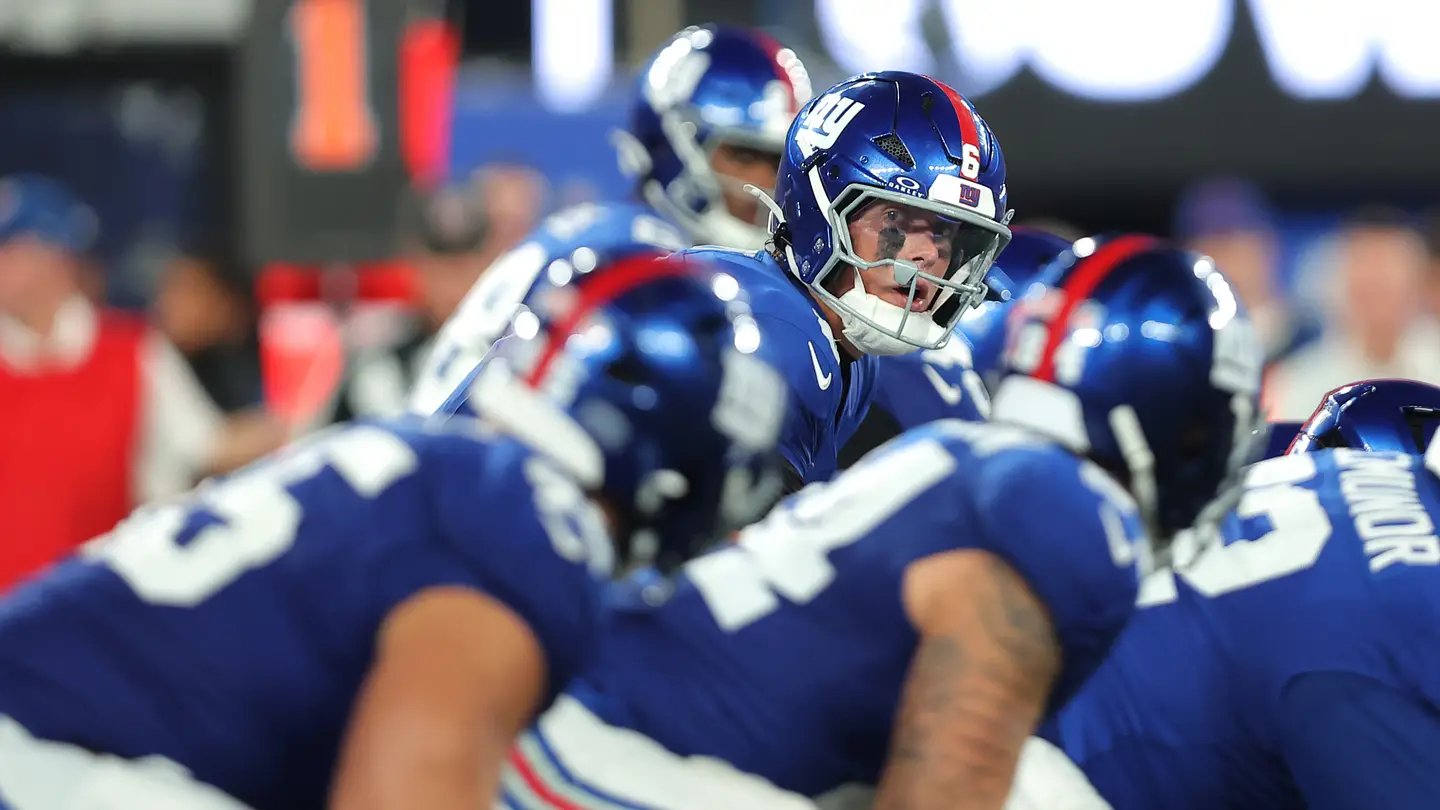
When I texted a longtime defensive coach about the proliferation of under center usage around the league in Week 1, the frustration was somewhat palpable.
“[It’s] a normal offensive play.”
I can imagine for someone who has been in the league for years, asking about a return to under-center football and talking about how cool it looks is a lot like dusting off your parents’ copy of The White Album and saying to them: “Hey, these guys were pretty good, ever hear of them?” The truth is that under-center play is not normal, at least not to some older millennials whose short-term recall dates back to the Air Raid-ification of the NFL and roughly a decade of football influenced by the various expressions of those offenses. In short, Patrick Mahomes comes out of Texas Tech, Andy Reid gets a copy of the playbook and turns his offense into a human laser show, the rest of the NFL follows suit and there’s absolutely no reason to force collegiate quarterbacks—who are always in the shotgun and creatures of comfort—to change their stripes and suffer through growing pains. Seriously, the under-center dropoff post-2017 is that notable.
In reaching out to experts around the league, one interesting nugget I stumbled upon was that we may have returned to under-center football sooner had it not been for coaches like Mike McDaniel, now the offensive coordinator of the Chargers. Back when McDaniel was the run-game guru for Kyle Shanahan, Jimmy Garoppolo, then San Francisco’s franchise quarterback, had dramatically better splits in the shotgun despite Shanahan desiring to run a more classic Kubiak–Shanahan–style, outside-zone offense. In 2019, Garoppolo was a top-seven quarterback in passer rating, completion percentage and on-target throws out of the shotgun, but bottom-12 in passer rating and completion percentage under center. So, McDaniel’s ability to retrofit some of the rushing concepts into a shotgun costume—as well as the strides being made in Baltimore’s Navy-ified rushing scheme with Lamar Jackson—made it convenient for coaches to crib those concepts and keep their passers in the gun, where heightened visibility leads to increased comfort for certain types of processors.
A look around the NFL after one week, starting with which offenses saw the biggest increase in under center rate (2026 Week 1 vs. 2025 average). 🧵 pic.twitter.com/sTxAse5yIP
— SūmerSports (@SumerSports) September 15, 2026
Of course, in Week 1 of the 2026 season, everything changed. Or, more accurately, we saw the summation of the seeds of change planted a year ago. The NFL saw its highest usage of under-center snaps since 2017. Ten teams, according to SumerSports, had at least a 10% increase in under-center usage and, for the first time since at least 2022—again, data from SumerSports—there was a positive EPA per play on under-center snaps collectively. The Jets, Ravens, Raiders, Jaguars, Falcons, Cardinals, Lions, Commanders, 49ers and Bengals all looked dramatically different and, perhaps not coincidentally, we saw the highest average scoring Week 1 since the AFL-NFL merger. We were one touchdown away from the highest point total in a Week 1 ever. Twelve teams took fewer than 50% of their snaps from the shotgun.
What it all means
• First off, why? The answer, according to another longtime NFL defensive coach, is simple: It really sucks to defend. In the shotgun, there is often a “double conformation” for the front seven as to what kind of play might be coming. First, in the shotgun, there are runs on the team’s playsheet that you cannot operate with both players starting yards from the center. Second, depending on which side of the quarterback the running back lines up on, you can further eliminate certain plays and focus on the probability that the offense is running a small subsection of its run package. Third, there are more notable offensive line cues in the shotgun, like how most teams often slide their center away from the running back, which is another tendency that became commonplace. Fourth, it is easier to get a catalog of the team’s personnel as they break the huddle. All of this makes life miserable for defensive tackles who now have less of a sightline and can get less of a jump on a given play.
Conversely, this means more realistic-looking play-action for offenses. According to statistician Neil Greenberg, passing plays over the past decade from the shotgun offered 0.05 EPA per play. Under center, it was 0.15 EPA per play. Coaches reviewing Week 1 film mentioned that even checkdown passes seemed more viable.
The other reason why we’re seeing a flood of under-center concepts? It’s hitting right now, and offensive coordinators are more shameless at plagiarizing material than an eighth-grader logging onto his ChatGPT account. During Ben Johnson’s first season with the Bears, he pushed Caleb Williams to an almost 50% under-center rate, finished the season with one of the best offenses in the NFL, and had the No. 2 explosive run game in the NFL. Johnson was one of the few play-callers who seemed to be truly thriving amid a league-wide defensive counterrevolution. Defensive coaches were figuring out how to mirror the magic tricks of their offensive counterparts by playing nearly all of their looks out of the same personnel package, as one NFL assistant told me. Houston, with Jalen Pitre and the linebacker-esque Kamari Lassiter; and Seattle, with the big nickel centerpiece Nick Emmanwori, embodied this shift.
Offensive coaches, who were scoring 2.55 and 2.56 touchdowns per game in 2024 and 2025, respectively—which was down from a stunning 2.88 total touchdowns and an all-time high 1.7 receiving touchdowns per game in 2020—began to accept the elephant in the room: We need to force these young quarterbacks to get uncomfortable. If Williams, who took eight—eight!—snaps under center in college, can become the poster child of the under-center revolution, what is anyone else’s excuse? The flashpoint moment, and the predictor that life may never be the same again, was seeing Fernando Mendoza play more snaps under center during his preseason debut with the Raiders than he did throughout the entirety of his year as Indiana’s starting quarterback.
• The change to under-center offenses has, as you would expect, produced some fascinating cat-and-mouse games. It is the norm now for defenses to come to the line with two play calls, depending on how a quarterback lines up. Coaches like Steelers defensive coordinator Patrick Graham utilized under-center looks to trigger calls like interior “A” gap pressures from linebackers, who rush the lanes opposite the center. In that scenario, a safety may then drop down to protect the middle of the field. A well-timed “A” gap pressure can sometimes neutralize a running back’s effectiveness in helping pass protect because, now that the quarterback is pressed up against the line and the back is yards behind him, he no longer begins the play with the posture of a personal bodyguard.
It is widely expected that we will see more “A” gap pressures now that under-center offenses are en vogue, which also means we’ll see more plays from the offense like “crack toss.” You can view an example of that here:
I’ve written a lot about Crack Toss in recent months
Great low red zone concept. pic.twitter.com/kesPmtUZvc
— Bobby Peters (@b_peters12) September 16, 2026
There is also a belief that five and six-man fronts, with bigger personnel forcing teams to retreat into the shotgun.
Because sightlines are harder for defenses in an under-center offense, another fun evolution has been teams getting more creative with the idea and keeping defenses from understanding their formation before the snap. The first play call in an NFL regular season game from new Ravens OC Declan Doyle utilized a slight tempo out of the huddle and into an under-center formation (it’s far easier to grasp from the behind view angle on the television copy, with the all-22 looking more like a stroll in the park), which scrambled Indianapolis’s front and—it seemed to me—prevented the Colts from getting into a secondary play call. Jackson played his most snaps ever under center on Sunday, and perhaps the effectiveness of this particular tactic will wane over time, with defensive coordinator Lou Anarumo being the unlucky soul who had to decipher it in the moment without any tape.
The Chiefs also tinkered with this idea on Monday night—though not quite under center—by placing Patrick Mahomes in a three-point stance in a condensed shotgun. Outside of it being a gigantic middle finger to every defense on Kansas City’s schedule—Mahomes was next to another quarterback, Justin Fields, also in a three-point stance, and now poses the question to every coordinator as to what indicators would result in Fields getting the ball and throwing it—it also prevented the defense from looking into the backfield and cutting down on the possibilities at hand. While goal-line defense is always a bit of a penalty kick scenario—guess the play, guess the gap and YOLO—not putting Mahomes in a true shotgun makes it even more of a guessing game.
#Chiefs HC Andy Reid said the trick play with Justin Fields and Patrick Mahomes together in the backfield, which resulted in a Kenneth Walker TD, came from Chris Berman. 😅🤣 pic.twitter.com/uCVEztPyHh
— Jordan Schultz (@Schultz_Report) September 15, 2026
• So what happens next? I call it the McVay and Shanahan question, and I wrote a little bit about that here. Before the summer ended, I talked to coaches who believed the effectiveness of the basic Shanahan and McVay offenses were waning. Not—let me be clear—Shanahan and McVay themselves, but the branches of the offense that were missing the single-most important ingredient: the brains of the actual play-callers.
Will the trend stick?
Week 1 is notoriously strange. And having that large gap in under-center usage from the previous season to this one—all but the Falcons and Commanders, the teams that had a 10% jump in usage, won—may have contributed to defenses on their collective heels and a spike in scoring. Of course, Ben Johnson was trying to hang 60 on the Panthers. Everyone already knew he’d be under center—and, according to one former coach who observed him, he has been deploying momentary glimpses of shotgun with tight ends split out wide to help him and Caleb Williams identify what calls the defense may have and how many bodies will be on their front before returning to under center—which speaks to how uncomfortable this feels for defenses in the moment.
But will it remain that way? The reason I bring up Johnson, McVay and Shanahan: Their offenses are beautiful and so well-thought-out. The creator can apply emergency fixes and adaptations because, in their own mind, the offense is a living, breathing entity. The borrower is less able to adjust when defenses finally put a foot down because, to them, it is a more rigid set of concepts that apply only to certain situations.
One of the defensive coaches I mentioned earlier suggested that, ultimately, quarterbacks and coaches return to what is comfortable and what they understand. Could a rash of “A” gap pressures this weekend force quarterbacks back to the bargaining table with their play-callers, begging not to get clocked the second the ball touches their hands (I would guess that Brian Flores’s serial killer defense may give us some answers against Ben Johnson this weekend)? Or will offenses more readily anticipate the anti-under-center measures being put in place and build in more counters? It will depend, again, on how deeply thought out the shift has really become. We’ve heard about more dramatic offensive changes from established play-callers like Kevin O’Connell and Zac Taylor than ever before. Are those aesthetic changes, or are those changes now root-deep?
Maybe for those who came to love football and truly dive into its intricacies before 2010 or so, all of this is another yawn. I, on the other hand, would argue that in this case, it’s not the NFL being cyclical, since many of the next-level presnap motion concepts and space-creating route concepts are now tied to more traditional under-center runs and passes. There are new chess matches. There are new games within games. And whether you’re hearing The White Album for the first time, or maybe the 10,000th time, it can still blow your mind.
 Add us as a preferred source on Google