
Now Reading: What Trump’s Executive Order Could Mean for Childhood Vaccines – time.com
- 01
What Trump’s Executive Order Could Mean for Childhood Vaccines – time.com

What Trump’s Executive Order Could Mean for Childhood Vaccines – time.com
Personalized Content
Follow this section to personalize your feed and get instant alerts.
WHY FOLLOW?
Update your preferences in Account Settings
Personalized Content
Follow this tag to personalize your feed and get instant alerts.
WHY FOLLOW?
Update your preferences in Account Settings
Personalized Content
Follow this author to personalize your feed and get instant alerts.
WHY FOLLOW?
Update your preferences in Account Settings
Health correspondent
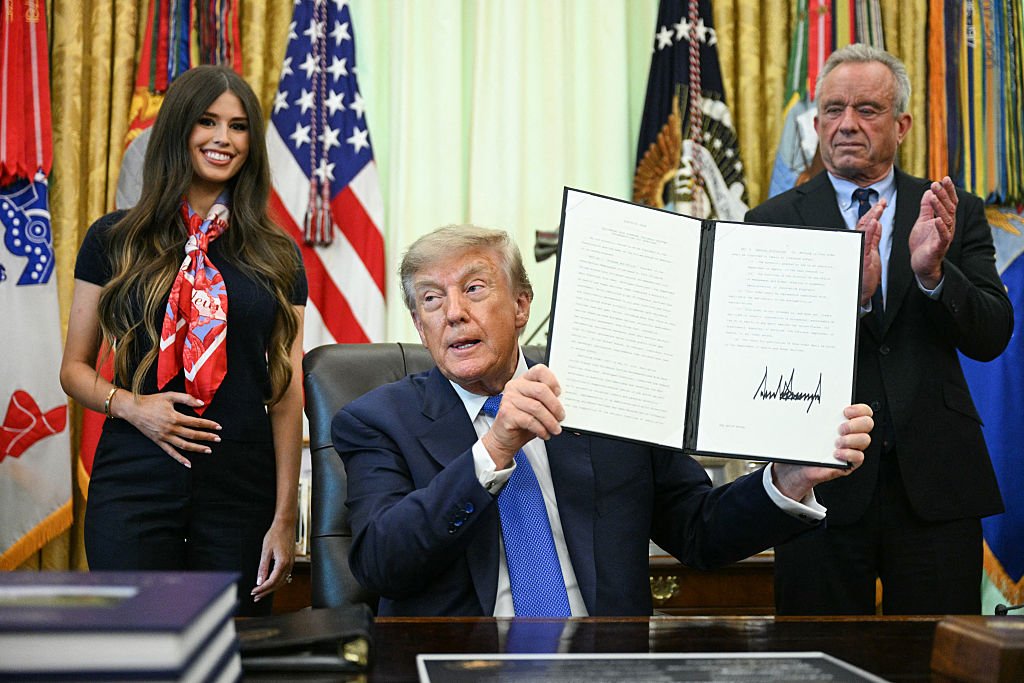
U.S. President Donald Trump signs an executive order calling for an overhaul of the childhood immunization schedule, alongside U.S. Secretary of Health and Human Services Robert F. Kennedy Jr. (right) and Jayme Leagh Franklin (L), founder of The Conservateur, in the Oval Office of the White House in Washington, D.C., on August 10, 2026.
Personalized Content
Follow this author to personalize your feed and get instant alerts.
WHY FOLLOW?
Update your preferences in Account Settings
Health correspondent
President Donald Trump has again taken aim at vaccines—this time in a new executive order. The directive, which Trump signed in the Oval Office on Aug. 10, calls for U.S. children to receive fewer vaccines and urges states to reconsider which vaccines they require for school attendance.
It also directs the U.S. Department of Justice (DOJ) to sue states that fail to provide religious and medical exemptions for mandated vaccines and orders the measles, mumps and rubella (MMR) shot—a combination vaccine that has been in use for more than 50 years—to be split into three separate jabs. “Today we’re proud to officially announce the United States of America’s gold-standard childhood vaccination recommendations,” Trump said during the signing ceremony.
Doctors and vaccine scientists have expressed dismay at the order, which they say is not backed by gold-standard science. "As measles cases reach a 35-year high in the U.S. and with cold and flu season quickly approaching, [the] executive order on vaccines is not only disheartening but dangerous,” Dr. Andrew Racine, president of the American Academy of Pediatrics (AAP), said in a statement. “There is no new evidence to justify significant changes to childhood immunization guidance.”
But will the executive order actually change what vaccines are available to children? Probably not, legal scholars and medical experts say.
Still, it could put pressure on states to change their vaccine recommendations and requirements. It could also have a chilling effect on vaccine uptake. “This is going to create confusion and chaos,” says Dr. Paul Offit, a pediatrician and director of the Vaccine Education Center at the Children's Hospital of Philadelphia.
The executive order calls for a significant overhaul of the federal childhood immunization schedule—the timeline of recommended vaccines for children and teens that influences insurance coverage guidelines, informs state-level school vaccine requirements, and guides clinical practice. But the order shouldn’t have the legal power to make those changes, says Dorit Reiss, a vaccine policy expert at the University of California College of the Law, San Francisco.
Executive orders are a way for presidents to communicate with federal agencies. They can instruct agencies on how to enforce existing laws, but they aren’t laws themselves, Reiss says.
Federal vaccine recommendations are also developed through a separate legal process, never by executive order.
Instead, it is the U.S. Centers for Disease Control and Prevention (CDC), following input from the Advisory Committee on Immunization Practices (ACIP), that determines the childhood immunization schedule.
Advertisement
In January, the CDC, prompted by an earlier presidential memorandum and under direction from U.S. Health and Human Services Secretary Robert F. Kennedy Jr., attempted to revise the childhood immunization schedule. The updated schedule reduced the number of routinely recommended childhood vaccinations from 17 to 11. The six vaccines no longer recommended to all children were for COVID-19, seasonal flu, hepatitis A, hepatitis B, respiratory syncytial virus (RSV), and rotavirus. The six vaccines were only recommended for children at high risk for the respective diseases, the guidelines said. Parents, however, could decide, after consultation with doctors about the benefits and risks of the vaccines, to inoculate their children against any of the six diseases.
A federal judge blocked the CDC’s schedule overhaul, which had been done without consulting ACIP, in March. The judge said it was unlawful for the CDC to unilaterally make those changes without ACIP’s involvement.
Advertisement
Trump in his new executive order called for similar changes to the childhood immunization schedule that the CDC tried to implement, and said he was “taking further action to reaffirm” the changes to the schedule in light of the ongoing litigation.
The CDC’s new director, Dr. Erica Schwartz, could face pressure to act on Trump’s executive order, Reiss says. Schwartz said in her Senate confirmation hearing that she believes in the safety and effectiveness of vaccines, though she wouldn’t commit to standing up to the president or Kennedy if she disagreed with them.
If Schwartz and the CDC attempt to change the schedule again, however, they will likely face similar legal challenges as before since the proper legal process again wasn’t followed, Reiss says.
“The executive order doesn’t have the rule of law behind it,” says Offit. “Nothing will come of this.”
The federal childhood immunization schedule remains the same as it was in July 2025, which recommends routine vaccines for 16 diseases. COVID-19 vaccines for healthy children are recommended based on shared decision-making between families and clinicians, rather than routinely for all children.
Advertisement
The AAP disagrees with this recommendation and says all young children ages 6 months to 23 months are at high risk for severe COVID-19 and should be vaccinated.
Insurance companies continue to cover all vaccines in the AAP vaccine schedule, including COVID-19 shots.
The executive order calls for the measles, mumps, and rubella (MMR) vaccine to be separated into three shots. Before signing the order, Trump said, without evidence and contrary to decades of established scientific evidence, that “together, there could be a possibility they’re quite lethal.”
Doctors say the MMR vaccine has an excellent safety record and is highly effective.
“These vaccines have been delivered together in millions of doses for decades,” says Dr. William Schaffner, professor of infectious diseases at Vanderbilt University. “No data was presented to suggest that administering them separately is safer than administering them together. There’s no scientific basis for this.”
Advertisement
The MMR vaccines were originally licensed as separate vaccines in the 1960s, but they were combined and approved as a combination vaccine in 1971.
It would be time-consuming and expensive to license the shots separately again, Schaffner says. It would also mean more shots for children, more work for doctors, and higher costs for insurance companies.
The executive order continues to recommend the MMR vaccine for all children, but talk of splitting the shot could cause confusion among parents, Schaffner says. “I can imagine parents going to the pediatrician and asking, ‘Can we do this one at a time? I saw on television that it’s now recommended.’”
The U.S. is currently experiencing a record-breaking measles surge. More than 2,400 measles cases have been confirmed in the U.S. so far this year—a 35-year high.
There is one section of the executive order that might have teeth, says Reiss, the law professor.
Advertisement
The order directs the DOJ to support or pursue lawsuits against states that fail to provide adequate religious and medical exemptions for school vaccine mandates, and tells the Department of Education to cut grants to those same states, Reiss says. States, not the federal government, determine which vaccines are required for children to attend public schools.
There are already lawsuits related to vaccine exemptions in several states, including California and West Virginia, Reiss says. The DOJ could choose to throw their weight behind existing lawsuits or launch new ones, she says. “The government can be influential in courts, especially the Supreme Court,” Reiss says.
The executive order could also more generally put pressure on states, particularly ones that lean Republican, to dilute their own vaccine recommendations and mandates. “The real political play will be at the state level,” Reiss says.
Advertisement
Doctors say they most fear what the executive order will do to increase vaccine hesitancy and uncertainty.
“This action follows an alarming pattern of government efforts to reduce Americans’ access to vaccines and sow unfounded doubt about vaccine safety and effectiveness,” said Dr. Ronald G. Nahass, president of the Infectious Disease Society of America, in a statement.
Though the executive order doesn’t mention autism, Trump cited rising autism rates as a reason for the changing recommendations during the signing ceremony. “Decades ago, children received only a small fraction of the vaccines required today,” Trump said. “In those times, people were much healthier, and of course, the high rates of autism now observed did not exist.”
Trump also claimed that children receive vaccines the size of a “bottle of soda."
Shots contain no more than a teaspoon of liquid, Offit says, and usually contain a fraction of that. “This is so embarrassing for this country,” he says of Trump’s comments.
Advertisement
He added that decades of robust studies have refuted any link between autism and vaccines.
Kennedy and Trump have nonetheless repeatedly suggested a connection.
“Kennedy is an antivaccine activist. As the secretary of the health department, you would think that he would care about the health and wellbeing of children in this country, but he doesn’t,” Offit says. “And he’s winning—now we have more cases of whooping cough, flu, and measles in children than before.”
© 2026 TIME USA, LLC. All Rights Reserved. Use of this site constitutes acceptance of our Terms of Service, Privacy Policy and .
TIME may receive compensation for some links to products and services on this website. Offers may be subject to change without notice.
This site is protected by reCAPTCHA and the Google Privacy Policy and Terms of Service apply.