

Now Reading: Christopher Nolan’s new film is causing a major controversy because of its filming location
- 01
Christopher Nolan’s new film is causing a major controversy because of its filming location

Christopher Nolan’s new film is causing a major controversy because of its filming location
Here’s what it’s all about
- Christopher Nolan’s new film, *The Odyssey*, has been a long time coming.
- Not least because he had already faced criticism leading up to its release. Among others, Elon Musk called the film “too woke” on X.
- But now it’s not Musk who’s causing a stir, but the renowned Sahara Film Festival, FiSahara.
- This calls for a boycott because of a filming location Nolan used.
- This is a territory that has been occupied by Morocco for decades in violation of international law.

Christopher Nolan’s new film, *The Odyssey*, has been in theaters for just under two weeks. It tells the story of Odysseus’s perilous journey home after the Trojan War, during which he must confront mythological creatures, gods, and his own guilt in order to return to his wife Penelope and his son Telemachus.
Even before its release, the film had already faced quite a bit of criticism, including from Elon Musk. The Tesla founder described the cast on X as too “woke.”

Lupita Nyong’o plays Helena in “The Odyssey.”
Captive Camera/Cover Images
He took issue with the fact that the role of Helen was not cast with a white actress, but rather with the U.S. actress Lupita Nyong’o, who has Kenyan roots. That is, as the wife of the Greek king Menelaus, who was descended from Zeus, the father of the gods, was abducted to Troy, and was considered the most beautiful woman in the world in ancient times.
Musk called the casting an “insult to the author.” The tech billionaire reinforced the post with the comment that Nolan had “lost his integrity.” When another X user made a transphobic joke about Elliot Page—who plays the character Sinon in the film—Musk praised it as a “banger.”
By the end of the year, Musk plans to create his own odyssey with the help of his own AI, “Grok.”
Before this year ends, Grok Imagine will make a full-length movie of The Odyssey that is historically accurate and true to the art of Homer https://t.co/bVHzUmY9WN
— Elon Musk (@elonmusk) July 22, 2026
First, criticism of the details; then, praise for the big picture
Other hateful comments focused on the actors’ English in the trailer, which was said to have an American accent. Criticism was also directed at the Greek ships, which some felt resembled Viking ships, as well as the design of certain suits of armor, which some considered un-Greek.
When the film was finally released, the reviews were more positive than expected. The “New York Times” praised “The Odyssey” as a grand, intelligent, and meticulously crafted film that transforms Homer’s epic into a modern cinematic experience.
Also, “Spiegel” review is positive. The film is described as an obsessive drama about men, carried by an “antihero driven by self-loathing.” At the same time, the review states that the early criticism was exaggerated and that the film is being unfairly disparaged.
Sahara Film Festival Calls for a Boycott
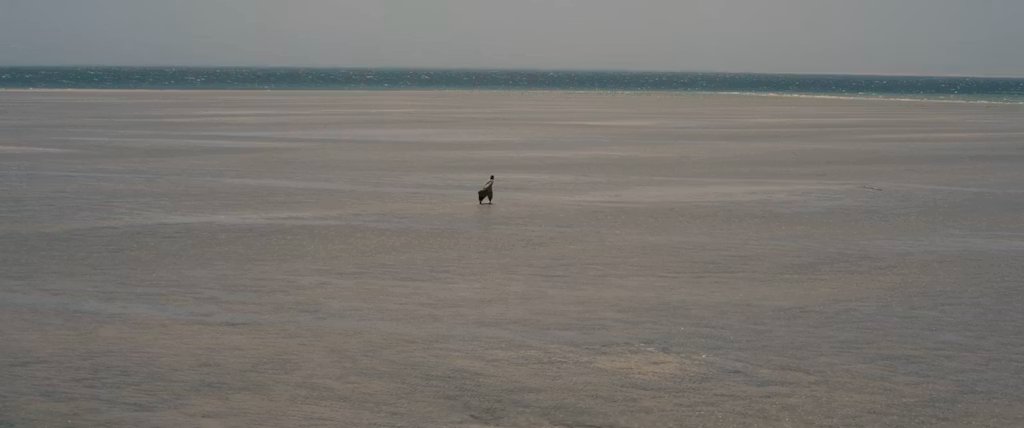
But now, calls are being made to boycott the film, including by the renowned Sahara Film Festival, FiSahara. Activists are also joining the effort. The reason is a filming location for the blockbuster: Some of the scenes were shot in Western Sahara, a territory disputed under international law that has been occupied by Morocco for decades. Filming took place over four days near the white dunes of Dakhla.

The Sahara Film Festival is calling for a boycott.
Screenshot Festival Sahara
The festival accuses director Christopher Nolan of violating international law and the Sahrawi people’s right to self-determination with his decision.
This right stipulates that a people may freely choose its political status and independently shape its economic, social, and cultural development.
Lines of Conflict for Decades
Since Spain’s withdrawal in 1975 and the end of colonial rule, Morocco has controlled most of Western Sahara and has regarded the territory as an integral part of its national territory ever since. Internationally, however, this claim is disputed.
At the same time, the left-wing liberation movement, the Polisario Front, has been fighting for the independence of Western Sahara for decades. It initially waged war against Morocco and Mauritania, receives political and logistical support from Algeria, and claims to represent the interests of the Sahrawi people.
Today, about 80 percent of the territory is under Moroccan control. This includes most of the major cities along the Atlantic coast, as well as the economically significant phosphate deposits.

Map of Western Sahara. The film was shot partly in Dakhia.
Wikipedia
The remaining portion in the east is administered by the Polisario Front, but it has poorly developed infrastructure and is barely economically viable. The two areas are separated by a sand wall over 2,000 kilometers long—built by Morocco and secured by military forces—that stretches across the desert.
Fewer and Fewer Indigenous People
For the Sahrawis, the indigenous people of Western Sahara, the situation is steadily deteriorating. They now make up less than one-sixth of the approximately 600,000 residents. The majority are immigrants from Morocco.
There are now more Sahrawis living in refugee camps on Algerian territory than in their actual homeland. Those who have remained in the Moroccan-controlled part repeatedly report instances of repression and intimidation, as several media outlets and human rights organizations have reported. Even local filmmakers can hardly shoot freely on location.
The UN also considers Western Sahara to be a “territory where the decolonization process has not been completed.”
Referendum Blocked for Years
A referendum on self-determination should actually have taken place years ago. However, it was never held because Morocco and the Polisario Front have still not been able to agree on the conditions and the voter rolls.
The Polisario Front demanded that only indigenous Sahrawis from the Spanish colonial era and their descendants be allowed to vote. Morocco demanded that additional people be included. Since the indigenous population is dwindling and the number of Moroccans is rising, it is difficult to determine who is eligible to vote in a way that ensures a fair election.
However, the unresolved referendum issue was not without consequences and brought the conflict more firmly into the spotlight of international politics: In 2020, under Donald Trump, the U.S. government caused a diplomatic upheaval by recognizing Moroccan sovereignty over Western Sahara.

In 2025, Moroccans will celebrate the 50th anniversary of the 1975 Green March in the Western Saharan city of Laayoune. That was when Morocco’s claim to Western Sahara began. At the same time, a new UN resolution cites Morocco’s autonomy plan as a possible path to resolving the conflict.
Environmental Protection Agency
The move came as part of the rapprochement between Morocco and Israel and drew international criticism because it shifted the status of the territory in Rabat’s favor without resolving the issue of the Sahrawi people’s self-determination. At the time, observers accused Washington of undermining international law and further exacerbating an already deadlocked conflict.
The decision remains particularly controversial because the United Nations continues to treat Western Sahara as an unresolved decolonization issue. When the U.S. recognized Moroccan sovereignty over Western Sahara in 2020, it put pressure on those who have been insisting for years on a referendum on the territory’s future.
In 2025, the debate gained new momentum when the UN Security Council, in Resolution 2797, established the Moroccan autonomy plan as the basis for negotiations. Although the text received the support of 11 of the 15 members, it was sharply criticized for a lack of neutrality and for discriminating against the Polisario Front.
Financially, filming in Morocco can be worthwhile
And right in the midst of this tense conflict, a Hollywood movie has now been filmed there. María Carrión, director of the Sahara Film Festival, draws a comparison: The public should treat the film as if it had been shot in a Russian-occupied region of Ukraine—such as the Donbas—with the consent of the Russian government.
The film festival accuses the film crew of contributing to the normalization of the political situation through their filming. Dakhla is considered a prestigious project for Morocco, specifically marketed for tourism, sporting events, and international film productions. Morocco’s Minister of Culture, Mehdi Bensaid, stated at the time that the film would raise the region’s profile worldwide.
Financially, filming in Morocco could also be worthwhile for “The Odyssey”: International productions receive a 30 percent rebate on their costs if they invest at least one million U.S. dollars and film in the country for at least 18 days. This rule also applies to Western Sahara. The Moroccan Film Center CCM treats the region the same as other parts of the country and refers to it as the “southern province.”
Nolang has not yet commented on the calls for a boycott—and it is unclear whether he will comment on them at all.