
Now Reading: MedCity FemFwd: How Midwives Can Support the Maternal Health Crisis
- 01
MedCity FemFwd: How Midwives Can Support the Maternal Health Crisis

MedCity FemFwd: How Midwives Can Support the Maternal Health Crisis
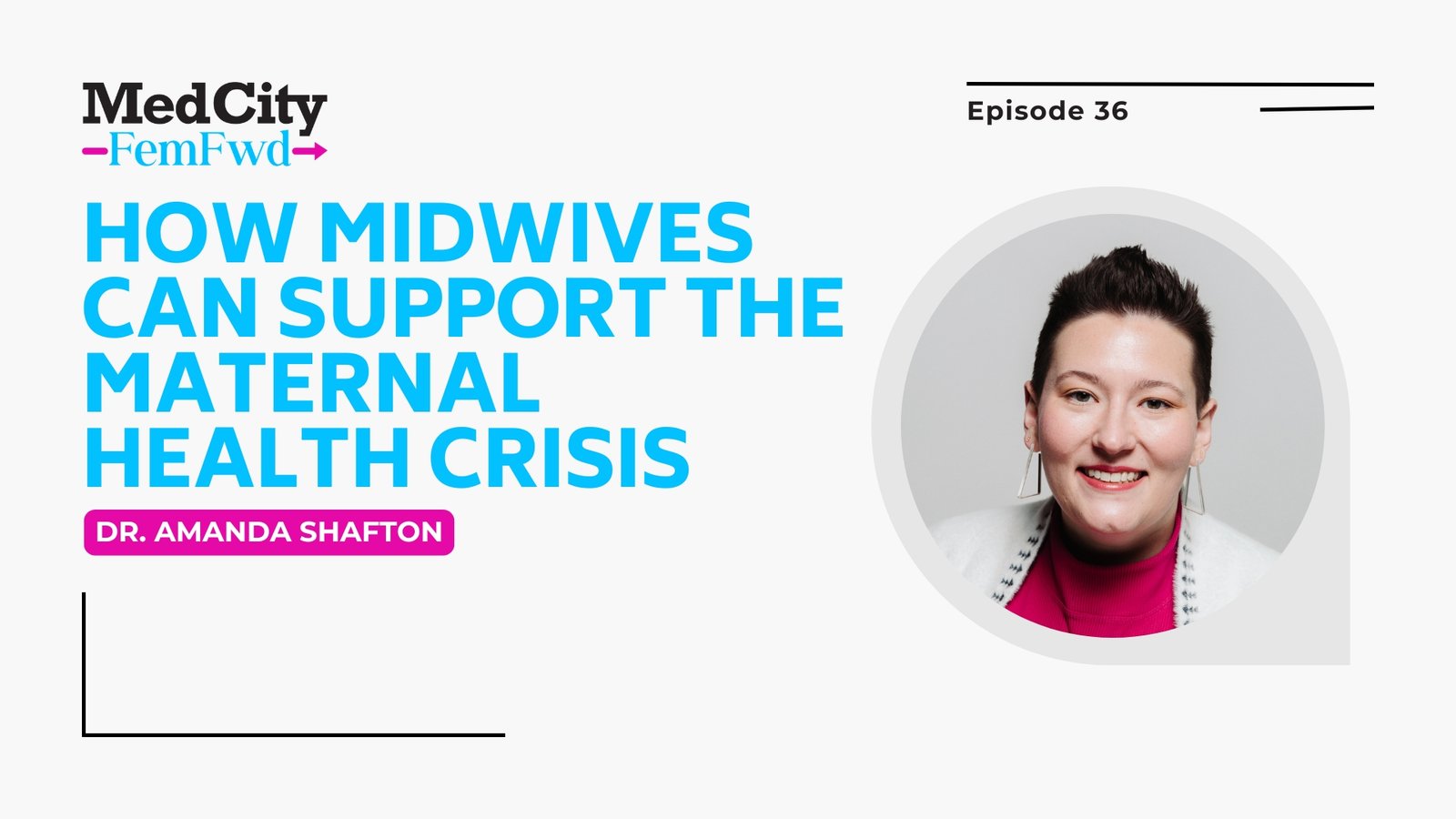
Welcome back to another episode of MedCity FemFwd, a podcast dedicated to exploring the breakthroughs and challenges in women’s health. In this episode, we’re joined by Amanda Shafton, practicing CNM and national director of midwifery at Ob Hospitalist Group.
We discuss the benefits of physician/midwifery collaboration and how midwives can improve maternal health outcomes.
Here is an AI-generated transcript of the episode:
Marissa Plescia: Welcome back to MedCity FemFwd. I’m Marissa Plescia, reporter for MedCity News. In this episode, we’re joined by Dr. Amanda Shafton, practicing CNM and National Director of Midwifery at OB Hospitalist Group. We discuss the role that midwives can play in improving maternal health outcomes
Hi, Dr. Shafton. Thanks so much for joining MedCity FemFwd.
Dr. Amanda Shafton: Hi, Marissa. It’s so nice to see you. Thanks for having me. Yeah. Please call me Amanda.
Marissa Plescia: Of course. Well, Amanda, can you tell me a little bit about yourself and your work?
Dr. Amanda Shafton: Yeah, I’d be super excited to. So my name’s Amanda Shafton. I am a certified nurse midwife.
I practice as a midwife hospitalist in Austin, Texas, and I get the honor and the privilege to work with OBHG Obstetrics Hospitalist Group, which is the largest employer in the country for obstetricians and midwives to be able to add services to different hospitals, um, and different communities across the country.
So I work to add midwife hospitalists in programs that we already have or in new programs, and also to examine how to add midwives into clinic spaces, and I always think the answer is more midwives. So more midwives all the time.
Marissa Plescia: Ah, yeah, that’s great. And going off of that, um, you know, what we’re talking about today is collaboration between physician and midwives.
Can you just tell us a little bit, um, about what this care looks like for patients?
Dr. Amanda Shafton: Absolutely. So we are really passionate at OBHG about collaborative team-based care. And so the idea for us is making sure that all of the patients are seen as OBHG patients. It’s really our job as the hospitalist team to be the safety net for the hospital.
So we like to ensure that we are the backup for any of the private physicians or private midwives that are caring for patients in those hospitals or in those communities. And then, of course, we usually take care of anybody who maybe doesn’t have a private practitioner, whether they haven’t had prenatal care during their pregnancy, or maybe they’re on vacation.
I see a lot of people in Austin who are here for a visit and then end up needing some type of care, and so our team takes care of them. And I say team because that team-based care is so important. So it’s not a midwife-only patient or a doctor-only patient. All the patients are cared for collaboratively by the team.
That usually includes a physician and a midwife. We find that when we look at our data at OBHG, our teams that have a doctor and a midwife outperform all other versions of our teams because there is something really magical about that collaborative care of bringing obstetrics and midwifery together to care for people.
Marissa Plescia: Yeah. In this kinda team-based model, is there ever any inclusion of doulas as well?
Dr. Amanda Shafton: Absolutely. So usually doulas are hired by the pregnant people. Usually that’s somebody that they’ll pick throughout their pregnancy journey who they have a bond with. And so then that person is there to support them physically, emotionally, help to advocate for them and ask questions.
And so then we as their team taking care of them, the obstetrician, the midwife, the nurse work with the doula as part of kind of, again, this idea of like surrounding that person with a community that all have the same desire for a great outcome for, for that patient and their family.
Marissa Plescia: Thank you. Yeah, and so what are some of the benefits to this kind of physician-midwife collaboration for the patient?
Dr. Amanda Shafton: Absolutely. So midwifery is based in the, the fundamental knowledge that pregnancy and birth is often a normal part of a reproductive journey for a, for a pregnant person. And so we really see the opportunity to provide education and support and care for, for pregnant people throughout that process. So it’s a s- it’s a little bit more of a wellness model than maybe typically, um, obstetricians are, are taught in a, a little bit more of a medically minded model.
So I always say that, uh, we’re experts in normal. So midwives typically have, um, higher rates of successful vaginal births, higher rates of successful vaginal births after cesarean sections or a VBAC. Um, we usually have less interventions in our care because we try to harness that natural process the best that we can, and of course, use medical interventions as needed.
Um, most of us who are hospitalist midwives are caring for higher risk individuals, medically more complicated people, um, throughout their, throughout their pregnancy and then their birth and their postpartum course. And so those medical interventions are super important, whether we need to use Pitocin to help labor progress or if a patient wants an epidural for their, for their pain management.
But it’s just being smart about the use of those interventions, and what’s– what I’m super passionate about and midwives are in general is just really making sure our patients have had the time to ask all the questions and feel really well informed so that they are the, the decision makers in their process.
Because at the end of the day, it’s not my baby and it’s not my birth. I want that person who’s having the baby, um, and that family to really make those decisions about what feels right for them.
Marissa Plescia: Yeah, well said. Um, and how extensively is this kind of model and this care really offered once?
Dr. Amanda Shafton: So we’re really proud at, um, OBHD to employ a very large number of midwives.
We have over three hundred and fifty midwi- full-time midwives across the country working with us in a variety of different settings. When I add our folks who aren’t, um, full-time and who are maybe, like, kind of PRN or part-time, that number gets closer to five hundred, which is super, super exciting. Like I said, I think midwifery is always the answer.
More midwives, uh, improve culture, they improve outcomes for patients, they improve satisfaction for nursing staff, and then they also improve the, the work-life balance for our physician collaborators as well. We know, and I’m sure you’ve talked about on your podcast, that there is this, this looming maternal healthcare crisis that is already happening, but is only gonna get worse as we have less people choosing to become OBGYNs, as we have, um, you know, more rural hospitals that are closing and forcing people to travel farther and farther for their prenatal care and for their birth care.
And so the idea of making sure that we have a workforce that includes midwives and physicians is then able to have ideally a longer time in full scope practice. So I, I think it’s the right answer for every single person. I would love to have a midwife at every hospital where babies are being born, at least one, if not more.
Um, but it, it’s been a challenge in the United States. Midwifery in general is a challenge, and so getting e-accepted into knowing that this is a normal part of a practitioner that cares for, uh, women during their lifespan and during pregnancy, and then getting buy-in from our physician colleagues and our hospital administrators and everybody else who works within that big system to take care of people.
Marissa Plescia: Yeah, absolutely. And going off of that, um, can you talk a little bit more about how this kind of care can support rural and underserved populations, but also some of the barriers to accessing this kind of care?
Dr. Amanda Shafton: Yeah, absolutely. I think midwives are uniquely positioned to provide that type of healthcare in rural settings.
Often most m- most hospitalist midwives ha- are nurses first and have practiced as nurses, although plenty of midwives, um, become CNMs because they wanna be a midwife and haven’t necessarily worked as a, as a nurse or a labor and delivery nurse. But often the folks that I work with have felt this was sort of a calling where they were a nurse, they’ve been working in a hospital in their community, and they see a need for providers, and so they can…
they then choose to go back for a master’s degree or a doctorate in midwifery to focus on caring for pregnant people. So the idea of educating people who already live in those communities and already have that connection i- is really exciting and important. The pathway to educating a certified nurse midwife is a shorter pathway than a physician who go, you know, goes through medical school and residency and potentially fellowship.
And so m- midwifery is kind of uniquely positioned to then be able to, to fill those gaps. It also expands the pool of practitioners. So again, if we think of this collaborative model of recognizing that we need the right healthcare provider for the right patient at the right time, we can recognize that sometimes that’s an obstetrician, sometimes that’s a high-risk obstetrician, a maternal fetal medicine specialist, and sometimes that’s a midwife, and that often throughout a person’s pregnancy and throughout their labor and delivery, all of those people are important and can kind of flow with the patient to provide that best care.
And so recognizing that by looking at not just OBGYNs, but also looking at midwives, looking at nurse practitioners, looking at other advanced practice providers, can help us to really fill that need and fill those gaps in those communities.
Marissa Plescia: Yeah, absolutely. And what, what does, um, insurance coverage really look like for midwife support right now?
Dr. Amanda Shafton: Yeah, so insurance, it, for the most part, has caught up to y- uh, supporting midwifery care. So if you are pr- if you are pregnant and you are coming into the hospital, um, labor and delivery to be seen in our triage department or obstetrical emergency department, you often will be cared for by a midwife a- automatically or a physician, and the insurance doesn’t care what type of provider is taking care of you as long as you’re getting that good care.
So that reimbursement from an insurance standpoint, whether somebody has private insurance or public insurance, is covered. The, the times where that’s more of a challenge for people is when people are choosing to do community-based birth, either in birth centers or in their own homes. That’s not something we do at OBHG.
We’re a hospitalist-based, um, organization, but that can be a little more challenging for individuals. Um, but speaking of community birth, it’s something that we feel really passionate about at OBHG, that we wanna make sure that we’re supporting those individuals who are, are choosing to birth outside of the hospital for the times where they need that escalated care.
When somebody needs a higher level of care, and they need to transfer to a hospital for a variety of different reasons, that we’re a safe place for them to land, especially when there’s a midwife-to-midwife transfer. That can be really nice for patients to know when their plan changes, and all of a sudden they’re in an environment and having interventions that they weren’t planning on, to know that there’s a midwife as part of their team is, is usually a really, a really nice thing to offer to people.
Marissa Plescia: Yeah, absolutely. Well,
Amanda, I just have one last question for you. Um, what can be done to further expand access to midwifery support?
Dr. Amanda Shafton: Oh, that’s my favorite question. So number one, we really have to continue to get the word out about what is a midwife and why midwifery care is so important. So at OBHG, we’re really proud to continually, uh, access data from all of our healthcare providers to be able to prove that not only is midwifery care safe, it’s actually this team-based care is even better.
Our programs that have a midwife and a doctor actually outperform our programs that have two physicians because there really is something magical about this care that, that is collaborative, that is respectful, that is recognizing that midwifery and obstetrics are both really important for pregnant people.
So number one is getting the word out so that patients know that this is something that they can advocate for, that they can ask their hospitals, that they can ask their OBGYN providers, “Do you work with midwives? Are midwives part of your care team?” And also, do you have a hospitalist program? Because that’s important when somebody is choosing a provider and choosing a hospital, um, to give birth at.
You should know w- who are the people that might take care of you. Is your doctor gonna be there twenty-four/seven? S- that’s not usually possible for people. And so then who is gonna help fill that time if your provider needs to be in two places at once or, you know, gets to go on a vacation or something like that.
So educating the public about midwifery and the fact that there are really excellently trained midwives who are hospitalists who want to provide that care for them is kind of a first piece. And then I think another piece in the puzzle is definitely continuing to have organizations like OBHG that are doing some of the legwork to have that partnership and that collaboration between midwives and physicians to ensure best outcomes.
So we help for… We help the hospitals to, if they’ve never had midwives before, what does that look like to have privileges as a midwife? That’s where I get to come in and answer some of those kind of nitty-gritty questions. So just more advocacy, more outreach, um, I think is, is the answer.
Marissa Plescia: Yeah, so well said.
Amanda, this has been such a great conversation. Thank you so much for joining MedCity Fem Forward.
Dr. Amanda Shafton: I’m so excited to be here and really appreciate all the work that you’re doing, so thanks for having me.