
Now Reading: Wisconsin Democrats hope for a trifecta in November elections
- 01
Wisconsin Democrats hope for a trifecta in November elections

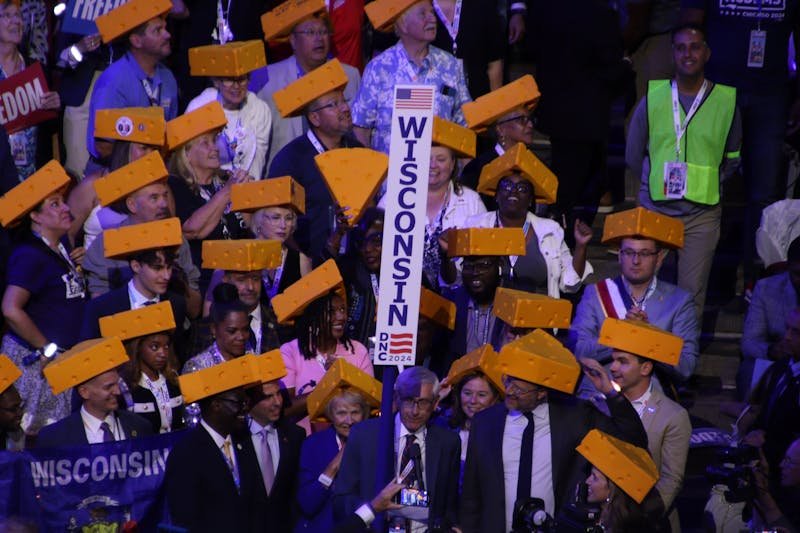
Wisconsin Democrats hope for a trifecta in November elections
Wisconsin government has been divided for the past seven years. This November, things could change.
Republicans have held a tight grip on the state Legislature since 2010, and the party controlled the Capitol until Democratic Gov. Tony Evers narrowly defeated former GOP Gov. Scott Walker in 2018.
Now, Wisconsin Democrats are hoping for a trifecta: control over the Assembly, Senate and governor’s seat.
A split government makes it hard for either party to pass legislation; Evers frequently vetoed Republican-backed bills, while the Democratic agenda stalled in the GOP-controlled legislature.
Democrat Milwaukee County Executive David Crowley and Republican U.S. Rep. Tom Tiffany will face off for the governor’s seat in the Nov. 3 general election.
Crowley previously served in the Assembly from 2017 to 2020 and won Evers’ historic endorsement in the primary. Tiffany has represented Wisconsin’s 7th congressional district since 2020 and served in the Wisconsin Legislature from 2011 to 2020. Crowley narrowly defeated State Rep. Francesca Hong in the Democratic Primary in August.
Democrats have an easier path to taking the Senate than the Assembly
Seventeen of the 33 state Senate seats will be up for election this November. Currently, Republicans hold the chamber with an 18-15 majority. Democrats only need to flip two seats from Republican control to win a majority, assuming they hold all of their current seats.
New legislative maps may also increase the chances of Democratic wins.
The Wisconsin Supreme Court struck down GOP-drawn legislative districts in 2023, and Gov. Evers signed new maps in 2024 to end what experts considered to be some of the most gerrymandered maps in the country. The new maps allowed Democrats to whittle the Republican majority in the Senate from 22-10 to 18-15 in the 2024 election.
Barry Burden, a University of Wisconsin-Madison political science professor and director of the Elections Research Center, told The Daily Cardinal Democrats have a better chance of winning a majority in the Senate than in the Assembly.
All 99 Assembly seats are up for reelection every cycle, but the Senate only elects half its members every two years. This means Democrats have elected only half of the Senate under the new, favorable maps, while the full Assembly has been elected.
Enjoy what you’re reading? Get content from The Daily Cardinal delivered to your inbox
“Democrats grabbed the wins that were easy in 2024, and now the next set of districts is a little harder to get,” Burden said.
Republicans currently hold a 54-45 majority in the Wisconsin Assembly, and all 99 are up for election. To gain a majority, Democrats would need to flip five seats.
Compared to the Senate, Republicans have a stronger incumbency advantage in the Assembly.
However, six Republican incumbents did not file for reelection in 2026 — including two of the most powerful Republicans in Wisconsin government: Assembly Speaker Robin Vos, R-Rochester, and Senate Majority Leader Devin LeMahieu, R-Oostburg.
Their retirements are both an advantage to Democrats and a sign of Democrats’ momentum, according to Burden.
“On the Republican side, there are quite a few who are just leaving elected political life,” Burden said. “That’s a sign that they sense their party’s in some trouble, and this is going to be a hard year.”
Democrats in those districts will now be facing non-incumbent Republicans — who voters are less familiar with — giving them a greater chance to flip those seats.
National sentiments may influence state elections
More favorable statewide conditions not only increase Democrats’ enthusiasm, but national sentiment also trickles down into state races.
“The president’s party tends to get punished in a midterm election, so everyone knows going into this year that Republicans are going to have a harder time. That’s just what the historic pattern is,” Burden said.
As of Aug. 26, President Donald Trump’s approval rating has fallen to 40%, according to a recent Marquette Law School Poll.
“That’s very low for a sitting president,” Burden said. “It’s a scary territory for a party in terms of the magnitude of losses they could experience.”
This could be especially influential in the governor’s race, where Tiffany received endorsements from the state GOP and Trump.
Democrats face an uncharacteristic fundraising slump
Republicans have a heavy fundraising advantage over Democrats. So far in 2026, Republican groups received $31.2 million in contributions, while Democratic groups received $14.4 million.
This includes contributions to the Republican Party of Wisconsin, the Committee to Elect a Republican Senate, the Republican Assembly Campaign Committee, the Democratic Party of Wisconsin, the State Senate Democratic Committee and the Assembly Democratic Campaign Committee.
Much of the state Republican Party’s contributions come from large individual donors — notably Diane Hendricks and the Uihlein family.
“It’s surprising because Democrats have been the better fundraising party for several years. That’s been part of their success here. But the Dems have a new party chair this year,” Burden said. “It’s not clear if he can live up to his predecessor in terms of fundraising and organizing.”
Former Democratic Party of Wisconsin Chair Ben Wikler was credited with Wisconsin Democrats’ fundraising success during his term from 2019 to 2025, during which he raised $200 million for the party, according to Wisconsin Public Radio. Devin Remiker currently chairs the party.
Despite the Democratic Party trailing in fundraising, Democratic candidates are doing their own fundraising and are doing “pretty well,” according to Burden.
Races to watch
There are a few races to watch as election season heats up.
In Senate District 17, Sen. Howard Marklein, R-Spring Green, defends his seat against Democratic Rep. Jenna Jacobson, D-Oregon. Jacobson has served in the Wisconsin Assembly since 2022.
While Marklein, a member of the powerful Joint Finance Committee, has held the seat since 2015, this is his first time running under the new maps. Kamala Harris carried District 17 under these new maps in 2024.
In Senate District 21, Democrat Trevor Jung, currently the Racine transit and mobility director, is running against Republican Jim Croft. Current Republican Sen. Van Wanggaard, R-Racine, announced his retirement in March.
Republican Michele Skinner challenges Sen. Jeff Smith, D-Brunswick, in Senate District 31. A lawsuit filed by the State Senate Democratic Committee claims Skinner does not meet the residency criteria under the Wisconsin Constitution and state statutes, as she claimed residency in both Wisconsin and Georgia.
After a Dane County Circuit Court Hearing, Judge Jacob Frost overturned the injunction. Skinner will appear on the November ballot.
These three seats are key in determining the balance of the Senate.
“If Democrats pick those up, which I think are likely wins, they win the state Senate,” Burden said.
In the governor’s race, the Marquette poll shows Crowley with a slight five-point lead over Tiffany among likely voters, and a tie among registered voters.
Still, polling can change in coming months. In the Marquette polls for the Democratic primary, Democratic Socialist Rep. Francesca Hong, D-Madison, held a 31-point lead over Crowley, with 34% undecided. Crowley defeated Hong by .4%.
“The state of the race is very competitive with a slight edge for Democrats,” Burden said. “There’s no guarantee.”
The general election is set for Nov. 3.
The Daily Cardinal has been covering the University and Madison community since 1892. Please consider giving today.