A new documentary offers a case study about a college takeover and young people learning to resist in real time.
When I told coworkers and friends I was going to see a documentary about the right-wing takeover of a small public Florida college, the reaction was immediate and unanimous: Why would you do that to yourself? Too depressing. I’d be too angry.
They weren’t wrong. Premiering at SXSW last month and directed by Patrick Bresnan, First They Came for My College is, at times, almost unbearable to watch: a slow, procedural dismantling of a public institution.
But what stayed with me wasn’t only the anger. It was the stubborn, surprising insistence on community, joy and showing up anyway.
The film follows the political remaking of New College of Florida after Gov. Ron DeSantis appointed a slate of conservative trustees in 2023, including activist Christopher Rufo, with the explicit goal of transforming the school.
What follows is now well documented: the firing of the college’s president Patricia Okker without cause, the installation of former GOP House Speaker Richard Corcoran as interim president (who remains in the role today), the elimination of gender studies, the dismantling of diversity programs, the exodus of faculty and students. In many ways, New College has become a proving ground for a broader ideological project targeting higher education.
And yes, the villains here are unmistakable. The film does not soften them. You see the smirks, the contempt, the casual cruelty of powerful men talking about students as abstractions, problems to be solved. You hear the language—about “woke ideology,” about “fixing” a college—and you watch as decisions with enormous human consequences are made with breezy yet violent certainty.
There are moments that feel almost surreal in their bluntness: My entire theater groaned in unison as students pleaded to keep programs alive, only for trustees to dismiss their concerns as manipulation; as policies reshaped an entire campus, while the people most affected are given seconds to speak; as adults with immense power picked fights with students, then punished them for reacting like students.
Even those who have spent decades in academia say they feel unmoored by what’s happening. A journalism professor in the film calls it a “trial by fire,” adding, “I’ve been doing this for 29 years, and I’ve never seen it like this.”
“Powerful forces have come onto our campus,” warns Amy Reid, a leading voice in the fight for academic freedom and one of Ms.’ top feminists of 2024.
But the film’s center of gravity is not the people doing the dismantling. It’s the people trying, in real time, to hold something together.
Early in the film, the camera lingers on the campus itself: the water, the light, the particular softness of the Florida coast. It made me unexpectedly nostalgic for my own small Florida college, Rollins, two hours north—another place that once felt like a haven. That feeling of a campus as refuge, as possibility, is what’s at stake here. And it’s what the students, faculty and families are fighting like hell to preserve.
I kept thinking of Fred Rogers, Rollins’ most famous alum, and his advice: “Look for the helpers.” In First They Came for My College, the helpers are everywhere.
They are the students who learn parliamentary procedure so they can navigate board meetings designed to silence them.
They are the parents—often moms—who show up again and again to give public comment, their anger sharpened into clarity.
They’re the faculty who, even as their jobs are threatened, stand beside their students and name what is happening without euphemism.
They are the student journalists, tasked with documenting the unraveling of their own college. One student describes sending dozens of emails, chasing sources who are suddenly too afraid to speak. “That’s the story,” the professor tells them. “People are too scared to talk about things that a year ago they were super proud of.”
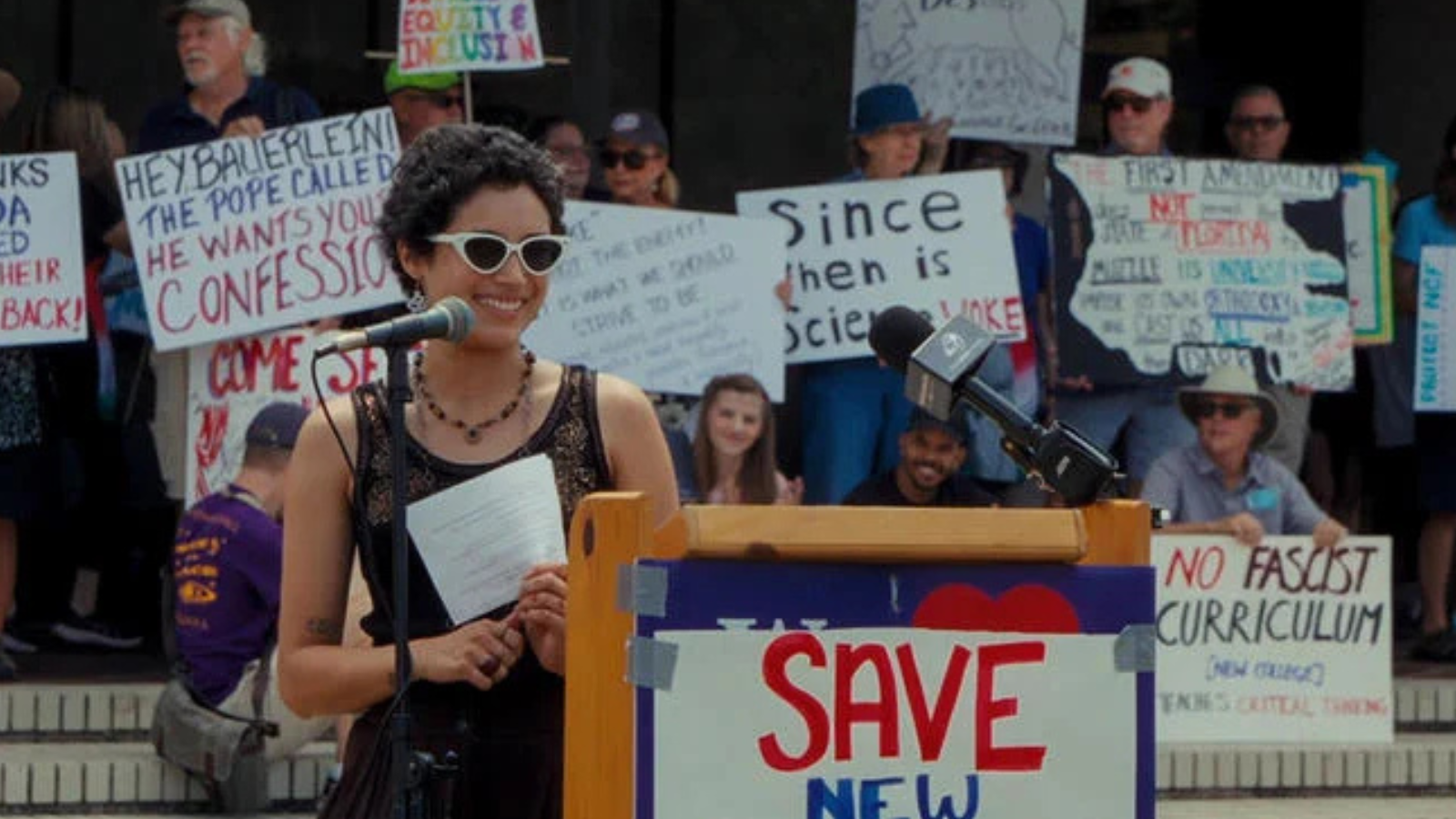
The film shows how resistance under authoritarian rule takes shape in everyday life. The protests and speeches are there: chants, confrontations, moments of raw anger. But so are the quieter acts of care: Students tending a garden, proudly showing it off to interim president Corcoran, even as their campus is being remade around them.
The janitor who quietly pulls books from the dismantled gender studies program from the trash and tells a professor nearby, “This is my heritage,” and it’s worth saving, even if no one else in power thinks so.
A decision to bring back the Rocky Horror lip-sync as a deliberate act of queer joy and a refusal to let that part of campus culture disappear.
Laughter in the face of an attempted graduation speech from billionaire and Islamophobe Joe Ricketts that feels out of step with the moment. The student body president taking the podium afterwards, declaring, “Long live the null set.” (The null set—also known as the open set, the empty set, empty brackets or epoché—was first recognized as the official mascot of the New College Student Alliance in the NCSA Constitution nearly 30 years ago. According to the NCSA, “the Null Set not only represents the unique quirks of our campus culture and community; but also emphasizes the student body’s undying passion and thirst for knowledge through ecstatic wonder and openness to diverse perspectives.”)
These moments matter. They are how people survive.
The film also captures the way these students are forced into a kind of premature political adulthood. They are asked to be strategic, composed, articulate—to master systems that were not designed for them—while also processing the loss of the institution they chose (all while dealing with the normal concerns of college students: romance, identity, belonging). They are learning, in real time, what it means to fight for something that may not be saved. And still, they show up.
First They Came for My College is not a story of victory. There are losses here—real, irreversible ones. Programs dismantled, faculty gone, students leaving or planning their exits. The film does not pretend otherwise. But it also doesn’t let that be the only story.
What it offers instead is a record of resistance in its most unglamorous, most human form: messy, procedural, emotional, sustained. A blueprint—not for how to win, exactly, but for how to refuse to disappear.
By the end, I understood why my friends didn’t want to see this movie. It will make you angry. But it might also remind you where to look.
*
First They Came For My College is currently screening at film festivals. Find one near you, or request one.
Ms. Classroom wants to hear from educators and students being impacted by legislation attacking public education, higher education, gender, race and sexuality studies, activism and social justice in education, and diversity, equity and inclusion programs. Cue: a new series from Ms., ‘Banned! Voices from the Classroom.’ Submit pitches and/or op-eds and reflections (between 500-800 words) to Ms. contributing editor Aviva Dove-Viebahn at adove-viebahn@msmagazine.com. Posts will be accepted on a rolling basis.