

Now Reading: EU Green Claims Rules Reshape Sustainability Marketing
- 01
EU Green Claims Rules Reshape Sustainability Marketing

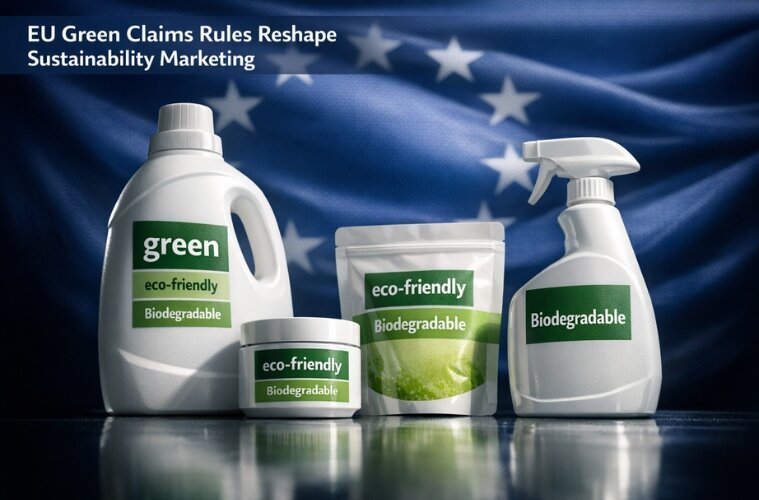
EU Green Claims Rules Reshape Sustainability Marketing
European Union member states must apply new consumer-protection rules restricting environmental claims beginning September 27, 2026. The rules touch language businesses have used for years on products, packaging, websites, and advertising. Directive (EU) 2024/825, known as the Empowering Consumers for the Green Transition Directive, requires member states to prohibit several types of potentially misleading sustainability practices. Countries had to transpose the directive into national law by March 27, 2026, with those measures applying from September 27. For multinational companies, the compliance question is increasingly straightforward. Can the business prove what it puts on the package.
Sustainability teams may find that language once handled largely by marketing departments now requires much deeper involvement from legal, product stewardship, and procurement. That shift is the real story here, more than the individual words being restricted.
Words Like “Green” and “Eco-Friendly” Become Harder to Use
The directive targets broad environmental terms including “green,” “eco-friendly,” “environmentally friendly,” “climate friendly,” “biodegradable” and similar claims when a company cannot demonstrate recognized excellent environmental performance relevant to the claim. A broad statement such as “climate-friendly packaging” can fall within the prohibition on generic environmental claims. A more specific claim, such as identifying that 100% of the electricity used to produce packaging comes from renewable sources, may be treated differently since the environmental benefit being asserted is clearly identified.
The directive also addresses claims that make an entire product or company appear environmentally preferable when the evidence applies only to one component or activity. The EU cites the example of a product marketed as made with recycled material when only its packaging contains recycled content. That example puts new pressure on the internal process used to approve environmental claims. Product sustainability teams may know the recycled-content percentage. Procurement may know where the material came from. Facilities teams may hold the energy data. Marketing writes the claim. Under the new framework, those functions increasingly need to agree before that claim reaches consumers, a coordination problem that mirrors how CSRD reporting has already forced sustainability data across formerly siloed departments.
Carbon Offsets Face a Particularly High Bar
One of the clearest changes involves carbon-neutral product claims. The directive prohibits claims that a product has a neutral, reduced, or positive greenhouse gas impact when that claim rests on offsetting emissions outside the product’s value chain. The EU specifically names terms such as “climate neutral,” “CO₂ neutral certified,” “carbon positive,” “climate net zero” and “climate compensated” among the claims covered. Companies can still communicate investments in carbon-credit projects, but information cannot be presented in a way that misleadingly changes how consumers understand the product’s own environmental impact. The affected businesses span consumer products, food and beverage companies, airlines, and logistics providers that have leaned on offsets for product-level environmental marketing, the exact category of claim that drew a formal complaint against Coca-Cola, Danone, and Nestlé over recycled-content claims on plastic water bottles.
Net-Zero Promises Need Evidence Behind Them
The rules also reach forward-looking environmental claims. Companies making claims about future environmental performance must support them with clear, objective, publicly available, and verifiable commitments. Those commitments need a detailed and realistic implementation plan with measurable, time-bound targets and the resources required to achieve them. Progress must also be regularly verified by an independent third-party expert whose findings are available to consumers.
That potentially changes the risk calculus behind statements such as “net zero by 2040” or “100% renewable by 2030.” The question is no longer only whether the target appears in a sustainability report. Companies need to consider whether capital plans, procurement decisions, energy contracts, supplier data, and operational investments actually support the public promise. For finance teams, that adds a layer of governance most had not budgeted for. An environmental commitment made in a consumer-facing campaign can imply spending and operational changes stretching years beyond the campaign itself.
Sustainability Labels Are Being Tightened Too
Sustainability labels face similar tightening. The directive prohibits labels not based on a certification scheme or established by public authorities. That provision could significantly affect the proliferation of proprietary environmental badges and company-created sustainability symbols on packaging and online listings. The EU estimates roughly 230 sustainability labels and 100 green-energy labels are in use across the European market, and its earlier review found significant weaknesses in the reliability and evidence supporting environmental claims generally, a concern the bloc had already flagged in a 2024 vote adopting the directive’s underlying greenwashing framework. For product stewardship and procurement teams, third-party certifications, environmental attributes, and supplier representations deserve closer scrutiny before they migrate onto packaging.
The Green Claims Directive Is a Separate Issue
Companies should be careful not to confuse these requirements with the EU’s proposed Green Claims Directive, a separate proposal intended to establish more detailed rules for substantiating explicit environmental claims. The European Commission announced in June 2025 that it intended to withdraw that proposal. Negotiations were suspended, and the proposal’s legislative status has remained uncertain since. Directive 2024/825 is different. It has already been adopted, and its September 27, 2026, application date remains in place.
The immediate compliance challenge is not simply deleting words like “green” from packaging. Companies selling into Europe may need a much broader inventory of environmental representations across packaging, websites, advertisements, product pages, sustainability labels, and corporate communications. From there, businesses need to determine who owns the evidence behind each statement. A recycled-content claim can depend on supplier documentation. A renewable-energy statement can depend on facilities and procurement records. A future net-zero commitment can depend on capital investment, operational plans, and executive decisions. That makes green-claims compliance look increasingly like other forms of regulated corporate disclosure. The marketing language may stay short. The evidence behind it cannot.