
Now Reading: Arizona’s Republican elections brawl raises fears over midterms, denialism and Trump: ‘The biggest threat is the president’ | Arizona
- 01
Arizona’s Republican elections brawl raises fears over midterms, denialism and Trump: ‘The biggest threat is the president’ | Arizona

Arizona’s Republican elections brawl raises fears over midterms, denialism and Trump: ‘The biggest threat is the president’ | Arizona
Nearly six years later, Donald Trump remains fixated on his 2020 election defeat.
That year, Republican officials in Maricopa county – Arizona’s largest county and one of the most competitive election battlegrounds in the country – resisted Trump’s efforts to overturn Joe Biden’s victory in the state, enduring threats, harassment and enormous pressure from the defeated president.
Their unity has since fractured. In 2024, Arizona swung back to Trump and voters elected Justin Heap – a Trump ally who campaigned on election skepticism – as county recorder, overseeing voter registration and early voting. Heap was recently labeled the “most dangerous election denier in Arizona” by the pro-voter organization All Voting Is Local, after a bitter power struggle erupted between him and the Republican-dominated board of supervisors, which shares responsibility for running county elections.
The yearlong standoff – triggered by a realignment of election responsibilities before Heap took office – featured the collapse of a “handshake” deal, a colorful legal battle and an investigation involving the alleged removal of election equipment.
The warring sides reached an unexpected truce on Tuesday, exactly one week before Arizona’s 21 July primary election. But it has done little to ease concerns among Heap’s skeptics, especially those who see the nasty brawl over election administration as a dress rehearsal for November, when Arizona voters will decide a series of fiercely contested races for governor, attorney general, secretary of state and Congress.
“Absolutely, positively not!” Patti O’Neil, chair of the Maricopa county Democratic party, said when asked if the deal bolstered her faith in the upcoming elections. Heap, who will assume new election duties as a result, “has not proven himself to be a good-faith actor”, she said.
Republican members of the board say they are hopeful the agreement will produce what chair Kate Brophy McGee calls “boring elections”.
While tensions in the county have quieted for now, many Arizona election officials still worry about Trump’s determination to relitigate – and his warnings that fraud could cost Republicans the fall midterm elections. “No country can be great without fair and honest elections,” the president said in a primetime address at the White House on Thursday. “Unfortunately, the system we have falls catastrophically short of that standard.”
Arizona’s secretary of state, Adrian Fontes, who held the recorder’s seat a decade ago, said the greater concern for Arizona elections was political interference by the White House.
“The biggest threat is the president, who is lying,” Fontes said.
Turmoil in 2020
In 2020, Maricopa county, home to Phoenix, become “ground zero” for election disruption as Biden edged out Trump in the county, putting him over the top in the state – and the electoral college.
Disbelieving and angry voters flocked to the county’s vote-tabulation center to protest, with the conspiracy theorist Alex Jones egging on the crowd. Rumors bubbled up from the crowd’s fevered imagination, including a debunked tale that hundreds of ballots had been shredded, transported to a chicken farm and burned in a henhouse fire.
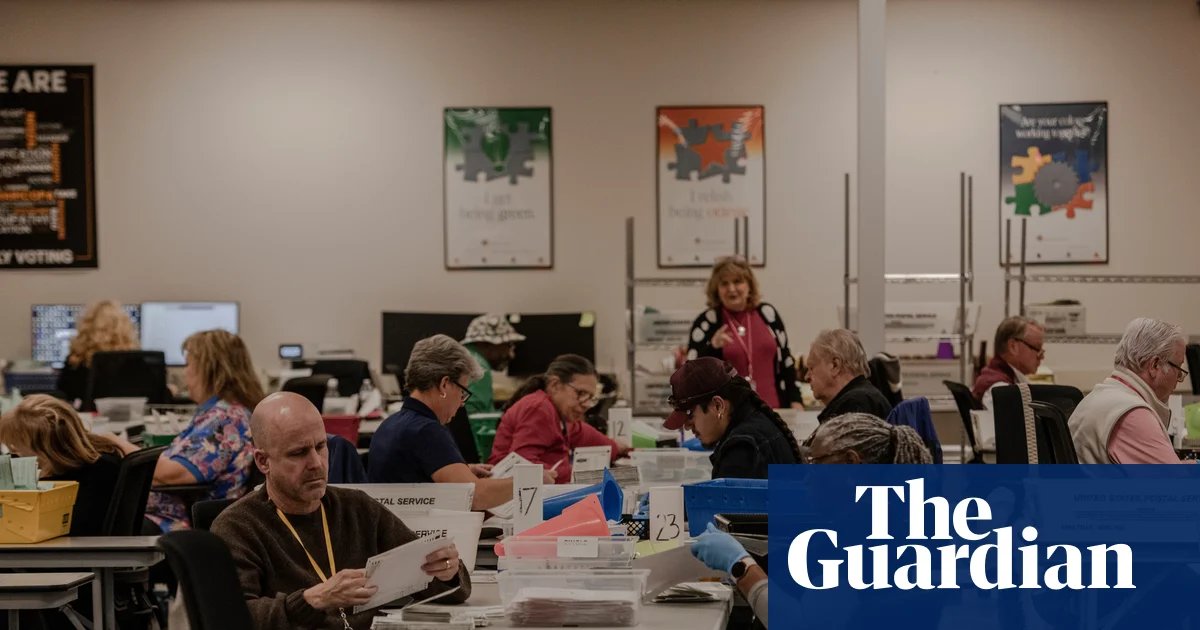
Trump envoys tried to persuade legislative leaders to pass laws that would overturn the election results. When the then house speaker, Rusty Bowers, a Trump supporter, refused, the senate president authorized a recount of the 2020 ballots to pacify Trump acolytes. But the so-called “audit” by a firm called the Cyber Ninjas was controversial and amateurish, relying on citizen volunteers who recounted ballots as they spun past on rotating stands. The review produced a surprising result: Biden had won Maricopa county by a slightly larger margin than the official tally.
The turmoil had lasting effects. In 2022, the Republican former TV anchor Kari Lake claimed that a rigged election caused her loss in a closely fought race for governor. Lake never backed down from those charges, even as she ran, unsuccessfully, for a US Senate seat in 2024. Lake is now Trump’s ambassador to Jamaica after overseeing deep cuts at the international broadcaster Voice of America.
Bill Gates was a member of the board of supervisors during the turbulent 2020 election cycle. He hoped the newly forged elections agreement would prevent any semblance of a repeat of 2020’s chaos.
“Hopefully, now it will be a straighter path,” Gates said of upcoming midterm elections. It would be naive to say the acrimony disappears, he added, but the deal untangles issues that had fueled the long fight.
But supervisor Steve Gallardo, the board’s lone Democrat, was skeptical of a new era of peace. He noted that Heap got everything he wanted in the court rulings and then agreed to give back some of those authorities in the settlement with the board.
Any problems in the general election should be laid at the recorder’s feet, Gallardo argued: “He owns November.”
‘Highway to hell’
Heap was serving his first term in the Arizona house of representatives when the Arizona Freedom caucus, a hard-right faction of Republican lawmakers, championed him to run for county recorder in 2024. In his successful primary challenge to incumbent Stephen Richer, who infuriated Republicans for rejecting Trump’s stolen election claims, Heap called the county’s elections a “laughingstock” and declined to say whether the 2020 or 2022 elections were stolen.
Shortly after taking office, Heap became embroiled in a dispute with the board’s Republican supervisors that spiraled into an ugly, intra-party feud, marked by name-calling, subpoenas, fights over ballot drop boxes and even an investigation into a possibly purloined envelope scanner.
Some Democrats called for Heap’s resignation while Heap argued the five-member board had stripped his office of powers guaranteed by state law. One provision, for example, removed the recorder’s ability to have his own information technology, which he wanted to build a voter registration list in his office.
After several months of negotiations, a deal seemed within reach.
But then, in June 2025, Heap turned to the courts to take back what he said were his lawful duties. He hired James Rogers, senior counsel with the America First Legal Foundation – a law firm co-founded by Trump’s policy director, Stephen Miller. It furthered suspicions that interests beyond Arizona were trying to influence elections in the country’s second largest voting jurisdiction.
The Republican-led board defended the county’s election administration as “the gold standard”. But Heap disagreed. Echoing the president, he claimed that recent elections had been riddled with “inconsistencies and illegalities”.
“The voters don’t think we’re the gold standard,” he told a local talk-radio host last month. “In fact, that’s why they voted for me to come in and address and fix many of the problems we’ve been seeing for almost a decade at this point.”
Tensions escalated further when Heap charged that the board sent armed deputies to the homes of several of his employees as part of its investigation into his office’s use of a scanner used to process ballot envelopes.
The board cast it as a threat to election security because the scanner removal happened during a local election, was the property of the board and also involved the removal of some ballot envelopes.
Debbie Lesko, a former member of Congress and staunch Trump ally who is now a board supervisor, said the move created “grave chain-of-custody concerns” and forced the board to buy a new scanner at a cost of $70,000 to taxpayers.
Heap disputed that, arguing his office paid for the equipment.
In April – three months before the primary election – a court sided with Heap and returned certain election duties, such as placement of ballot drop boxes and oversight of all forms of early voting, to him. The judge reprimanded the board members for “shenanigans” and “gamesmanship” and urged the parties to negotiate an agreement, rather than continuing to fight in court.
Heap’s attorney proposed Cleta Mitchell – an election denier who echoed Trump’s distrust in elections – as a mediator – an idea the board dismissed immediately.
Ultimately, the case landed with the state supreme court, which unanimously ruled in Heap’s favor – just two weeks before the primary.
While Heap celebrated a “monumental win” for election integrity and the rule of law, it still wasn’t the final word. Closed-door mediations, overseen by a judge, continued. At last, on 14 July, a settlement was reached and signed by both parties.
The pact clarifies election duties in this sprawling county, which has evolved from a Republican stronghold to a swing jurisdiction since Trump lost the state by fewer than 11,000 votes in 2020. Both parties applauded the deal.
“We will now run elections lawfully in accordance with what the law says they are supposed to be run,” Heap said at a rally after the settlement was finalized.
Heap did not return a request for comment.
Thomas Galvin, the board’s chairman when the 2024 division of duties was crafted, said the settlement, while not perfect, offered certainty.
Reflecting on the rancorous tone of the previous 18 months, Galvin said: “This settlement provides an off-ramp from the highway to hell.”
President’s spectre hangs over state
Trump once again looms over Arizona’s elections. Since returning to office, he has appointed election skeptics to key posts, pushed voting changes that critics say would make casting ballots more difficult, seized voting records related to his 2020 defeat, and dismissed officials who investigated his efforts to overturn his defeat six years ago.
Earlier this month, the US Department of Justice announced that it would prosecute election officials who knowingly allow non-citizens to vote – a threat Arizona’s secretary of state called a “nastygram” and “insulting” to election officials statewide.
Harmeet Dhillon, the assistant attorney general for civil rights in the US Department of Justice, followed that announcement with a notice that her office would send election monitors to Arizona and five other states this fall, including in Maricopa county.
The federal actions come after the FBI subpoenaed the Arizona state senate for records of the ballot review it conducted in the wake of the 2020 election. The records are needed as a federal grand jury continues its investigation into that election.
Earlier this year, the Department of Justice sued Arizona’s secretary of state when he refused to hand over unredacted voter rolls. A federal judge appointed by Trump dismissed the case, saying there was no legal basis for the department to obtain the records.
In his speech on Thursday, Trump insisted a trove of declassified documents were further evidence of the country’s election vulnerabilities – and called for increased federal oversight of state voter rolls. Kris Mayes, Arizona’s Democratic attorney general, who is running for re-election, warned that Trump’s rhetoric could be a “precursor” to federal intervention in Arizona’s elections” – and vowed to push back.
Fontes, who is seeking a second term as Arizona’s secretary of state, dismissed the president’s claims as “nothing new” but said the state would evaluate any “credible evidence” of election malfeasance. “Our responsibility is to follow the facts,” he said in a statement issued after the president’s speech, “not political rhetoric.”