

President Donald Trump has finally given the green light to pour millions of dollars from his personal PAC toward boosting vulnerable Republicans in November, two people familiar with the plans told CNN, as some top campaign advisers privately acknowledge that Republicans’ chances of keeping control of both the House and Senate are dwindling.
Trump’s political team is still debating what the final dollar figure will be, though one person familiar with the discussions floated $30 million in the first tranche. Another official cautioned that the final amounts have not yet been decided. The long-awaited cash infusion is happening in the coming weeks, two people said, describing it as the first salvo in a stretch-run effort as November looms just three months away.
And it comes amid growing GOP concerns that severe headwinds over the Iran war and high gas prices could suppress voter turnout.
“There is a path where we keep the House and the Senate,” one source told CNN. “I’m not in a place today where I’m prepared to say we’re cautiously optimistic about that.”
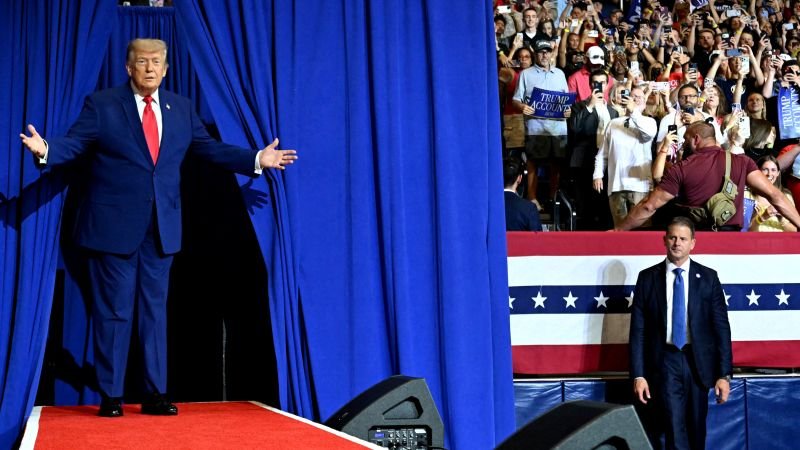
Trump is also belatedly preparing to ratchet up his own campaigning schedule, with plans to travel at least once a week to hold a spate of rallies in battleground districts, one adviser said. His team first promised this move months ago, and Republicans have long argued it’s a crucial step to energizing MAGA voters critical to the party’s midterm chances.
“He loves to travel, but he hates to travel,” said one of his advisers, noting that domestic issues and the Iran war upended early plans to get him on the road more frequently. Trump has recently told his closest aides that he wants to be out more stumping for GOP candidates. But advisers acknowledge his enthusiasm could evaporate just as quickly.

“We’ll see how long that lasts,” the adviser said. “Once he’s traveling, he’s like: ‘Why am I doing this? I want to be doing other things.’”
Still, there’s widespread angst within the party that Trump has waited too long to get more directly involved. Lawmakers and operatives have privately agonized for months over the president’s reluctance to commit his vast sums to helping elect candidates across the country. The GOP is fighting to hold dozens of House districts and a handful of critical Senate seats amid voter backlash over rising prices and the deeply unpopular war in Iran — with no end in sight on either problem.
“President Trump is the unequivocal leader of the Republican party who is committed to maintaining Republicans’ majority in Congress. In just over one year, the President has made our country greater than ever before with the most secure border in American history, the largest middle-class tax cuts ever, and the lowest murder rate since 1900,” White House spokeswoman Olivia Wales said in a statement to CNN.
“President Trump will continue to draw a sharp contrast with his commonsense agenda and the radical Democrats in Congress,” she added.
An adviser close to Trump acknowledged that, with the president’s approval ratings scraping new lows, there’s little expectation he can win over large numbers of independents and swing voters — which was part of his path to victory in critical swing states in 2024. Instead, Republicans believe their fate in November rests almost solely on turning out millions of the MAGA faithful who typically don’t vote in midterm elections.
“Without a doubt, we’ve got to make sure we get some of these voters who show up for Donald Trump in presidential elections to show up for these congressionals,” the adviser said.
But in recent months, Trump and Republicans haven’t offered much to energize their base. Congressional Republicans squandered the final weeks before the August recess fighting amongst themselves over legislation — specifically the president’s controversial elections bill that would cement federal voter ID laws and install more voting restrictions, which stands little chance of becoming law and never even made it to the Senate floor.

Congressional GOP leaders have long believed that their success in the midterms will largely hang on Trump’s ability to recreate his 2024 coalition. They need Trump to help turn out as much of his MAGA base as possible in crucial battleground turf — especially in states like Michigan, Ohio and North Carolina, which have critical House and Senate races that could determine control of Congress next January.
Republicans are defending critical blue-state seats too, like the pivotal Senate seat in Maine and several House seats in both New York and California. But the vast majority of this fall’s map is in places where Trump has already proven he can win, like in Iowa and Pennsylvania.
GOP campaign officials have also been urging their candidates from the start to lean in — not away — from Trump on the trail, according to House and Senate campaign operatives. That includes even the most centrist Republicans, like Rep. Mike Lawler, who represents a vulnerable seat in New York’s Hudson Valley and welcomed Trump this spring for a joint rally in one of the reddest parts of his district.
Lawmakers also need him to stay on message, driving out big crowds and turning on his election-year charm with talk of the GOP’s accomplishments on affordability. But Trump has made little headway in selling his domestic accomplishments — or ending a monthslong foreign war that he repeatedly vowed would only last four to six weeks.
In private conversations with Trump, some advisers have sought to emphasize how significantly the war is dragging down Republicans’ chances, arguing that even voters who generally support his goals in Iran are unwilling to stomach a drawn-out conflict that’s raising prices at home.
The prospect of persistently high gas prices has particularly damaged Trump’s standing, people familiar with the internal discussions said, serving as a prominent visual reminder of an affordability crisis that many Americans feel has gotten worse under this administration.
“It’s higher prices; that’s what they’re upset about,” said one of the advisers.
Perhaps reacting to those pressures, both Vice President JD Vance and departing White House press secretary Karoline Leavitt this week started emphasizing that lowering gas prices was equally as or more important to Trump than keeping Iran from obtaining a nuclear weapon. That’s a shift from Trump’s frequent assertions that Tehran’s nuclear capabilities are all that matters.
“I think both goals are equally as important to the president: We want to keep gas prices low but also ensuring Iran can never get a nuclear weapon. Something he will see through no matter what,” Leavitt told reporters traveling on Air Force One Friday.

Trump has nevertheless insisted publicly that he’s willing to prolong the war for as long as it takes to win it, downplaying the domestic impact even as he struggles to find a clear path toward achieving his aims in the Middle East.
Amid that worsening backdrop, Trump has repeatedly suggested recently that the midterms aren’t really his problem. And in addition to waving off Americans’ economic anxieties and declining to prioritize bringing an end to the Iran war, he’s also emphasized his own pet projects over the broader GOP agenda.
“I don’t have to be supporting all the people. You know, I have a busy schedule,” Trump said in an interview with Punchbowl News last week, adding: “I said to somebody, ‘I won. I’m not campaigning.’”
Those closest to the president insist he still cares deeply about ensuring Republicans win as many races in November as possible. But, one adviser cautioned, he won’t get involved in races he thinks aren’t winnable.
“He doesn’t want to carry dead carcasses across the finish line,” that person said, referencing Trump being incredibly protective of who he chooses to endorse. “He’s not going to endorse a loser and ruin his brand.”
But he does acutely understand that Democrats winning either the House or the Senate in November would have a highly negative impact on his final two years in office, they said.
“The next two years will be f*cking horrible if we lose both chambers. And Trump knows that,” that source said. Other officials have emphasized that Trump does not want to go through the same type of investigations and battles with Congress that he did during his first term, which included two impeachment trials.
The political operation surrounding the president consists of a tight group of loyal advisers who worked on Trump’s 2024 presidential campaign and other previous campaigns. It’s run by his former political guru, James Blair, who up until recently served as the White House deputy chief of staff for legislative, political and public affairs.
Other high-ranking members of the team include: Chris LaCivita, a co-campagin manager of Trump’s 2024 reelection campaign; Taylor Budowich, who previously ran MAGA Inc. and later led White House communications; Timothy Saler, who previously helmed Trump’s 2024 data operations; and Tony Fabrizio, the president’s longtime pollster.
White House chief of staff Susie Wiles, who worked alongside LaCivita and the others throughout Trump general election campaign, continues to be heavily involved in all strategy ahead of November, the officials said.
There was a bit of a shakeup this week when Leavitt announced she’s departing her role as press secretary at the end of August, just two months before the midterms. Leavitt has long been viewed inside the West Wing as one of the president’s most effective messengers on the upcoming elections. As of Saturday morning, it was unclear when the role would be replaced.
Those on the team have described their strategy as being guided by the same principles they used to take them across the finish line in 2024. The most crucial aspect, they said, is their data operation. The president’s chief of staff will often remark to the group that everything must be driven by the extensive data they have amassed in recent years and used to energize members of Trump’s base.

“We know exactly who our voters are,” one of the president’s political operatives said. “Based on the data operation, we know how to reach them, and we know what it takes to get them off their ass.”
Trump’s advisers also cite a number of recent political wins they argue should help come November, including Republicans’ unprecedented effort to redraw congressional districts across several states, shifting a handful of seats toward the GOP and further limiting the number of races that are realistically up for grabs. That redistricting push — spurred directly by Trump — is a key reason that Republicans believe they still have a chance to keep the House.
Republicans claimed another victory after the Supreme Court struck down restrictions on the amount that official campaign committees can spend on individual candidates — a change that party operatives insist will help even up the financial arms race given the GOP has far more money than Democrats in PACs and outside groups.
“Our money’s going to go so much further,” one Republican campaign official said following the ruling. “We’re not going out there and saying we’re going to win a gazillion seats … but we feel like we’re probably in the best possible position we’ve been in.”