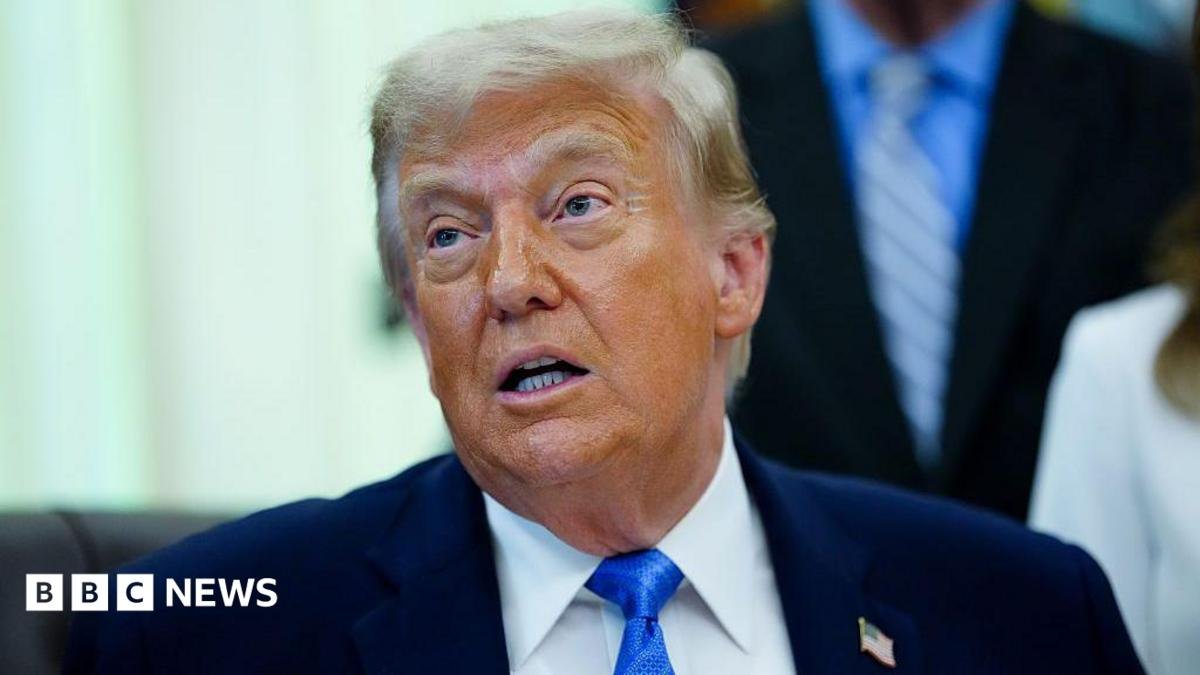
US President Donald Trump says the US will hit Iran "very hard" tonight
In a post on Truth Social, he also vows to "assume total control" of Iran's oil and gas markets and to take Kharg Island – a major oil terminal off the coast of Iran – in the "not too distant future"
Oil prices rose by about $2 and Brent crude futures increased to $94.16 a barrel in the space of a few minutes after Trump threatened fresh strikes, our business reporter writes
Earlier, three Indian sailors were killed in a US strike on a ship – the Settebello – near Oman on Wednesday
The US also confirmed it attacked two other ships – the Guinea-Bissau-flagged vessel Jalveer and Palau-flagged oil tanker Marivex – in the Gulf of Oman
In recent days the US hit military, surveillance and radar sites in southern Iran. Tehran has responded with strikes on US military sites in the region overnight
Edited by Jenna Moon and Jamie Whitehead Jemma Crew
Business reporter
The price of oil rose by about $2 after US President Donald Trump promised to hit Iran "very hard" with fresh strikes, and take control of its oil and gas markets.
Brent crude futures increased to $94.16 a barrel in the space of a few minutes this afternoon, before falling back slightly.
"At some point in the not too distant future, we will be taking Kharg Island, and other oil infrastructure points, and assume total control of their Oil and Gas Markets, much like we have with Venezuela, which is working out brilliantly for both Venezuela and the United States of America," Trump wrote on Truth Social. You can read the post in full here.
Earlier on Thursday, the oil price had been on a downward tilt from a high of just over $95 just after 01:00 BST, to just under $92 by mid-morning in the UK.
This video can not be played
Why Trump wants to take Iran's Kharg Island
Explosions have been heard in the vicinity of the Iranian city Sirik, which borders the Strait of Hormuz, Iran's semi-official news agency Mehr reports.
The BBC has not independently verified this report, and neither the US nor Iran have commented directly on if strikes were carried out.
The island processes a huge amount of Iran's crude oil for export via pipes from the mainland
In his latest Truth Social post, Trump says he will be "taking" Kharg Island "at some point in the not too distant future".
He claims he will take control of their oil and gas markets, "much like we have with Venezuela".
The small island off the coast of Iran is home to a major oil terminal that is considered the country's economic lifeline.
On 13 March, the US launched strikes on Kharg, with Trump saying US forces had "totally obliterated" every military target there. It held off targeting the island's oil infrastructure, but the president warned of possible further American action.
Taking the island could choke off Iran's oil exports and provide a platform for the US military to carry out attacks against the mainland.
The US could use the island as leverage to compel the Iranians to keep the strait open.
But, analysts warn that it could be challenging and a US landing force would have to move considerable distances, either through naval vessels or airborne forces. Chris Partridge
BBC News weapons analyst
US Central Command (Centcom) says one of its aircraft used two Hellfire missiles to disable the oil tanker in the Gulf of Oman yesterday.
The missiles were fired into the engine room of the Guinea-Bissau flagged Jalveer vessel, Centcom says. US military authorities say the crew repeatedly failed to comply with directions from US forces as the ship tried to transport oil from Iran.
Hellfire missiles – or AGM-114s to give them their official designation – are carried by both US military drones and US Army Apache helicopters. They are often guided using semi-active laser technology for precision strikes.
The pilot locks a laser beam onto a target using a screen in the cockpit / control panel and the weapon flies to the point where the laser is striking. With a stated range of some 8km, even fast-moving targets can be engaged with Hellfire.
To date some nine vessels have been disabled as a blockade is enforced against any vessels entering or leaving Iranian ports.
Donald Trump says that the US will strike Iran "very hard tonight" in a new post on Truth Social.
Here's what the president says:
"The United States will be hitting Iran (Whose Navy, Air Force, Radar, Anti Aircraft, and all other forms of Defense, together with most of its offensive capability, are GONE!), VERY HARD TONIGHT
"At some point in the not too distant future, we will be taking Kharg Island, and other oil infrastructure points, and assume total control of their Oil and Gas Markets, much like we have with Venezuela, which is working out brilliantly for both Venezuela and the United States of America."
Since the beginning of the conflict, Trump has repeatedly threatened to seize Kharg Island, a small island off the coast of Iran that is home to a major oil terminal.
An 11-year-old girl was injured in an Iranian drone attack on Bahrain this morning, according to local authorities.
Iran's Islamic Revolutionary Guard Corps (IRGC) has confirmed it launched strikes against American bases in Bahrain, Kuwait and Jordan in response to US strikes in southern Iran.
Jordan says it shot down 20 Iranian missiles, while Kuwait's military says its military engaged "hostile aerial targets".
In Bahrain, which hosts a US naval base, homes and cars were damaged in an Iranian attack, authorities say.
The aftermath of an Iranian drone strike on Bahrain
Firefighters use water canons to extinguish remaining flames
Buildings in Bahrain, damaged by the strikes
By Shruti Menon
BBC Verify has been looking into what happened to the Settebello since reports it was attacked first emerged yesterday, before the US military confirmed it was responsible for the missile strike.
Settebello’s location tracker has been inactive since 31 May, data on ship-tracking website MarineTraffic shows, so it is not clear exactly where the vessel was when it was hit.
But we have seen the vessel in satellite imagery from 8 June in the Gulf of Oman, about 80 miles (120km) from port of Sohar in Oman.
India's shipping minister confirmed earlier that all three missing Indian crew members have been confirmed dead after their bodies were "located and identified".
Pakistan says it remains "deeply concerned" about the escalation of the conflict in the Middle East.
A foreign ministry spokesman says "diplomacy and dialogue should be the guiding principles" between the US and Iran, adding that Pakistan's Interior Minister Mohsin Naqvi held "important meetings" with senior leaders in Iran this week.
Meanwhile, India's foreign ministry has described repeated attacks on commercial vessels as "deeply worrisome" and called for an immediate de-escalation of tensions and continued negotiations.
Russia has also called on the US and Iran to restart peace talks, warning that new strikes would harm the world economy.
China has also said it is "seriously concerned" by the recent escalation, with a military spokesperson telling Reuters that resorting to force "will only further aggravate tensions and military action cannot resolve the underlying issues".
Turkey's Foreign Minister Hakan Fidan called for the US and Iran to halt their renewed attacks and resume negotiations.
Saudi Arabia’s foreign ministry has also called for de-escalation and for fresh negotiations to be mediated by Pakistan and Qatar.
The US has confirmed it carried out a strike on Guinea-Bissau-flagged vessel Jalveer.
Central Command (Centcom) says the ship "violated the blockade" by attempting to transport Iranian oil through the Gulf of Oman.
It is the third vessel struck by US forces in the Gulf this week after attacks on the Marivex and Settebello vessels, according to Centcom.
India's ministry of external affairs has accused the US of striking a third ship carrying Indian sailors near the Shinas port of Oman this morning.
Jalveer, a Guinea-Bissau-flagged vessel, had 20 Indian sailors on board, all of whom are reportedly safe, according to India's shipping ministry, which says evacuation is still in progress.
In a press conference in New Dehli this morning, the ministry of external affairs said three separate strikes on the Settebello, Marivex and Jalveer vessels "came from the US Navy".
US Central Command (Centcom) has confirmed strikes on Settebello and Marivex but is yet to comment on reported strikes on Jalveer.
Ministers added that 13 Indian-flagged vessels and more than 18,000 Indian sailors remained stranded in the Gulf region, including 562 on Indian-flagged ships.
The US struck an Iranian cargo vessel carrying "essential goods" in the Gulf of Oman this morning, according to the governor of Sirik, who was quoted by Iran's semi-official state news agency Mehr news.
Five crew members were rescued after a projectile hit the vessel, which was reportedly struck as it departed from the city of Khasab, Oman, towards the Iranian city of Sirik.
The US has not commented on the reported strike.
The M/T Settebello was the eighth ship to be disabled by US forces since the start of its blockade of Iran's Gulf Coast, according to US Central Command (Centcom).
The US initiated its blockade of Iranian ports in the Strait of Hormuz on 13 April, and has been intercepting or turning back vessels travelling to or from Iran's coast.
Centcom says 134 ships have been redirected after complying with US forces, while eight non-compliant vessels – including the Palau-flagged Settebello – have been "disabled". The tanker was struck by US forces on Wednesday, resulting in the deaths of three Indian sailors.
It adds that US forces have allowed 42 humanitarian ships to pass through the waterway since the blockade began.
Meanwhile, Donald Trump also claimed on Wednesday that the US military had helped 200 commercial ships pass through the strait as part of a "secret mission".
Iran, however, insists the shipping channel is "completely closed".
BBC Hindi
India has summoned a senior American diplomat after three Indian sailors were killed in a US strike on an oil tanker near Oman.
India’s Ministry of Foreign Affairs summoned Jason Meeks, the US Embassy’s deputy chief of mission in New Delhi, to lodge a "strong protest".
The three Indian sailors who were killed in the strike on the Palau-flagged Settebello on Wednesday have been identified as deck cadet Aditya Sharma, engine fitter Shivanand Chaurasia and chief engineer Patnala Suresh.
Earlier today, India's shipping minister described their deaths an "irreparable loss" and said he was "deeply saddened" to learn about the "tragic incident".
He added that their bodies would be returned to India at the earliest opportunity.
Yesterday, US Central Command said it had disabled an oil tanker as it transited the Gulf of Oman, accusing it of violating its blockade of Iranian ports in the Strait of Hormuz.
The US military released footage of its attack on the Settebello. It said "the crew repeatedly failed to comply with directions from American forces"
Sandwiched between Iran, Oman and the United Arab Emirates, the Strait of Hormuz is one of the most vital shipping lanes in the world.
Around 20% of the world's oil and liquefied natural gas usually passes through the tight waterway but it was effectively cut off by Iran after the US and Israel launched wide-ranging strikes on 28 February.
The closing of the strait has sent oil prices soaring globally.
The US established a blockade of Iranian ports in early April after a ceasefire was agreed.
US President Donald Trump has said the blockade will remain "in full force and effect until an agreement is reached, certified, and signed".
This Flourish post cannot be displayed in your browser. Please enable Javascript or try a different browser.
This Flourish post cannot be displayed in your browser. Please enable Javascript or try a different browser.
The father of a sailor killed in the US attack on oil tanker Settebello says he last spoke to his son on Tuesday, and "everything was alright".
Ramji Chaurasiya tells Reuters that his son had left home eight or nine months ago.
Chaurasiya says he was informed that a bomb had been dropped on the ship and that several crew members were missing.
When asked what information he had received, the father breaks down in tears.
Debate is continuing between Iran and the US over the closure of the Strait of Hormuz.
On Wednesday, Iranian state media reported the busy shipping channel was "completely closed to all type of vessel".
On Thursday morning, Iran's waterway authority says again the strait is closed, state media reports, following a new wave of US strikes yesterday.
However, overnight US Central Command denied its closure, writing: "Commercial ships are continuing to transit in and out of the Strait of Hormuz tonight."
The Strait of Hormuz remains at centre of negotiations, with both the US and Iran attempting to exert control over its future.
Iran has been blocking the waterway since the beginning of the war leaving thousands of sailors stranded, with the US imposing a blockade on Iranian ports in retaliation.
Iran has created the Persian Gulf Strait Authority, which it says will allow the Iranian army to oversee vessels moving through after the war.
But the US insists Iran will not be allowed to control the strait after the war – Donald Trump claimed on Wednesday that the US military had helped 200 commercial ships pass through the waterway as part of a "secret mission".
Iran’s foreign ministry has said the latest US strikes leave the ceasefire between the countries “practically meaningless”.
In a statement, the ministry strongly condemns the “illegal and criminal attacks” carried out by the US, claiming they violate the UN Charter and fundamental rules of international law.
It adds that US leaders will be responsible for the consequences of the escalation.
It comes after US Central Command said it completed a wave of “self-defense strikes” targeting military, surveillance and radar sites in southern Iran on Wednesday.
Iran also carried out strikes, targeting US military assets across the region in Bahrain, Kuwait and Jordan.
Announcing the death of three Indian sailors after the US struck an oil tanker, India’s Shipping Minister Sarbananda Sonowal says it was “deeply unfortunate to learn of the tragic incident”.
In a post on X, he adds that it's a "profound loss".
The Palau-flagged Settebello came under attack on Wednesday after the US military accused it of violating an American blockade by "attempting to transport oil from Iran". There were 24 Indian crewmen on board – 21 were rescued.
The US Central Command said it fired munitions into the ship’s engine room after crew “repeatedly failed to comply” with American forces.
Manoj Yadav, general secretary of the Forward Seamen's Union of India, told The Economic Times newspaper that he "refused to believe" that the US lacked information regarding the nationalities of the people on board those ships. He said detaining the ships instead was a “viable alternative”.
This is the second vessel with Indian crew that has come under attack this week. On Monday, US forces hit Marivex, also a Palau-flagged oil tanker with an Indian crew, in the Gulf of Oman after it failed to comply with US instructions, Centcom said.
All 24 crew were rescued by the Omani military, Indian authorities said.
Ships and tankers remain stranded in the Strait of Hormuz off the coast of Musandam, Oman
Three Indian sailors were killed after a US strike on the Palau-flagged Settebello, New Delhi’s Shipping Minister Sarbananda Sonowal has announced, describing it as "deeply unfortunate".
On Wednesday, US Central Command said it had disabled the oil tanker, accusing it of violating the ongoing blockade of the shipping channel the Strait of Hormuz.
India's government had initially said three Indian sailors were missing and 21 Indian crew members had been rescued.
Meanwhile, the Indian embassy in Oman said it was investigating a separate incident involving a vessel off the Shinas port in Oman, which took place in the early hours of Thursday morning.
It's the latest in a series of strikes on vessels operating around the coast of Oman this week – on Monday the US said it disabled a different oil tanker, another Palau-flagged vessel, the Marivex.
The ceasefire between the US and Iran is under increasing strain after the two sides exchanged fire for a second consecutive day on Wednesday, with both sides targeting military sites.
Despite the escalation of strikes, three Iranian sources told Reuters this morning that diplomatic efforts had intensified, with negotiations centring around the release of frozen Iranian funds.
We'll bring you the latest developments on this story throughout the day.
Copyright © 2026 BBC. The BBC is not responsible for the content of external sites. Read about our approach to external linking.