
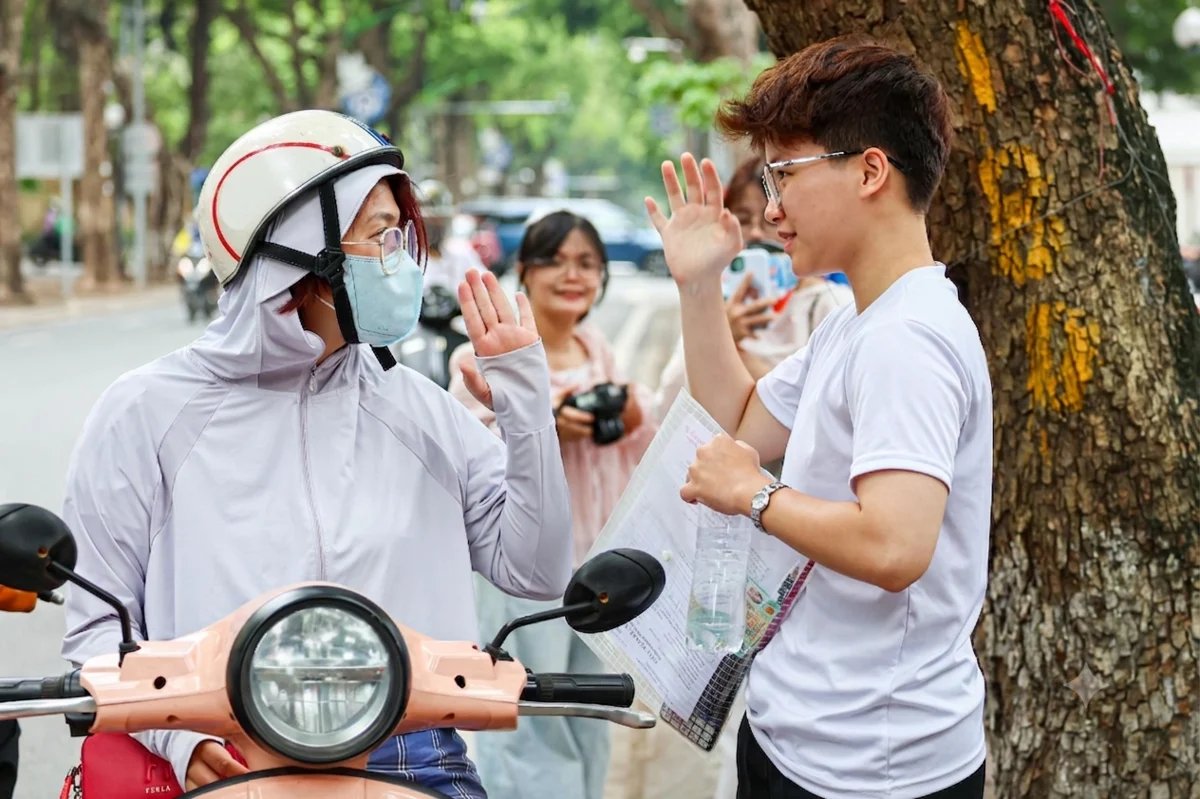
On the morning of June 11th, the social commentary question in the Literature exam for the 2026 high school graduation exam, titled ” How can we have ‘Vietnamese Steve Jobs’? “, sparked much debate. The introduction mentioned Steve Jobs, Mark Zuckerberg, and Elon Musk and their “technological inventions that have changed the world , ” thus raising the question of the aspiration to cultivate individuals who can contribute to the development of science and technology in Vietnam.
The biggest point of contention lies in the use of the concept of “invention.” Many argue that Steve Jobs, Mark Zuckerberg, and Elon Musk are not inventors in the traditional sense – those who directly create new scientific principles or technologies.
Their greatest value lies in their ability to recognize the potential of technology, connect resources, and lead organizations to transform ideas into globally impactful products. They are “innovation ecosystem shapers,” rather than mere inventors.
Literature exam for the 2026 high school graduation exam.
Suggested answers for Literature
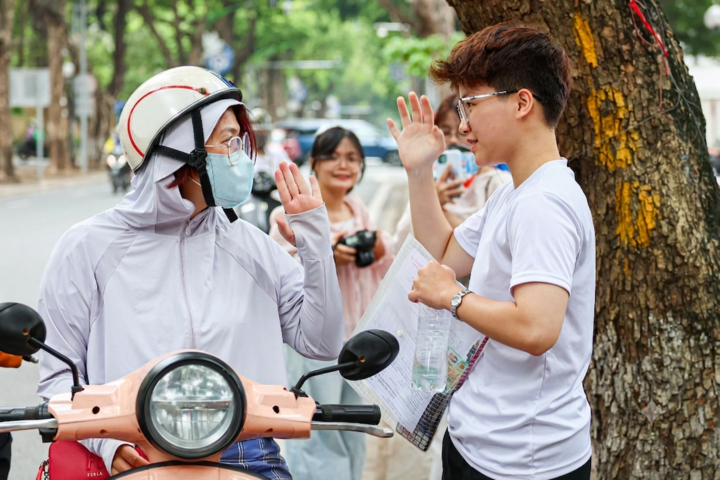
Candidates complete the Literature exam this morning, June 11th. (Photo: Minh Duc)
Le Viet, who has 15 years of experience in the media field, argues that the mistake in the question is equating the role of tech CEOs (founders) with that of scientists in a laboratory.
The historical reality of technology proves the opposite: Steve Jobs (former CEO of Apple) did not invent the computer mouse or the graphical user interface (GUI). Those technologies were developed by the Xerox PARC Research Center; what Jobs did was see their potential and commercialize them on the Macintosh.
Similarly, Elon Musk didn’t invent electric cars or lithium-ion batteries; he acquired Tesla when it was already established and used his management expertise to elevate it. The same goes for SpaceX.
Based on the above analysis, according to Mr. Le Viet, using the phrase “technological invention” to describe the achievements of CEOs is inaccurate.
According to this media expert, in Vietnamese, “invention” means discovering something completely new, a scientific principle that no one had ever known before, or something close to it (such as the invention of electricity, the theory of relativity…). Question 1 in the Writing section of the Literature exam used inaccurate terminology.
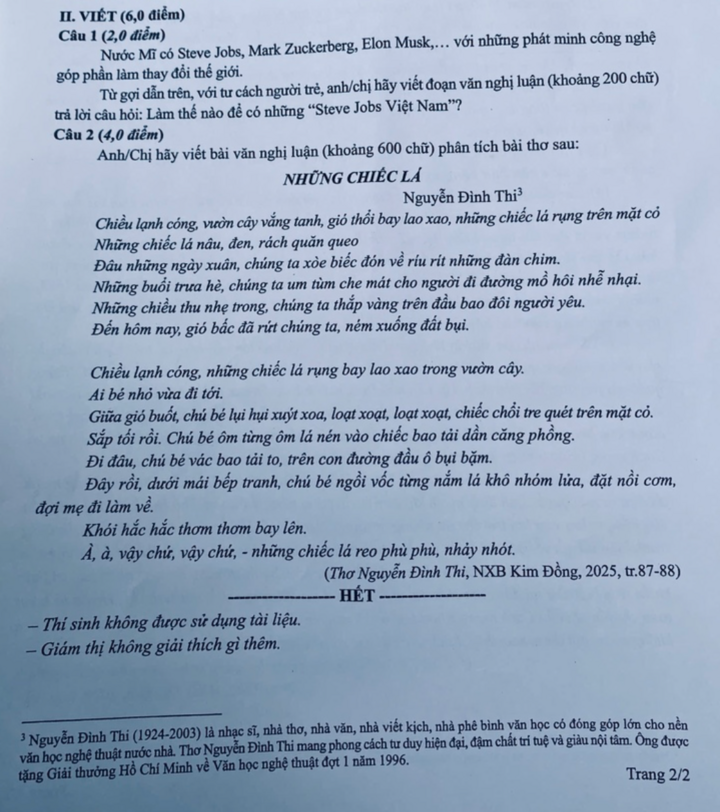
Question 1 of the 2026 high school graduation exam’s Literature section is causing controversy because it uses the term “technological invention” in reference to Steve Jobs, Mark Zuckerberg, and Elon Musk.
Dr. Pham Huu Cuong also argued that, in the traditional sense, Steve Jobs, Mark Zuckerberg, or Elon Musk are not entirely classic inventors like Thomas Edison. However, from another perspective, Dr. Cuong believes that the concept of “invention” in exam questions should not be interpreted too rigidly. Even if they are not classic inventors, figures like Steve Jobs and Elon Musk are still creators of technology ecosystems, assembling human resources and transforming existing technology into revolutionary products.
Take Steve Jobs, for example; he co-authored hundreds of patents related to Apple. More importantly, his greatest value lay in his vision, his ability to assemble talented engineers, and combine existing technologies to create groundbreaking products like the iPhone, thereby changing the way people access and use technology.
“From the perspective of contribution, vision, and inventiveness, figures like Steve Jobs, Mark Zuckerberg, and Elon Musk play a role that goes beyond the traditional concept of an inventor. They are leaders of technology ecosystems, bringing together talents to create products with profound impacts on humanity,” commented Dr. Pham Huu Cuong.
” It’s important to understand that the topic is referring to exemplary individuals associated with technological inventions that have had a significant impact on the world, and not equating them with the concept of inventors,” he added.
Some education experts also argue that, given the persistent disparities in access to information between regions, including global technological role models in exam questions is both timely and demands adaptability from candidates. Not all students have the same level of exposure to figures like Steve Jobs or Elon Musk, but what matters is their ability to understand the issues and develop logical reasoning from the prompts.
From a broader perspective, the trend in exam questions also reflects a shift in education, from testing memorization to assessing critical thinking, problem-solving, and practical application skills. This places demands not only on candidates but also on the teaching and learning process in schools.
Dr. Trinh Thu Tuyet believes that, although the wording of the question may lead to different interpretations, most candidates can still grasp the main spirit of the question. That is the aspiration to excel in science and technology to change the country’s position in the context of globalization.
Clearly, the essay’s aim is not to find a “Vietnamese Steve Jobs” in the literal sense, but rather to pose a broader question: How will Vietnam nurture its people so that they are not left behind in the global wave of technological development?
The answer lies not in one exceptional individual, but in an entire generation that knows how to think differently, dares to innovate, and has the ability to transform ideas into practical value.
Source: https://vtcnews.vn/tranh-cai-de-van-goi-steve-jobs-elon-musk-la-nha-phat-minh-chuyen-gia-noi-gi-ar1022477.html