
Now Reading: DeSantis calls for Florida action on Flock cameras, warns against ‘digital surveillance
- 01
DeSantis calls for Florida action on Flock cameras, warns against ‘digital surveillance

DeSantis calls for Florida action on Flock cameras, warns against ‘digital surveillance
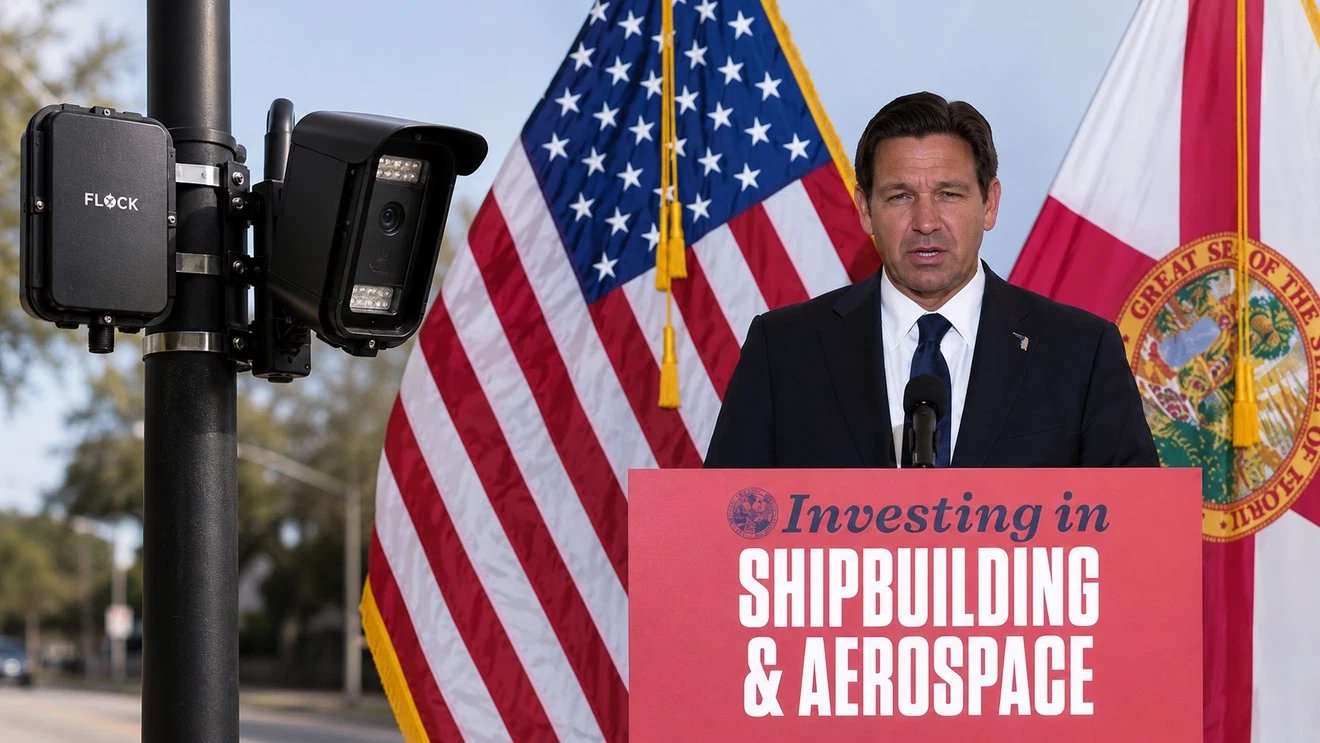
Gov. Ron DeSantis says automated license plate readers can help solve crimes but wants new protections governing how Flock and other companies collect, store and use Floridians’ location data.
JACKSONVILLE, Fla. — Gov. Ron DeSantis says Florida lawmakers need to put stronger limits on Flock cameras and other automated license plate readers, warning that technology designed to help law enforcement could also be used to create a sweeping record of where ordinary Floridians go.
DeSantis addressed the growing controversy Monday after being asked about the Putnam County sheriff’s decision to remove license plate readers.
The governor said license plate readers, or LPRs, can be useful to law enforcement. But he said Florida needs to confront much bigger questions about who controls the information they collect, how long it exists and what private companies could potentially do with it.
“What we don’t want in the state of Florida is to have a digital AI surveillance state where everything we’re doing is being tracked at all times,” DeSantis said.
DeSantis questions where Flock data goes
At the center of DeSantis’ concerns is not simply whether police can use cameras to identify vehicles connected to crimes.
He questioned what happens to the enormous amount of information generated as cameras repeatedly capture license plates and vehicle movements.
“Where is this data going?” DeSantis asked. “How much data is the company’s doing?”
He said companies may promise not to misuse information, but questioned whether sufficient oversight exists.
“You can make some money selling cameras, but you really can make a lot of money if you can sell people’s data,” DeSantis said.
DeSantis said that is an issue the Florida Legislature needs to address.
Governor acknowledges cameras can help police
DeSantis stopped short of calling for a statewide ban on Flock cameras.
Instead, he repeatedly acknowledged their potential value in criminal investigations.
The governor said he believes local police and sheriffs using the technology are generally trying to target criminals rather than conduct broad surveillance of the public. He also said Florida sheriffs could likely provide examples of cases in which license plate readers were used appropriately and effectively.
But DeSantis argued policymakers cannot judge the technology solely by how it is being used today.
They must also consider how it could be misused in the future, he said.
DeSantis points to alleged misuse by Florida officer
The governor specifically cited a case involving a Florida law enforcement officer who he said used license plate reader information to track an ex-girlfriend.
DeSantis said Florida does not have strong enough penalties for that type of misuse.
He said legislation should address potential abuse by both government employees and private companies possessing the data.
His concern extends beyond intentional misconduct.
Because Flock cameras are powered by artificial intelligence, DeSantis said Florida must also establish a broader principle that humans — not AI systems — remain responsible for important decisions.
“Human beings always need to be in control of this technology,” DeSantis said.
‘None of the government’s damn business’
DeSantis offered a simple example of the privacy line he believes government should not cross.
“You want to get in your car and you want to go down to Buc-ee’s in St. Augustine,” DeSantis said. “It’s really none of the government’s damn business if you’re doing that.”
The governor said he does not want Florida transformed into a system where government or private companies can compile a comprehensive record of an individual’s movements throughout the week.
That concern goes to the heart of the debate surrounding automated license plate readers.
Unlike a traditional police camera focused on a particular crime, a network of readers can capture information about large numbers of motorists who are not suspected of wrongdoing.
DeSantis said law enforcement tools should be targeted at criminals rather than sweeping up everyday citizens.
DeSantis wants AI Bill of Rights
The governor said the solution should extend beyond Flock.
Earlier this year, DeSantis called for an AI Bill of Rights intended to protect Floridians from emerging forms of digital surveillance.
According to DeSantis, the Florida Senate approved a version of the proposal 39-1, but the Florida House did not take it up.
He sharply criticized that decision Monday.
“We need an AI Bill of Rights,” DeSantis said, arguing it should cover surveillance cameras as well as the collection and use of personal information through mobile applications and other technology.
New Hampshire could provide model for Florida
DeSantis said he believes New Hampshire has developed a strong approach to regulating license plate readers and suggested Florida could look to that state as lawmakers develop their own restrictions.
He said he has already discussed the issue with new Florida House Speaker Wyman Duggan and believes the speaker is open to action.
“Florida is going to need to do something for sure on that,” DeSantis said.
The governor did not spell out Monday precisely what restrictions he wants placed on Flock systems, nor did he call for every camera currently operating in Florida to be removed.
Instead, his remarks point toward potential statewide rules addressing data collection, privacy, access, misuse and penalties.
Could lawmakers act before DeSantis leaves office?
Asked whether he wants lawmakers to act before the November election, DeSantis left open the possibility of another special session but said he did not know whether lawmakers could reach an agreement that quickly.
DeSantis noted that he has authority to call lawmakers into special session but generally does so after reaching an understanding with legislative leaders about what can be accomplished.
“Are there some things that could be done? Yes,” DeSantis said. “Are we going to have the meeting of the minds prior to the election to necessarily get it done? I don’t know.”
He said there could also be an opportunity for lawmakers to address the issue after the election and before he leaves office in January.
For DeSantis, the debate comes down to drawing a line between giving police technology to pursue criminals and creating a system capable of tracking everyone.
“I’ve no one’s given law enforcement more tools than we have,” DeSantis said. “But they need to be targeted at criminals.”
The governor said he does not want Floridians told simply to trust that the enormous amount of data generated about their daily movements will never be misused.