
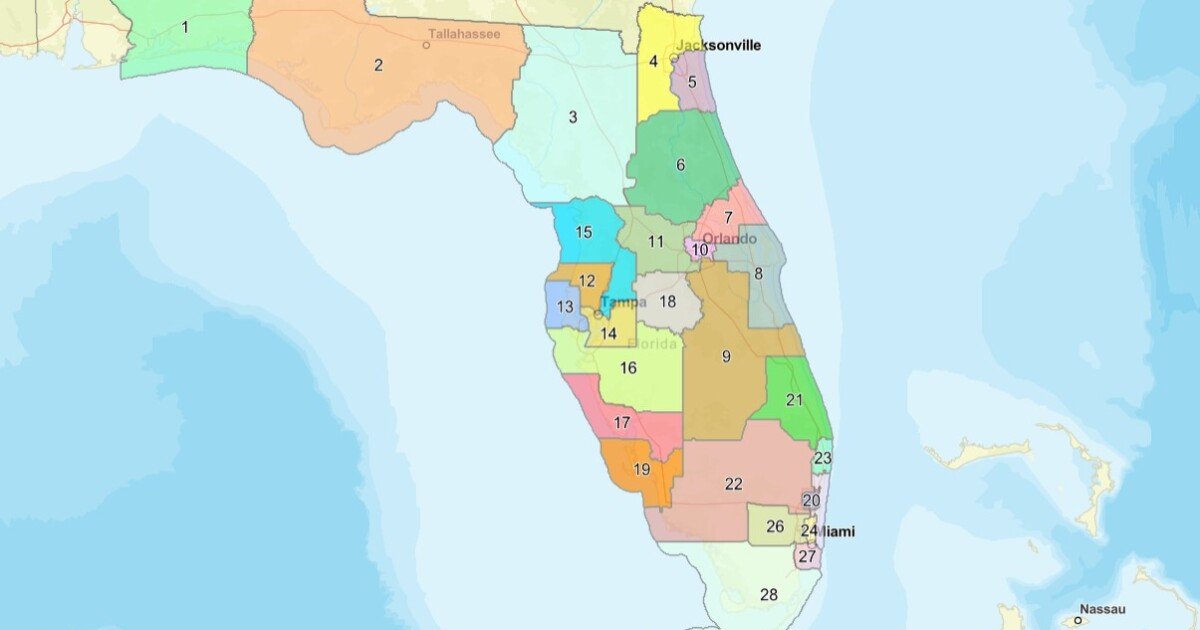
Florida’s new congressional map is shaking up the competition across the state this campaign season.
The map leaves Districts 1 to 7 unchanged, but others are significantly altered. News Service of Florida reported 21 out of Florida’s 28 U.S. House districts were reworked, with four more Republican-leaning districts.
The deadline for candidates to file paperwork to appear on the ballot was Friday at noon. The Florida Supreme Court also declined an emergency request last week to block the newly drawn map. WUSF’s Douglas Soule reported the case has to first be heard by a lower court, which already declined to fast-track it.
This means the new districts will be in place for the midterm elections this year. The primaries are on Aug. 18, with the general election on Nov. 3.
ALSO READ: A breakdown of the changes for Florida’s new congressional map
Amid the political shuffle changing boundaries, some candidates are facing new challengers, while voters are facing new choices.
“The Florida Roundup” checked in with Florida Public Radio reporters for a better sense of the political landscape.
Here’s a breakdown.
Tampa Bay
In the Tampa Bay region, the maps have been scrambled. WUSF reporter Steve Newborn said this has people wondering who their congressperson is.
“I mean, myself and my own house, I’ve had three representatives in the past five years,” he told “The Florida Roundup” host Tom Hudson. “Now I’m represented by somebody I never even had a chance to vote on. So you have to wonder if people know who they’re going to vote for.”
He said the biggest change in the area involved District 14, a seat now held by Democrat U.S. Rep. Kathy Castor.
ALSO READ: Rep. Castor says redistricting without public input is an ‘intentional poke in the eye’
“She’s been around for 20 years, but her blue district, which included most of Tampa, has now been shifted to the south and east in rural Hillsborough County,” Newborn explained. “So this is an area that President (Donald) Trump would have won by about 10% in the last election, so the big question here is: Will her name recognition be enough to carry her to another term?”
Newborn said the National Republican Congressional Committee has targeted this as a district it can flip. A big name for competition past the primaries is former state Rep. Kevin Steele. The Republican has the backing of all three of Florida’s elected cabinet officials, but he still has to win against other party candidates.
Central Florida
According to News Service of Florida, District 9 was originally Osceola County and parts of Orange and Polk counties.
It now stretches from the south Orlando area and includes parts of Orange, Polk and Osceola counties, as well as Indian River, Okeechobee, Highlands and Glades.
It’s held by Rep. Darren Soto, D-Kissimmee. Central Florida Public Media reporter Sam Stockbridge said the changes could give Republicans a bit of an advantage during the election, and the counties included are more rural.
“That is going to pose some challenges for him as he has to work with constituents in four new counties that were not previously under his boundaries,” Stockbridge said.
There were also minor changes to District 10, where Democrat Maxwell Frost represents. But Stockbridge said those alterations aren’t expected to affect his ability to win re-election.
“Now, conveniently for voters, those two districts are keeping the same numbering scheme as they were under the previous map, and that’s actually the case for most of them up here, so at least that’s one concession is that you won’t have to relearn new numbers,” Stockbridge said.
South Florida
District 20, a historically Black district, has been redrawn.
WLRN reporter Daniel Rivero said the district was originally created in 1992 to be, in many ways, a Black majority district. So it stretched from the northern part of Miami-Dade County up through mostly Black areas of Broward County and into Palm Beach County.
ALSO READ: Black Caucus leader: Broward’s 20th U.S. House district must be protected amid redistricting squeeze
It’s been held by a Black Democrat since, he said.
“The lines have been shifted in a way it’s not majority Black anymore, but it’s plurality Black,” Rivero told Hudson. “It’s like 48% Black, and with Hispanics, there’s still minority majority.”
He added that Democrats are still favored in the district. However, some Black Democrat-leaning parts areas have been redrawn into other seats.
Quite a few candidates are running, including Democrat Sheila Cherfilus-McCormick. She was once the representative for this district but resigned this yearwhile facing federal charges of money laundering.
But the biggest point of contention in this race is Democratic Rep. Debbie Wasserman Schultz of Weston. She is District 25’s representative, but those boundaries have shifted to be more Republican-leaning, and she doesn’t live within the confines anymore.
Community members and other politicians have been upset with Wasserman Schultz’s decision to switch districts. They worry Black residents won’t have proper representation.
WLRN reported that 10 of 15 elected members of the Florida Democratic National Committe condemned her decision.
“Ever since 1992, Florida has had three or more Black members of Congress. If Debbie Wasserman Schultz wins the nomination for the Democrats, that number will probably go down to two, which there’s never been that few Black elected officials at the federal level in Florida going back to Reconstruction.”
On the other hand, District 24 is thought to be “generally safe” for Black Democrats, although Rep. Frederica Wilson is retiring after decades of service.
“It’s the only existing Black majority district in Florida at this point,” Rivero added.
It did shift north and took more of Broward, including a bit of Hollywood, and it stretches down to Miami-Dade, according to News Service of Florida.
You can find a full list of candidates in each House district on the Florida Department of Elections’ website.
This story was compiled from interviews conducted by Tom Hudson for “The Florida Roundup.”