


More than four years into the Russia-Ukraine war, and as NATO members approach a critical summit in Ankara, Turkey, people around the world continue to have largely negative impressions of Russia and its leader, President Vladimir Putin.
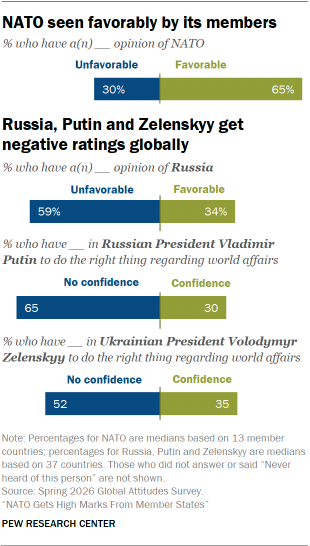
But publics also express little confidence in Ukrainian President Volodymyr Zelenskyy.
NATO is seen positively in most of the 13 member states surveyed, especially Germany, Hungary, Poland and Sweden.
A majority of Americans still have a positive opinion of the military alliance, and half have confidence in Zelenskyy to do the right thing regarding world affairs. Their views of Putin and Russia remain near historic lows: 10% express confidence in Putin and 14% have a favorable view of Russia.
Related: Americans Have Become Less Confident in Trump’s Decision-Making on Ukraine
Views of Russia, Putin and Zelenskyy are not uniform around the world. There are pockets of support for Russia and Putin, mainly in South and Southeast Asia, and Zelenskyy receives higher levels of support from some publics in Western Europe, as well as in Australia, Canada and Japan. Around half of adults or more in Kenya and the Philippines have confidence in both leaders.
Political ideology plays a role in these attitudes, particularly in Europe. In several European countries, people who place themselves on the ideological right – and especially those who support right-wing populist parties – are more likely to have a positive view of Russia and Putin and a negative view of Zelenskyy. Views of NATO are more mixed by ideology and support for right-wing parties.
Learn more about: How right-wing populists view Russia, NATO and Zelenskyy.
In the United States, there are similar partisan divides:
- 75% of Democrats and independents who lean toward the Democratic Party have a favorable view of NATO, compared with 42% among Republicans and Republican leaners.
- 69% of Democrats have confidence in Zelenskyy, compared with 34% of Republicans.
- 12% of Democrats have a favorable view of Russia, versus 16% of Republicans; and 7% of Democrats have confidence in Putin, versus 14% of Republicans.
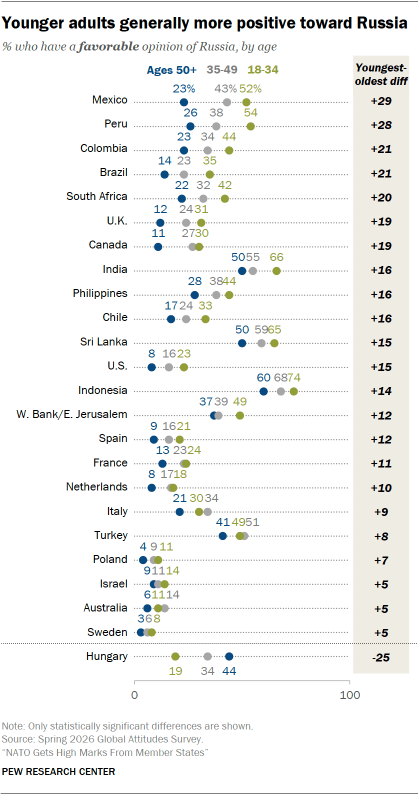
The survey also finds that young adults ages 18 to 34 tend to see both Russia and Putin more favorably than those ages 50 and older. (In many middle-income countries, younger people are also more likely to answer the question.)
For this report we surveyed 45,658 adults in 37 countries from Feb. 8 to May 13, 2026.
What do people in 13 member states think of NATO?
Views of NATO vary across the 13 member countries surveyed in 2026, though the balance of opinion tilts positive overall.
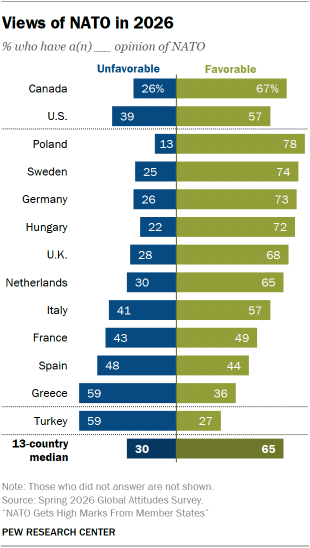
A median of 65% in these nations have a favorable opinion of the security alliance, while 30% have an unfavorable opinion.
Roughly eight-in-ten adults in Poland (78%) view NATO positively, as do around seven-in-ten or more in Sweden (which joined the alliance in 2024), Germany, Hungary, the United Kingdom and Canada.
Majorities in the U.S., the Netherlands and Italy also have a favorable view of NATO.
In the U.S., there is a sharp partisan divide: 75% of Democrats are favorable toward NATO, compared with 42% of Republicans.
Related: Republicans have become less likely to say NATO membership benefits the U.S.
Opinion of NATO is marginally more favorable than not in France and about evenly divided in Spain. These evaluations come amid tension between the U.S. and Spain over access to joint military bases and other issues.
People in Greece and Turkey express the lowest opinion of NATO in the survey: Majorities of 59% hold an unfavorable view.
Since last year, there have been some changes in overall views of NATO:
- In France (-7 percentage points), Italy (-6) and the U.S. (-3), there have been significant declines in favorable opinions of NATO since last year.
- Meanwhile, in Greece, the share with a favorable view has risen by 8 points.
Among the remaining countries, there have not been significant changes in these views from 2025 to 2026. However, favorability toward NATO in Canada, Germany, Greece and Hungary is at or near the highest level measured in the last two decades of Pew Research Center polling.
For detailed views of NATO over time, refer to Appendix A.
There are relatively few significant demographic differences in views of NATO.
In Hungary, though, 87% of young adults ages 18 to 34 have a positive opinion of NATO, compared with 64% of those ages 50 and older. This age pattern also appears in Germany, Italy, the Netherlands and the U.S.
What do people around the world think of Russia?
A median of 59% of adults across 37 countries have an unfavorable opinion of Russia, while 34% have a favorable opinion.
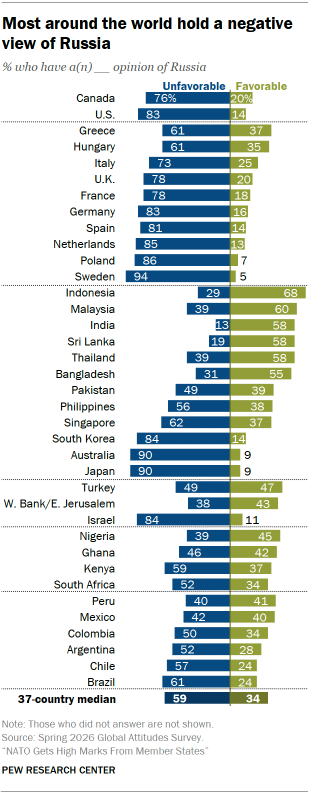
Russia is consistently unpopular within Europe. At least six-in-ten adults in each European country surveyed express an unfavorable view of Russia. These shares include clear majorities who hold a very unfavorable view in the Netherlands, Poland, and Sweden.
Around three-quarters or more in Canada, the U.S., South Korea, Australia, Japan, and Israel also report negative attitudes toward Russia.
Views are most positive in South and Southeast Asia: Majorities have a favorable view of Russia in Indonesia, Malaysia, India, Sri Lanka, Thailand and Bangladesh.
Views over time
While there has been no broad change in overall views of Russia since last year, adults in several countries surveyed have warmed somewhat toward it. Favorable views of Russia are up by 6 points in Canada and the U.K., though only 20% in each country report a positive opinion in 2026.
In Sri Lanka and India, favorable views are up by 12 points since 2024. In India, positive views of Russia are the highest they have been since we first asked this question there in 2013.
For detailed views of Russia over time, refer to Appendix A.
Views by age
In most countries surveyed, adults ages 18 to 34 are more likely than those ages 50 and older to have a favorable view of Russia. For example, 35% of young Brazilians rate Russia positively, compared with 14% of older Brazilians. Hungary is the only country where older adults are more likely than younger adults to have a favorable view of Russia (44% vs. 19%).
What do people around the world think of Putin?
Like overall favorability of Russia, confidence in Russian President Vladimir Putin is low across the 37 countries surveyed. A median of 65% lack confidence in Putin to do the right thing regarding world affairs.
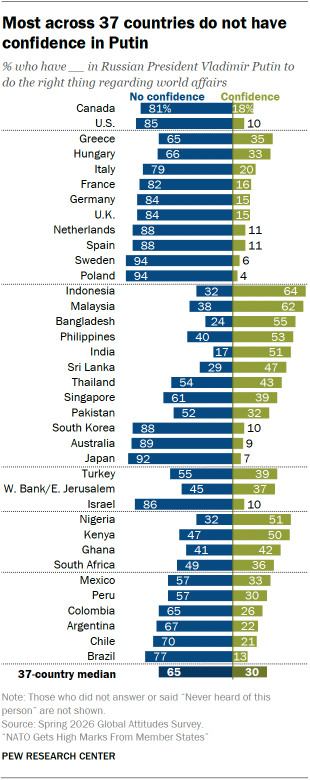
Majorities across Europe and the Americas, as well as in Israel and several Asia-Pacific countries, lack confidence in Putin. Only in Indonesia, Malaysia and Bangladesh do majorities express confidence in him.
In Latin America, people share more critical views of the Russian president than of Russia itself. In each Latin American country surveyed, views of Putin are more than 10 points more negative than views of Russia. For example, 40% of Peruvians have an unfavorable opinion of Russia, while 57% lack confidence in Putin to do the right thing regarding world affairs.
Related: How do views of Trump compare with other global leaders?
Views over time
Confidence in Putin has remained low in most countries surveyed since Russia’s 2022 invasion of Ukraine. In several nations, however, views of Putin have warmed somewhat since we last asked about him. One of the largest shifts was in Ghana, where a third of adults had confidence in Putin in 2024, compared with 42% in 2026.
Indian and Sri Lankan adults have also become more confident in Putin since our last survey, parallel to their rising overall favorability toward Russia.
For detailed views of Putin over time, refer to Appendix A.
Views by age
As with views of Russia, younger adults are more positive toward Putin than older adults in about half of the countries surveyed. This age divide is broadest in the Philippines, where around two-thirds of those ages 18 to 34 have confidence in Putin to do the right thing regarding world affairs, compared with around one-third of those ages 50 and older.
What do people around the world think of Zelenskyy?
On the whole, views of Ukrainian President Volodymyr Zelenskyy are more negative than positive. A 37-country median of 52% say they do not have confidence in him to do the right thing regarding world affairs, while a 35% median say they do. Majorities of adults in 15 countries lack confidence in Zelenskyy.
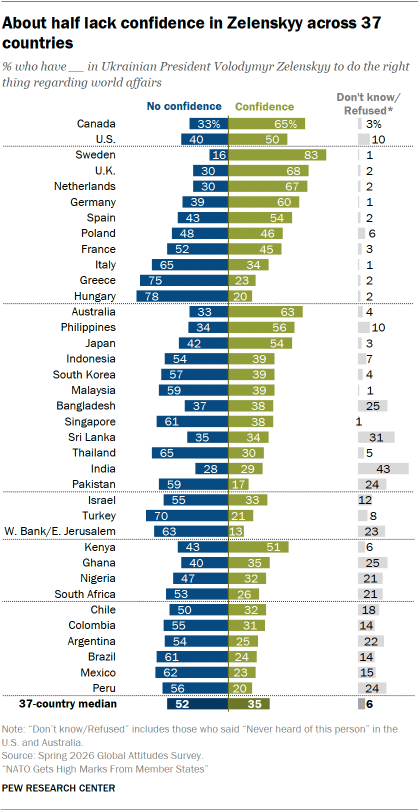
People across NATO member states are especially divided on Zelenskyy. Around seven-in-ten or more in Sweden, the U.K. and the Netherlands express confidence in him, while similar shares in Greece, Hungary and Turkey lack confidence.
In some countries, large shares did not share an opinion of the Ukrainian leader. This includes 43% who did not answer in India and 31% in Sri Lanka.
Views over time
In some countries, confidence in Zelenskyy has declined since we last asked about him. For example, 40% of Thai adults expressed confidence in Zelenskyy in 2024, compared with 30% this year.
For detailed views of Zelenskyy over time, refer to Appendix A.