Enter your email to receive alerts for this author.
Sign in or create an account to better manage your email preferences.
Are you sure you want to unsubscribe from email alerts for Christina Cauterucci?
Spring is pure magic in D.C. Flowering trees burst into color, social gatherings spill into public spaces, and the oppressive humidity that makes D.C. summer feel like three months in the depths of a pro wrestler’s boxer briefs has not yet descended. On a weekday evening this April, I walked to Logan Circle, one of my favorite little parks for people-watching, hoping to sit on a bench and soak in the charms of the season. When I got there, I found the park walled off by a chain-link fence covered in netting.
“We are making DC SAFE & BEAUTIFUL,” read a banner affixed to the fence. Like many D.C. parks, this one had been shuttered for renovation in advance of the America 250 celebration, which Donald Trump is turning into a self-promotional pageant. Another sign on the fence made clear the culprit of the closure with a photo of the president, who appeared to survey the construction site approvingly from beneath a hard hat. “Thank you, PRESIDENT TRUMP,” it said.
This was not the first time since Trump’s second inauguration that I’d been shaken from an otherwise lovely day by a reminder of the president’s hand on my hometown’s throat. The past year has brought a series of material insults, physical threats, and aesthetic humiliations on the capital city that have been unmatched by any president in modern history.
In addition to boarding up our parks and compelling us to thank him for it, Trump has renamed, repainted, and nearly shuttered the Kennedy Center, one of our principal venues for the arts. He has torn down half the White House, plastered towering images of his face on downtown buildings, and painted a sober, dignified swath of the National Mall the color of Sonic the Hedgehog. At his direction, members of the U.S. military have been roving our peaceful streets for nearly a year. In the next two months, he will force the two crudest components of contemporary culture—a UFC exhibition and an IndyCar race—on a city with little interest in them. After that, he aims to add a monument to himself to our riverfront skyline and cover a stretch of our public parkland with hundreds of statues modeled on American “heroes” that strike his personal fancy.
Much has been written about how Trump’s cut-rate renovation of the capital spits in the face of presidential norms, the democratic process, and the values that D.C.’s federal center was designed to embody. He has rammed through his plans with his characteristic hubris and expectation of impunity, and even if legal challenges curb his ambitions, there are certain changes—like his destruction of the East Wing of the People’s House—that won’t be undone. In an essay about Trump’s D.C. makeover, Slate’s Ian Prasad Philbrick writes that the president’s mark on the city will be exactly what the country voted for and deserves, because it “matches the scar he has left on American society.”
This is all true. But “American society” will encounter Trump’s fingerprints on D.C. only when it visits for the occasional work conference or eighth grade field trip. Those of us who live here will suffer them on a near-daily basis. We already dodge his military patrols on the walk to get our slop-bowl lunches. We’re missing world-class theater productions and concerts because he choked out the Kennedy Center. We (minus me, I’m busy sleeping) will soon take our morning runs by his Caribbean-tinted Reflecting Pool. Someday, we’ll drive across the Potomac through the hideous Trump arch, over a bridge flanked by statues he covered in gold leaf.
Those of us bearing the brunt of Trump’s capital remodel are among the least deserving of it. While Americans reelected Trump by popular vote in 2024, we played little part in it: Just 6.5 percent of D.C. voters went for Trump, making the capital the most Trump-hating city in the nation. If the president were defiling federal buildings and siccing the military on a jurisdiction that adored him, it would be nothing more than a good old-fashioned waste of money and a stain on American history. To do so in a place that reviles him—populated by tens of thousands of people his administration has left unemployed—is like rubbing our noses in the pile of excrement someone else left on the rug.
That’s the point, of course. MAGA Republicans love to smear cities as cesspools of degeneracy and decay; D.C. has additionally been deemed a deep-state swamp. It pleases Trump’s base to see an urban center that rejected him brought to submission, forced to play host to his roughshod redecoration. His Washington overhaul can be read as a stint of analog trolling, a protracted trigger-the-libs gambit funded almost entirely by your taxes.
As a federal district without the privileges of statehood, D.C. is a fantasyland for any politician with dreams of total domination. The city routinely endures incursions on our right to self-govern: Whenever Republicans control Congress, they pass bills negating our D.C. Council’s actions on taxes, voting rights, criminal justice, and abortion access. Even so, the extent of Trump’s intrusion on our physical landscape is not the norm. If you haven’t spent much time here, you might overestimate how much D.C. residents interface with the federal government. Unless you work in a politics-adjacent field or socialize only on the Hill, on a good day it can feel like any other city, albeit with a higher incidence of dress shoes with sneaker soles. Historically, the federal center has been staid and unchanging as presidential administrations have come and gone. Most of us have enjoyed a healthy psychic distance from whatever new guy moves in downtown. A therapist would call it “boundaries.”
The Trump 2.0 era has changed all that. During his second term, as part of his efforts to consolidate power and suppress dissent, Trump has made D.C. a hyper-visible symbol of his hegemony. In the introduction to Controlling the Capital: Political Dominance in the Urbanizing World, Tom Goodfellow and David Jackman argue that bringing a capital city to heel is a crucial step in producing and maintaining authoritarian control. “Capital cities specifically are ‘containers’ of national sovereignty,” they write. “Demonstrating territorial authority within them is an important signifier for broader sovereign authority, to the extent that in civil wars, control of the capital is often synonymous with victory.” Trump may not have won D.C. in the election, but he’s demonstrating that he’s captured it anyway.
His most literal show of force is the mass deployment of thousands of National Guard members, whom I see nearly every time I leave my house. They walk around in groups of three or four, some of them masked, killing the vibe wherever people are having fun: nightlife strips, shopping corridors, public parks, the city’s best restaurant patios. Sometimes, when they reach a street corner and have to wait for a walk signal, they pivot into a little formation with their backs facing one another, as if they’re traversing enemy territory, when they’re actually standing outside a Lip Lab.
The federal government pays around $1.5 million a day to get these guys their 10,000 steps on D.C. sidewalks. That’ll add up to about $660 million this year—more than the entire annual budget of our Metropolitan Police Department. For all that investment, the guard has had precisely zero impact on our already-dropping rates of violent crime. Its greater effect has been on the D.C. psyche. Anything we do to enjoy the city—picnicking on the Georgetown waterfront, biking through a cute neighborhood at golden hour, barhopping with friends—is clouded by the troops’ presence, whether they’re tackling and detaining a resident outside her own home or just smirking as they pass by. It’s harder now to get lost in the beauty of a sunny day or a walk-and-talk with a good friend; so many times in the past year, I’ve been absorbed in a pleasant moment, only for a cadre of guard members to roll up and remind me of all the ways the country as we knew it has collapsed.
“Fascism is a cult of power,” Omer Aziz writes in his recent book Shadows of the Republic: The Rebirth of Fascism in America and How to Defeat It for Good. “It works by intoxicating half the population and filling the other half with dread and despair.” The danger for D.C. residents, and the promise for Trump, is that he’ll acclimatize us to the sensation of impotent rage until we accept that there’s nothing we can do to stop him.
For now, though, there are still signs of resistance. Soon after the Logan Circle banner of mandatory gratitude was hung, an enterprising resident modified it to read “Fuck you, PRESIDENT CUNT.” The courts, too, may push back on some of Trump’s efforts to sully the capital city. The White House ballroom and the “Arc de Trump” are the subjects of current litigation. Last month, a federal judge ruled that only Congress can change the Kennedy Center’s name and that the administration must pause its plan to close for a two-year redesign in July. (The venue does need some physical repairs, but arts institutions usually make renovations in phases to avoid complete closure.) Trump seems to be tiring of this fight: He wrote on Truth Social that if he can’t do exactly as he likes with the Kennedy Center, he’s ready to cede control back to Congress.
But what the president has already done cannot be easily undone. Even if the venue doesn’t shutter at Trump’s command, with no performances on the schedule post-July, it is unlikely to recover with any speed. And there is always the possibility that, as he did with the White House East Wing, Trump will demolish one of the few buildings of real beauty along the Potomac (avert your eyes from Washington Harbour!) on a whim without anyone else’s input or approval.
If Trump is able to end the Kennedy Center’s era as a bastion of high culture in D.C., it will be a fitting accomplishment for a political movement that sneers at free expression and values art only as a vehicle for an ideological agenda. It will also support the right’s assault on the defining benefits of urban life: racial and ethnic diversity, thriving arts scenes, access to museums, abortion clinics, and trans-affirming doctors. Did I mention that Trump tried to demolish D.C.’s best-loved bike lane to make room for car traffic?
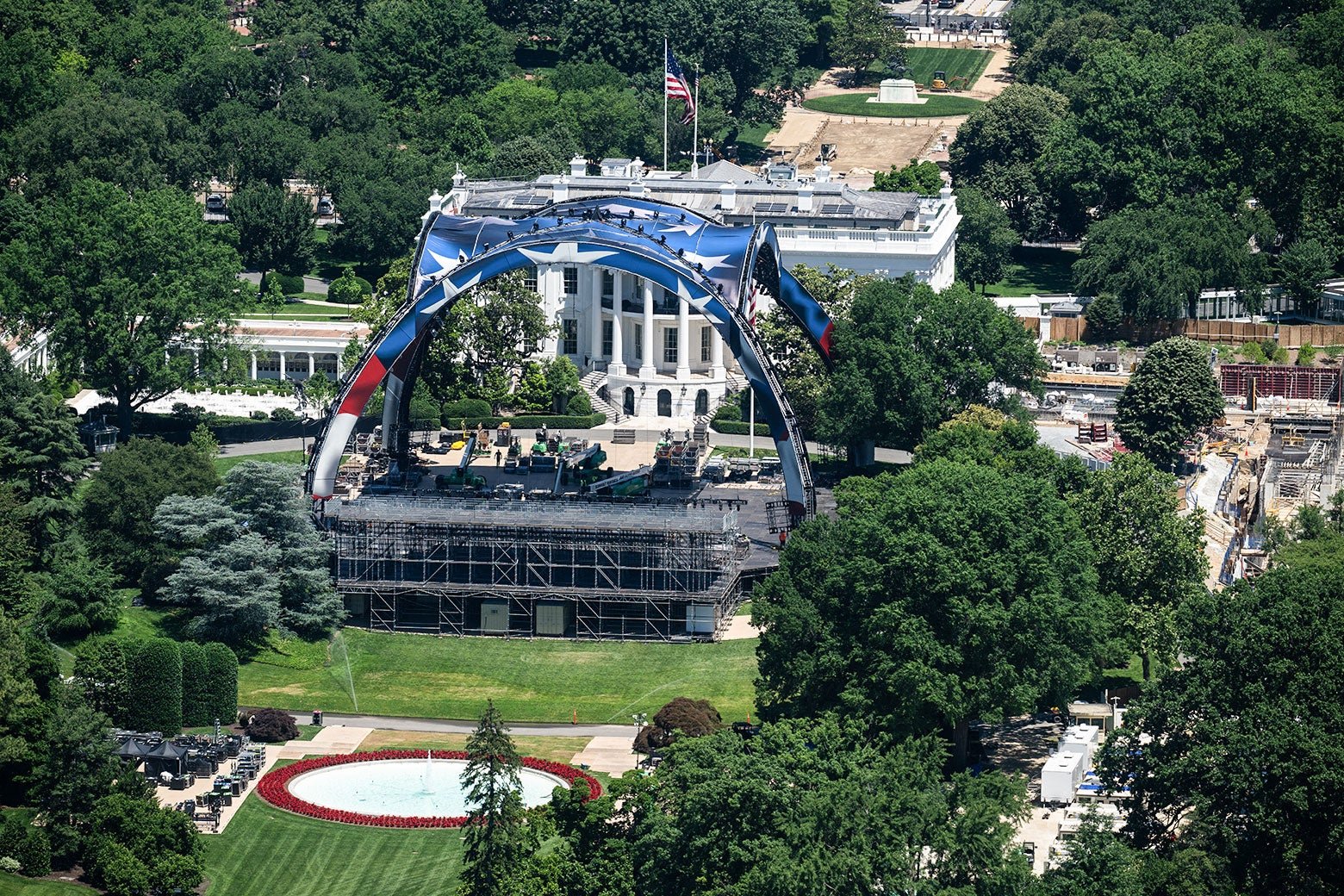
And then there’s “the claw.” The 92-foot-high metal structure Trump raised on the South Lawn of the White House has brought all the chintziness of a Six Flags entertainment pavilion to the center of the city. This weekend, it will host a series of UFC fights for the president’s birthday; you can practically smell the B.O. just looking at it. With the wisdom of someone who recently rewatched the movie Gladiator on an airplane, I can tell you that a political leader who stages barbaric fights as a propagandistic demonstration of power is courting his own demise, but no matter. I’m sure Trump would be pleased to know that the city’s Pride festivities, held on the second weekend of June every year in recent memory, had to be postponed by a week to accommodate his showcase.
The date change will have no substantive impact on local Pride offerings, as far as I can tell. But the symbolism of the switcheroo is staggering. For Trump’s pleasure and his close friend’s profit, queer dance parties have been supplanted by ritualized beatings. Drag performances have been replaced with a spectacle of aggressive gender conformity. A homegrown community celebration has been deferred for an event “presented by crypto.com.”
Not to be that guy, but in his 1935 essay “The Work of Art in the Age of Mechanical Reproduction,” Walter Benjamin wrote that “the logical result of fascism is the introduction of aesthetics into political life.” When the masses demand a new distribution of power and property, he argued, fascism offers them aesthetic expression and the illusion of change while keeping the prevailing system of property relations as is. Donald Trump promised his supporters lower gas prices, affordable homeownership, and a domestic manufacturing boom. He gave them a ravaged arts center, a Mar-a-Lago-blue Reflecting Pool, and a fight night on the White House lawn.
Slate is published by The Slate Group, a Graham Holdings Company.
All contents © 2026 The Slate Group LLC. All rights reserved.
Slate relies on advertising to support our journalism. If you value our work, please disable your ad blocker. If you want to block ads but still support Slate, consider subscribing.
Already a member? Sign in here