
Sign up for the Slatest to get the most insightful analysis, criticism, and advice out there, delivered to your inbox daily.
I did not ask to be born with the aesthetic preferences of a 12-year-old on 4chan, and yet, here we are. My favorite movie is Fight Club. My apartment walls feature not one, but two pieces of Berserk manga fan art. I’m a gun owner, I love German industrial music, and when it comes to video games, I almost exclusively play Eastern European survival horror. How I long for a single interest or hobby that doesn’t instantly generate that record-scratch noise at well-heeled liberal networking events: to watch soccer without falling asleep, to shazaam NPR music without shrugging, to get literally anything out of bird-watching.
It’s not that I’m ashamed of my tastes. It’s just that, at a time when we’ve decided every facet of daily life has to be blue-coded or red-coded, it all gets a bit lonely to be the only leftist I know who’s looking forward to watching mixed martial arts combatants beat the shit out of each other tonight outside the White House. (Or, as it’s officially known, “UFC Freedom 250.”)
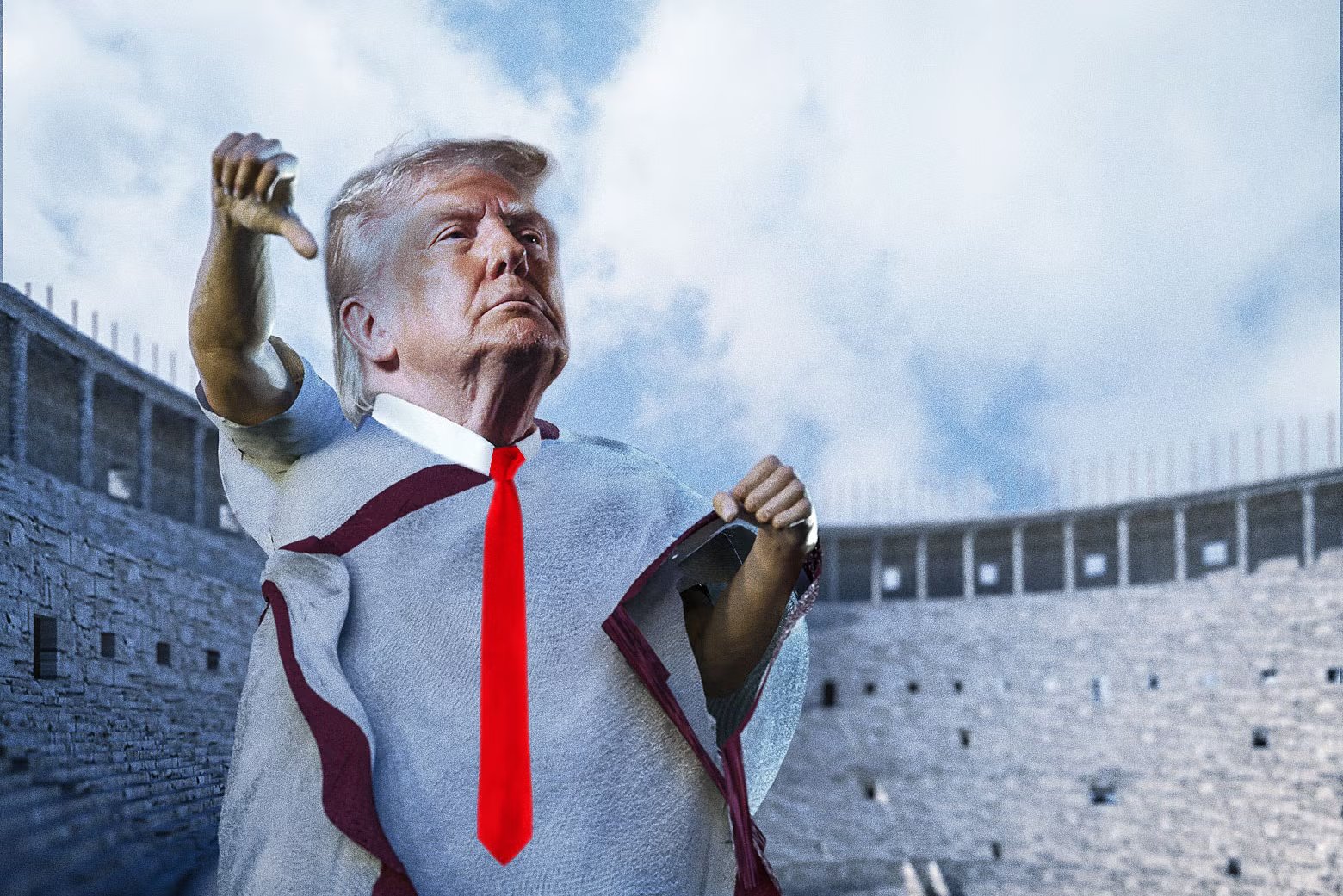
Let’s get one thing clear from the jump: What’s happening this weekend—Donald Trump throwing himself a birthday party under the guise of celebrating America—is an obscenity. Thanks to Trump, we’re marking our nation’s 250th anniversary with literal bread and circuses like some kind of Temu Rome. The cheesiest gladiatorial pit in history should not be killing all the grass on the White House lawn. It’s The Onion made flesh, the kind of absurdity that would cause any 2014 time-traveler to instantly smell burnt toast. The biggest tragedy here is for our country, full stop.
But permit me, as a lifelong MMA fan, to grieve a bit for my favorite sport: the only one I’ve ever truly loved. When the fighters step onto the lawn tonight, it’ll be the culmination of two ugly trends: Trump’s MAGA movement trying to claim MMA for its own, and the business empire that controls the UFC—and, increasingly, MMA itself—giving itself a Trumpy makeover.
I get why, to the uninitiated, MMA and MAGA seem like a natural match. It’s a blood sport whose fan base includes many young men—some of them quite angry. And I understand why people dislike it, even at its best. But mixed martial arts have always been deeply misunderstood. It is not WWE, which is high-level athletic theater; it’s a contest between two fighters, often with wildly different skill sets. It’s not “human cockfighting,” as John McCain termed it in 1996 while pushing for a ban on the sport—preliminary research suggests that both football and boxing cause more brain damage than MMA. It’s not (just) freak-show violence porn for atavistic freaks.
Until these last few years, however, it had little to do with politics. And any political framing one put on it would have to reckon with the fact that it had (MAGA trigger warning here) a lot of diversity, equity, and inclusion.
This sport transcends race, class, nationality, language, and religion. Aside from soccer, it’s the only truly global sport: Fans around the world watch as people from around the world practice martial arts from around the world. Amanda Nunes, the greatest female MMA fighter of all time, is an out lesbian from Brazil. Islam Makhachev, the current No. 1 pound-for-pound ranked fighter, is a devout Muslim from Dagestan. Francis Ngannou dropped out of school to work in a sand quarry at 10 years old and illegally migrated from Cameroon to France to pursue boxing, and went from homeless to heavyweight champion.
We’re marking our nation’s 250th anniversary with literal bread and circuses like some kind of Temu Rome.
MMA breaks down gender stereotypes every time a woman steps into the octagon. We endure endless screeds from the manosphere about the fundamental differences between men and women: men as strong providers, women as nurturers who belong in the home. MMA takes that assumption and sets it on fire. Women fighters are ferocious. They train hard, they go hard, they fight spectacularly. Go ahead. Try to constrain Ronda Rousey to the kitchen. See how that goes for you.
And, in its own bloody way, MMA can be beautiful: humans in extremis, rising to the occasion, pushing past their own boundaries to accomplish the impossible under the most adverse of conditions. MMA is everything Trump and his puffed-up sycophantic goon squad can never be: a contest of skill and discipline grounded in respect, in which appearance counts for nothing and genuine strength—physical, mental, and psychological—means everything. Or at least, that’s what it can be.
Thanks to the UFC executive suite’s decision to court MAGA and collaborate with the Trump administration, however, that potential is getting harder and harder to see.
I go to far-right events for a living. By 2024, my hobby was starting to feel like work, and it was only a matter of time before the sport degenerated enough to make it official. I’m in D.C. as you read this, preparing to cover the two-day UFC Fan Experience that will culminate in one of the stupidest things to ever happen on the White House lawn: Dear Leader’s gladiator-themed birthday party. Goddamn it.
So how did we get here? How did this sport I love transition from a contest of strength and skill into a giant birthday celebration in honor of our geriatric god-emperor? And can it ever return to what it used to be?
Scientists have yet to isolate the part of the human brain that enjoys wondering who would beat whom in a fight. But from lived experience, we know it’s very large, and I know personally that it’s especially large in the enlisted ranks of our armed forces. In the late aughts, my Army buddies and I made regular pilgrimages to the Buffalo Wild Wings just outside Fort Bragg in search of wings, beer, and enlightenment. Could a kung fu master beat a kickboxer? Was Jeet Kune Do (as developed by Bruce Lee) even real? Could a Greco-Roman wrestler take down a boxer? In the antediluvian world before seedy promoters began mixing martial arts, there was no way of knowing. Now, we had answers. Traditional kung fu? Pretty to look at, garbage if you’re trying to win a fight. Jeet Kune Do? Nonsense. Greco-Roman wrestling, Muay Thai, Russian Sambo, sometimes Taekwondo? Effective. The clear winner, out of left field, was Brazilian jiu-jitsu: a relatively new art accepted so rapidly that we already knew the basics from our Army combatives course.
MMA is the bastard child of illegal street fights and martial arts, which has always made for a strange blend of freak-show sleaze and a culture of respect. Traditional martial arts competitions do not revolve around personal grudges or showboating, but testing one’s skill against a worthy opponent. There’s nothing quite like watching two people duke it out for 15 vicious minutes, then hugging each other the moment that final whistle blows—or watching one fighter help another to their feet after a brutal knockout.
The UFC was one of many promotions back then: We watched Strikeforce, EliteXC, Pride. Everyone was having a great time. People won, people lost, people learned. The sport evolved before our eyes.
I got out of the military in 2010, then met and married a man just as into MMA as I was. Fights were our date night and always a blast. We bought compilations of the greatest matchups, watched The Ultimate Fighter, developed strong opinions on fighters, rankings, and preferred techniques.
The sport gained popularity throughout the early 2010s largely thanks to the Ultimate Fighting Championship, which quickly eclipsed other promotions until, for the general public, UFC and MMA became synonymous. UFC CEO Dana White became the de facto matchmaker for the entire sport. As a businessman, his primary goal was selling pay-per-views, which he accomplished by developing a reputation for arranging interesting, well-matched fights. Event promos occasionally played up drama between fighters, but nine times out of 10 the actual pre-fight interviews were primarily statements like “My opponent is very good, but I’m better and will beat him.”
It’s hard to say exactly when that culture of respect began to shift. Maybe it was The Ultimate Fighter: a competition reality show for a spot on the promotion’s roster that, like most reality TV, emphasized drama and personal beef. Maybe, as the sport grew, it attracted more fighters motivated by fame. Certainly Dana White realized he could sell more pay-per-views by playing up personal insults and grudge matches. Big personalities like Rousey and Conor McGregor helped him do it: both great fighters in their own right, both polarizing entertainers capable of generating big headlines. Those headlines attracted the kind of crowd more interested in drama than the fights themselves, which in turn incentivized more drama: a spiral that eventually changed the feel of the entire sport. I more or less accepted it. The fights were still good, even if White’s matchups started prioritizing personality conflicts over actual talent, and the theatrics had a trashy sort of appeal I could get behind.
In 2018, my husband and I divorced. Going to UFC events on my own made me sad, so I stopped going. COVID happened. I moved across the country. Sometime around 2022, I saw a poster on the outside of the bar. Looked like a good fight. Maybe I should watch again.
Some things were as I remembered them. I still got to watch supreme athletes do exceptional things under exceptional circumstances. But something had unmistakably changed.
Thanks to my job as a journalist covering the far right, I knew Trump was now a fight-side regular. I knew Dana White aggressively supported our disgraced then-former president. And yet, I still wasn’t prepared for how much the vibes had shifted. How many pre-fight interviews now involved personal insults, aggressive posturing, the desire to settle a score—how many post-fight speeches involved aggressive call-outs, rather than thank-yous to their coaches or families or God.
The crowds seemed different too. When I came back, I blamed New York City aloofness for the unwillingness of the people at the bar to talk shit with me, but now, I’m not so sure. Can East Coast brusqueness explain the chants of “USA! USA!” when Trump made his way ringside, and occasionally when an American fighter walked out? Can the city’s infamous combativeness explain the drunken asshole in a red hat who tried to start a physical altercation at the bar about Joe Biden with a stranger out of nowhere?
While the UFC was moving MMA away from what so many of us had fallen in love with, it was also moving it toward Trump and Trumpism.
Trump attended his first UFC event in 2019, but the love affair began in earnest after Jan. 6. At a time when almost having toppled our democracy seemed like a crime punishable by, at least, banishment from public life, UFC granted a stay of excommunication: Trump appeared at events and was welcome. Eventually he became part of the spectacle itself. “You can’t buy what the UFC gave to Trump in the 2024 election,” longtime combat sports analyst Luke Thomas said in a video posted to his Substack in April. “The fighters genuflecting before him, the commentators dapping him up, talking about how great it is that he’s here.” Every time Trump found himself in legal trouble, he popped up at a UFC event. His first public appearance after Jan. 6, aside from CPAC, was ringside in July of that year. He attended a UFC event immediately after every indictment, then popped up at the UFC 302 event two days after his NYC conviction. Dana White has served him well. “You can see why the UFC is now being granted a fight on the White House South Lawn,” Thomas said.
MAGA loves UFC because, like John McCain, they see MMA as human cockfighting—in the most phallic sense of that phrase. To them, fighters are pure, unadulterated masculinity: avatars of violence, power, and dominance divorced from every other aspect of the human experience, free from the corrupting gentleness of femininity. Because MAGA privileges aesthetics above all else, they value peacocks like McGregor, who long ago abandoned training in favor of celebrity, over actual discipline and talent. The (almost) no-holds-barred nature of the fights mirrors the total warfare Pete Hegseth lusts for, and the spectacle allows weaklings like Trump and Kash Patel to become tough guys by proxy.
As MAGA reaches for MMA, MMA reaches back. The sport’s movement toward drama and away from everything that makes this sport actually cool has only accelerated as Trump’s ethos of style over substance contaminates everything he touches.
Most people see a UFC event on the White House lawn as a profoundly inappropriate way to celebrate our nation’s 250th anniversary, and I wish I could agree. It is difficult, however, to imagine a more accurate representation of what we are becoming as a nation. Our pathetic colosseum will try and fail to evoke the glory of ancient Rome even as we try and fail to assert imperial power over Iran. Fighters will put their bodies and health on the line in the punishing D.C. heat with no medical insurance and little compensation for the amusement of the wealthy few. And fans like me will watch, helpless, as Trump enshittifies a sport that was never perfect but contained something beautiful regardless.
Is there a way back? Will the sport just be MAGA now? Will America just be MAGA now? And am I going to stay lonely in the crowd forever?
My favorite fight of all time never should have happened. Khabib Nurmagomedov, one of the best grapplers to ever set foot in the octagon, was set to compete for the lightweight belt. His opponent suffered an injury and withdrew last minute; his replacement pulled out the day before the fight. Desperate to save the card, the UFC tapped Al Iaquinta to step up at the last minute.
“Ragin’ ” Al, a low-ranked fighter known for decent grappling and heavy hitting, had no business fighting for the lightweight strap. He could, in theory, win with a knockout punch, but only if he could stay standing. Everyone knew how this fight would go: Nurmagomedov would take Iaquinta down to the mat, wear him down, and eventually choke him out.
For the first two rounds, that’s exactly how things went. But in round three, Ragin’ Al started talking shit and began to eat Nurmagomedov’s jabs for a chance to land that big knockout punch. Suddenly Nurmagomedov wasn’t trying to take Iaquinta down anymore: He was risking it all to stand and bang. For two and a half long rounds, Iaquinta ate punch after punch, swinging for the fences, hoping to connect. By the time Nurmagomedov took him down late in the fifth and final round, Iaquinta’s face was pouring blood, one eye swollen nearly shut. No one expected him to last that long, yet he refused to give up until that final bell, when the two men embraced and awaited the decision. Iaquinta lost catastrophically. Nurmagomedov defended the lightweight belt three more times and retired undefeated.
At the time, the Iaquinta fight was eclipsed by the exact kind of theatrics that the UFC values and that increasingly overshadow the sport itself. All anyone wanted to talk about was an incident two days earlier, when Conor McGregor shattered a window on Nurmagomedov’s tour bus and forced a different fighter to pull out due to cuts from broken glass. The stunt paid off; McGregor used the drama to score a lightweight title fight with Nurmagomedov six months later, where he lost in the fourth round.
But I think about that fight all the time. I tear up every time I talk about it; I’m getting choked up just writing about it. Where do you find the courage to keep going like that, knowing the odds? To encourage a larger, stronger opponent to punch you in the face over and over again, enduring the pain as your body breaks a little more each time, on the off-chance you can pull off a miracle?
Sometimes all you can do is fight, knowing you’ll probably lose but going for that puncher’s chance regardless. Winning is nice. But fighting is the point.