
Now Reading: Homing in on your breast health
- 01
Homing in on your breast health

Homing in on your breast health
Episode Transcript
Dr. Jill Klemin:
The main thing is just how common breast cancer is and we hear that statistic: One in eight women develop breast cancer. One in a thousand men develop breast cancer. So it’s not to exclude them, but I do think about 375,000 women in the United States will be diagnosed. It’s a huge number.
Courtney Collen (announcer):
Welcome to “Her Kind of Healthy,” an informative and unfiltered podcast series by Sanford Health. We want to start new and honest conversations about age-old topics, from fertility to postpartum, and so much more with our Sanford Health experts.
In this episode, we’ll hear from Dr. Jill Klemin who is a family medicine physician managing Sanford’s breast specialty clinic in Bismarck, North Dakota. We recorded her speaking during a Sanford Women’s event on Oct. 23, 2025 in Bismarck. It was called the Women’s Social where Dr. Klemin joined other Sanford Health providers on stage to discuss popular women’s health topics.
Here’s Dr. Klemin on breast health.
Dr. Jill Klemin:
Essentially, breast clinic is for anybody and everybody if you have any kind of breast concerns at all. So lumps or bumps, rashes, nipple discharge, pain, any kind of concern, anybody can come to breast clinic for a full evaluation. You can self-refer or have your physician refer if you have any questions.
Oftentimes I see patients certainly with concerns, symptoms, but also I see patients that have a family history of breast cancer, just wanting to know what’s their risk and what should we do about that. I see patients that have genetic mutations, which is so common since starting this work. I’m actually shocked at how common that is, that we have all these genetic mutations in our community as well.
And then what we do is take everything into consideration about that particular woman: density, family history, everything that could apply to a risk factor for her and we make a personalized risk assessment, just me and that patient and talk about what does that then mean? What does it mean once we find out that you’re at higher risk than we anticipated for breast cancer? What does that mean?
And so we do this together and what it usually propagates is a plan which includes imaging. So we work very closely with Dr. (Christina Tello-)Skjerseth and getting patients in for mammograms, extra screening, which could be an MRI ultrasound. We use all kinds of different modalities depending on the patient’s case.
I work very closely with our genetic counselors. They’re some of my favorite people. They do a great job with patients and can help us uncovering genetic mutations that they might have in their family. I work closely with the surgeons and anybody that needs general surgery, plastic surgery.
And then another thing that we do at breast clinic is there’s certain abnormalities or certain findings that we have in women that might require a medication, anti-estrogen medication, and we use that in the appropriate patient as well.
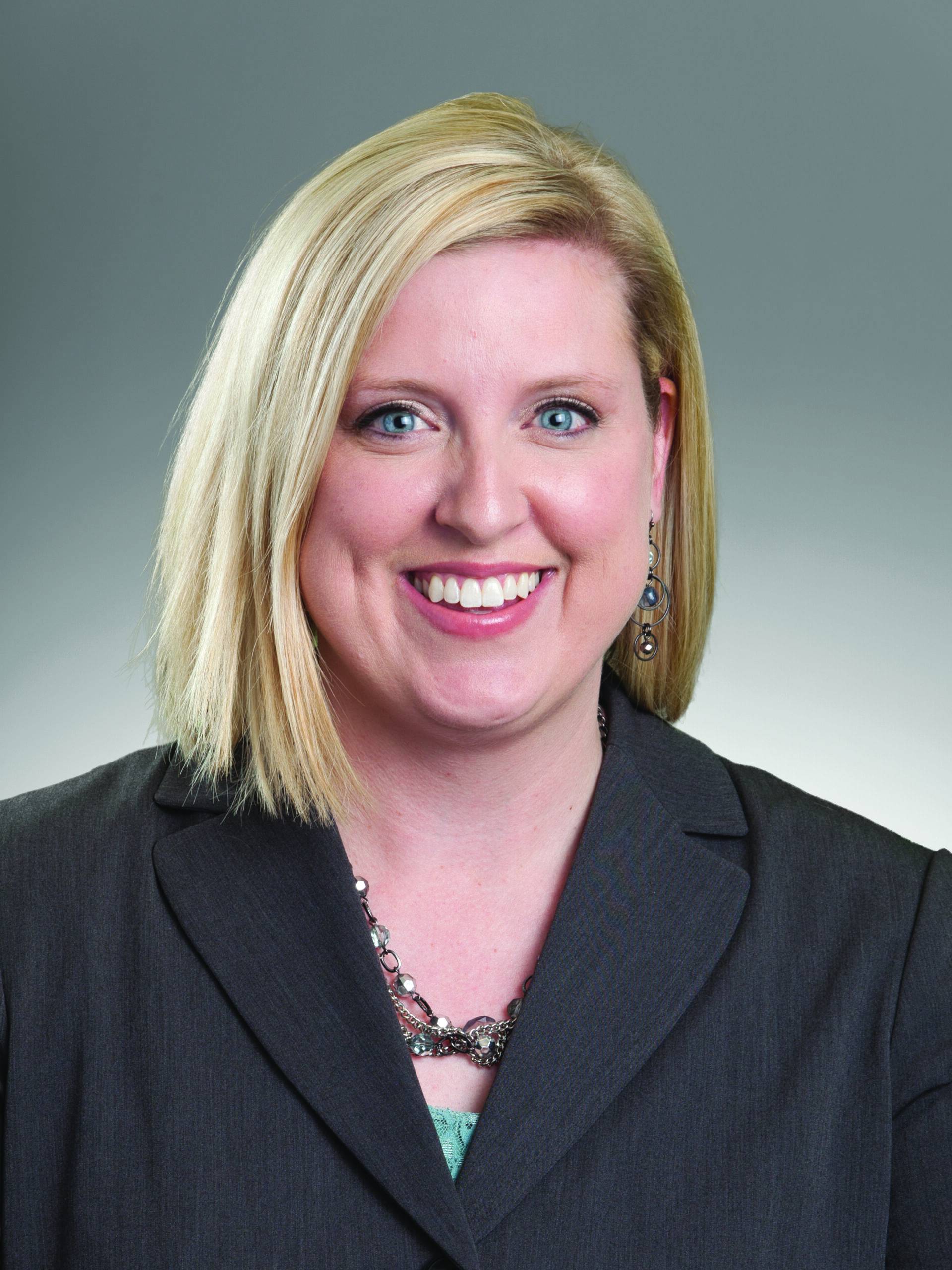
Dr. Jill Klemin
Photo by Sanford Health
I work with oncology a little bit in that I see all the non-cancer patients and try to do what we can to prevent, to do what we can to work anything up quickly and efficiently. But if there is a diagnosis of cancer, then work very closely with our oncology team to get the patient handed over there as well.
So what I do a lot of times when I have patients, as I’m sure my friends up here do, is just a ton of education. And so just wanted to go over some of the topics that come up in breast clinic every day.
The main thing is just how common breast cancer is and we hear that statistic: One in eight women develop breast cancer. One in a thousand men develop breast cancer. So it’s not to exclude them, but I do think about 375,000 women in the United States – can’t really wrap my brain around that. But there’s a new diagnosis every couple minutes. So as I’ve been sitting here tonight and we spend these hours together, I was just thinking how many women in the U.S. you know, would be diagnosed in that time. It is that common.
And I dare say that everybody knows somebody or has been touched by breast cancer in their family in this room as well. So it’s something that is on a lot of people’s mind and they really feel better when they come into breast clinic and we can evaluate their personal risk and then we make their plan based on that risk following national guidelines. We follow all of the national guidelines, NCCN (National Comprehensive Cancer Network), American College of Radiology, we try to use evidence-based medicine to design it and then typically insurance follows those guidelines.
So then we make sure that we have the financial piece covered for patients too. So, we talk to patients about the education, about how common it is, why it needs to be on our radar at all times. And then we talk about risk factors.
I always break this down into two simple ways of thinking about it. One is modifiable. Like what is controllable in our world? And a lot of that falls under the things we learned earlier tonight about self-care. Then there’s the other silo that’s the non-modifiable. So I’ll start with ideas there.
One would be gender obviously. So women are much more likely to develop breast cancer. Nothing we can do about being ladies. Secondly is race plays into it as well. Certainly genetics. We all know there’s things that run in our family that we can’t escape. And so knowing all of those things about our family history is really important. But again, not modifiable at all.
One of the things as I sit next to a gynecologist, one of the things that does play into a risk factor for breast cancer is age that you get your first period and age that you transition to menopause. And I always think about that makes complete sense because if you get your period and the studies really say that age of 12 years old, if you get your period before 12 years old or if you don’t transition through menopause until 55 or later, it makes complete sense that we’re exposed to those higher levels of estrogen for longer. So those women would then be at higher risk for breast cancer.
The other thing that’s a hot topic, and I love talking about it, Christina loves talking about it too, is breast density. We can’t do much about it. Maybe a few things changed. You know, weight gain, weight loss can change our density a little bit. But a lot of it is genetics that play into it. And there’s so many studies, hot topic being looked at, that density seems to play into the risk of breast cancer development. We can’t do much about what our density is.
And then one of the things that I see in breast clinic are certain breast biopsy results. So when it comes to breast biopsy, benign or cancerous are kind of the two options. But there’s this middle ground that is a benign biopsy. It’s not cancerous, but having those cells in your breast tissue will increase your risk in the future for developing breast cancer in either breast. So again, I consider that under non-modifiable risk factor because it is what it is and we deal with it and we make a plan based on that.
And then I really love listening to all of the self-care and how important that is when it comes to health care and putting ourself first sometimes. And the modifiable risk factors of course are going to be nutrition and it’s been studied very carefully like what certain diet, what should we avoid, what should we eat? And it really is simple for those of us that practice family medicine or primary care and that it’s the Mediterranean diet, which is easy for me as a family practice doc because I can lean into that for cardiovascular health too. So the lean proteins, tons of veggies and fruits. Really just taking the healthy fats, taking good care of your nutrition with self-care and that planning ahead a little bit, prioritizing what’s right for your body and not just like the chicken nuggets that the kids will eat. Like all of that plays into this.
And risk modification. Smoking obviously is always a risk factor I think for probably every cancer. When I talk about breast health, it’s actually alcohol use even more than smoking that I talk about which surprises most women. Like why are you asking me about how much I drink when we’re talking about my breast?
But we know that alcohol definitely impacts breast cancer risk. So having three drinks a week on average increases your risk by 15% and alcohol’s like an exponential graph. So the more that you drink, the higher the risk. And so these are things we see in textbooks all the time. But actually the more that I’ve done with breast clinic, I see it play out with my patients too. So it’s something that everything in moderation, but it’s something that I wanted to mention is a risk factor that most people don’t really realize when it comes to breast health.
And then exercise. So the data really shows right at about 40 to 45 minutes on a regular basis, more days than not, does decrease your risk of breast cancer as well. So there’s things that are in our power that if we pay attention to and practice our self-care and put ourselves first, really can change your risk of breast cancer.
And then there are things that we can’t change. So that’s what we’re here for. So when I have patients with me, we talk about screening. Mammogram is the only modality shown to save lives and it truly, truly does. The whole idea behind screening is to try to find something before we can feel it because then the prognosis is so much better and the treatment is much more limited in a lot of cases. So the idea of screening is to find it before we can feel it. And I always emphasize that I have a lot of patients that are like, “I don’t think I need my mammogram. Everything feels fine.” Like, oh that’s why we need our mammogram. So that is really important.
And then the whole idea too about finding out your personal risk is because sometimes it’s not just about the mammogram alone, that there’s supplemental or extra screening that we can do. So we never substitute for the mammogram because that’s our favorite. But there’s modalities we can do in conjunction with like MRI, ultrasound, things like that. So that’s really important too. So screening with a mammogram is really important. It does save lives.
Density – we talked about hot topic – about half of women have dense breast tissue. 10% of us are like the top tier and what we know about that top tier of density is that our risk is higher than we ever really realized before. It’s really important. And so there’s just something about that density, about the connective tissue in the breast, that does innately increase our risk.
Density also looks white on mammogram, and breast cancer oftentimes looks white on mammograms, so it’s also harder to see on mammogram. I tell my patients we’re looking for a snowflake in a snowstorm. And over time we’ve gotten better at finding that snowflake by having 3D modalities where the radiologist can scroll through that density a little bit better and they can find that snowflake in the snowstorm. So density is something too I wanted to talk about.
It’s not the way your breasts feel. So almost every day I have a patient come in and say, I have such dense breasts. Like they are so lumpy, bumpy and density is actually a radiology term. And so it’s how white your breasts look on mammogram, mammograms or X-rays. So how much connective, fibrous tissue is in your breast compared to how much fat is in your breast. And really only after having that first mammogram will you be able to kind of know your category. So that’s really important too.
And then just my last thing I wanted to wrap up with is patients always say, should I see genetics? Should I get genetics done? And I will never tell a patient no because you can’t always see a genetic counselor. You can have genetic testing done and the cost has come way down over time to have genetics done. But it’s really important for those we have guidelines to tell us who’s more likely to have genetic mutations. This would be somebody that has two relatives on the same side of your family. So like maternal side or paternal side, two relatives. One being young, at least one being young, like before menopause. That would be somebody that should be having genetics.
If you know about a genetic mutation in the family, like cousin so-and-so said they might have a check two mutation. That would be something to pay attention to and either a closer relative to that relative or you should be tested for that mutation itself. Certain cultural heritage that we do test because there’s more genetic predisposition in certain races or cultural heritage.
So it really is important to know your family history. I always tell my patients the holidays are coming up, there’ll be family gatherings, why don’t you like gently broach the subject? Because sometimes it’s taboo. It’s important to know your family history. That’s what I think. I know, that’s what I know. It’s important to know and sometimes different generations or just different family members don’t talk about it, so carefully enter that conversation.
Courtney Collen:
This was part of the “Her Kind of Healthy” podcast series by Sanford Health. For more by Sanford Health, visit Apple, Spotify and news.sanfordhealth.org.
Get more episodes in this series
…
Posted In
Bismarck, Cancer, Cancer Screenings, Cancer Treatments, General, Health Information, Health Plan, Healthy Living, Imaging, News, Specialty Care, Women’s