KRISTEN WELKER:
Subscribe to read this story ad-free
Get unlimited access to ad-free articles and exclusive content.

This Sunday: Ending the war? The U.S. and Iran move closer to a deal to end the conflict.
PRES. DONALD TRUMP:
We just made a great settlement of the war with Iran.
KRISTEN WELKER:
Is this the path to peace? And with the midterms approaching — and inflation rising — is the president delivering a message to help his party?
DONALD TRUMP:
I love the inflation. When the war is over, it’s coming down.
KRISTEN WELKER:
Steve Kornacki reveals the results of our latest NBC News poll. Plus: Slow count. As California takes weeks to count ballots, Republicans renew their attacks on the state’s mail-in voting system and the integrity of its elections.
SPEAKER MIKE JOHNSON:
I think everybody knows instinctively something is wrong here.
REP. HAKEEM JEFFRIES:
Republicans are peddling conspiracy theories.
KRISTEN WELKER:
And, Maine fight.
GRAHAM PLATNER:
Thank you Maine.
KRISTEN WELKER:
Despite the controversy surrounding his campaign, Graham Platner wins the Democratic nomination in Maine.
GRAHAM PLATNER:
If you believe as I do that we can change our politics and change our country, then you must also believe that people can change.
KRISTEN WELKER:
Will he help Democrats retake the Senate, or cost them one of their best pickup opportunities? My guests this morning: House Democratic Leader Hakeem Jeffries of New York, Republican Senator James Lankford of Oklahoma, and Democratic Senator Raphael Warnock of Georgia. Joining me for insight and analysis are: NBC News White House Correspondent Monica Alba, Jonathan Martin of POLITICO, Mike Dubke, former Trump White House communications director and former Biden White House senior adviser Steve Ricchetti. Welcome to Sunday. It’s Meet the Press.
ANNOUNCER:
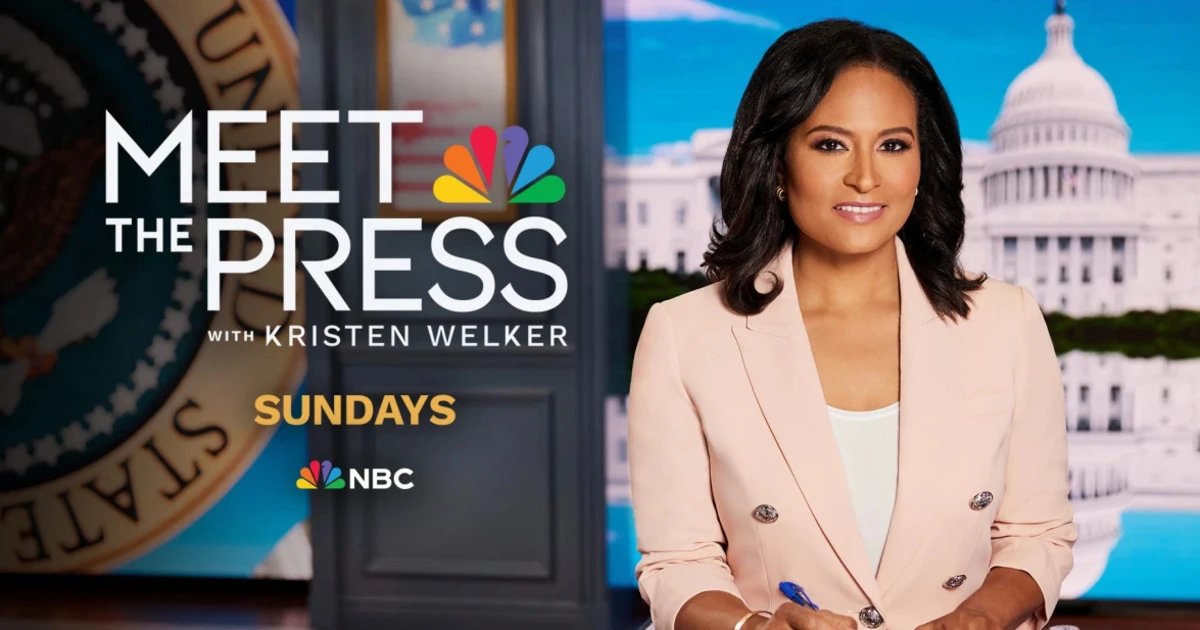
From NBC News in Washington, the longest-running show in television history, this is Meet the Press with Kristen Welker.
KRISTEN WELKER:
Good Sunday morning. After more than 100 days of war, this weekend, President Trump said the U.S. and Iran would sign a deal today. Mr. Trump saying that deal would reopen the Strait of Hormuz. It would also set a timeline to dismantle Iran’s nuclear program, according to the president. But no final agreement is final until President Trump and Iranian leadership sign on the dotted line. Against that backdrop, today, President Trump celebrates his 80th birthday, marking a milestone with an elaborate UFC fight on the White House south lawn. Meanwhile, inflation rocketed about 4% this week, marking a new three-year high. With the midterms less than five months away, our Chief Data Analyst Steve Kornacki, joins me now with the results of our latest NBC News poll. So we are within five months of the midterms, what are the big headlines?
STEVE KORNACKI:
Yeah, Kristen. To start, just the bottom line on Trump’s standing with the voters right now. His approval rating sits at 42% in our NBC poll. Now, this is with registered voters. And that is down a tick. You can see the last time we checked in, early in the spring, he was at 44%.
KRISTEN WELKER:
Is that a new low, Steve? 42%?
STEVE KORNACKI:
That is the second term low in our poll for Donald Trump, falling to 42% right now. And the other thing that this dovetails with of course is the generic congressional battle with the Democrats now. As you said, inside of five months to the midterm, a five-point lead for the Democrats here. Now obviously that’s a strong number for them. What the Republicans would say on this is: If you think back to Trump’s first term, that blue wave of 2018, this number was more at, like. eight to ten points. So Republicans hoping to contain the damage at least looking at a number like that.
KRISTEN WELKER:
And as the country prepares to mark its 250th anniversary, you’re also looking at how Americans feel overall Steve.
STEVE KORNACKI:
Yeah, some — some big picture numbers on how folks feel about the country, where it is. Some sobering numbers maybe. Take a look at this one. “How proud are you to be an American?” we asked, as we celebrate 250 years. So you see the different options here. Look: “extremely proud,” “very proud.” Those numbers together get you 56%. At the other end of it: “only a little” or “not proud at all,” 21%. The significance of this, this number is in decline. A steady 21st century decline. At the turn of the century, three quarters of Americans were extremely or very proud. That number’s fallen to 56%. What’s behind this? It’s familiar fault lines, Kristen, political demographic. Check — check this out here. First, it’s partisan. Look at this: Republicans are almost universally going to tell you, “extremely or very proud.” Look at that number for Democrats. And meanwhile, “only a little or not at all,” 12 times as many Democrats say that compared to Republicans. We have talked about age here so many times. Older Americans more likely to have that extremely proud feeling. Younger Americans much more ambivalent on this question. That’s the state of the country. How about the major institutions that sort of undergird the country? Two ways to look at this. First of all, just take a look at these words. Very, you know, “great deal” or “quite a bit” of trust and confidence in institutions. This is a very small list right here. Military is the only major institution that a majority of Americans have a great deal or quite a bit of confidence. You’re probably looking at colleges and universities and you say, “Why are you putting a number with only 36% on there?” It’s because of that divide we were just talking about. Check this out, that partisan divide. Look at this. A majority of Democrats have a great deal or quite a bit of trust in colleges and universities. The significance: this is the only major institution that a majority of Democrats feel that way about. They don’t feel that way about the military or any other institution. Meanwhile Republicans you can see, 86% in the military, only 17% colleges and universities. And then the flip side. Look at this. “Very little” or “no confidence” at all, long list here of these institutions: the news media, Congress, federal government, religious organizations, Supreme Court. Over the last 20 years these numbers are 20 or 30 points higher than they’ve been. Just deteriorating confidence. You could see a partisan divide a little bit on these too. Republicans much more distrustful of the media, Democrats extremely negative on the Supreme Court. And then Kristen, just again, big picture here, asking folks about where we are going. Do our best days lie ahead of us or are they behind us? Look at that number, almost 60% behind us. There is a bit of a partisan gap here. One thing to note, when Joe Biden was president a few years ago, it was the Democrats who were a little bit more optimistic than the Republicans. So there is a partisan aspect. That’s where we’re going. Maybe we end on a positive note, where we’ve been. How about this question? How much has America achieved its founding ideals? 70% say, “a great deal or fair amount,” only 29% not. And — and by the way, 50 years ago, the bicentennial, same question was asked. Numbers weren’t too different. So big picture, looking back, we do feel good about where we’ve come.
KRISTEN WELKER:
And yet, a lot of pessimism about where the country is according to this poll. Steve Kornacki, thank you so much. Great to have you hear as always. And of course, the number one issue for voters continues to be the economy, part of what’s driving the urgency to end the war in Iran.
[BEGIN TAPE]
PRES. DONALD TRUMP:
Our numbers were great. You know what I really love? I love the inflation. You know why? Because as soon as this war is over, you know, I can say it now. Something you didn’t know. Do you know we’ve been taking out millions of barrels of oil? Nobody knows that. You know who doesn’t know about it? Iran until right now. When the war’s over, it’s coming down. It’s going to come down like a rock.
[END TAPE]
KRISTEN WELKER:
And joining me now is House Democratic Leader Hakeem Jeffries of New York. Leader Jeffries, welcome back to Meet The Press.
REP. HAKEEM JEFFRIES:
Good morning. Great to be with you.
KRISTEN WELKER:
It’s great to have you back. I want to start right there on Iran with President Trump saying a memorandum of understanding could be signed as early as today, which based on all of the public information, based on what he has posted, would reopen the Strait of Hormuz, set a timeline for dismantling Iran’s nuclear program. What — based on what you know so far, Leader Jeffries, do you support this memorandum of understanding?
REP. HAKEEM JEFFRIES:
Well, we’d have to take a look at what the ultimate resolution is, if there is one. Donald Trump has now said 38 or 39 different times during the course of this war that it was about to come to an end and an agreement was about to be reached. And that has never happened. In fact, Donald Trump told us that Iran’s nuclear program had been completely and totally decimated. He said that last year. It was not true. Donald Trump told us that the Iranian regime was on the brink of collapse in the aftermath of the Ayatollah being killed. That of course has not happened. And so, at this point in time, all we can conclude is that this reckless and costly war of choice has been a disaster. As it relates to strengthening the national security of the American people, things aren’t better for us. They’re worse. In fact, Iran is stronger right now. What we have seen is gas prices skyrocket through the roof. And that has had an adverse impact on hard-working American taxpayers.
KRISTEN WELKER:
Leader Jeffries, though, if President Trump is able to strike a deal with Iran that ultimately leads to Iran getting rid of its nuclear enrichment program, will it have been worth it? And would you support that?
REP. HAKEEM JEFFRIES:
We actually had an agreement that was executed and led by President Barack Obama to constrain Iran’s nuclear program. It was Donald Trump who made the decision to actually rip that agreement up because apparently he suffers from Obama derangement syndrome. That agreement that had been reached by President Obama actually resulted in Great Britain, France, Germany, South Korea, India, Japan and thanks to the leadership from President Obama and his administration, China and Russia, all engaged with Iran to limit their nuclear aspirations. Donald Trump then enters us into this reckless and costly war of choice. And the question that the American people are understandably asking is how has this in any way made things better? Gas prices are through the roof. Iran is stronger now, not weaker. And the American people are less safe.
KRISTEN WELKER:
The Iran nuclear deal that was struck during the Obama administration was not signed into law by Congress. Should it have been? And should any new deal be signed into law by Congress?
REP. HAKEEM JEFFRIES:
Well, there was a process by which Congress could either accept or reject the agreement. And I, of course, along with the overwhelming majority of Democrats in the House and the Senate, supported the Iranian nuclear agreement and it clearly was the right decision at the time. And what we’ve seen is that Donald Trump promised not to start wars in the Middle East, but to stop them. But he’s turned around and done the exact opposite as opposed to actually focusing on the problems that the American people need to see resolved, which is driving down the high cost of living. The economy is broken. The American people know it. And as Democrats, we’re committed to actually doing something about it.
KRISTEN WELKER:
All right. Well, let’s look ahead to the midterms. We are of course in the middle of the primary season. You just heard my conversation with Steve Kornacki which shows Democrats have a five-point lead on the generic congressional ballot. Early voting has of course already started in New York. Democrats failed to win the House majority back in 2024 by running largely campaigns against President Trump. Do you believe that candidates should replicate that same strategy in this election cycle?
REP. HAKEEM JEFFRIES:
Well, actually House Democrats failed just three seats short of taking back the majority in 2024, outrunning the national political environment. When Donald Trump won in 2016, he lost the popular vote but he came to Congress with 241 Republicans and only 194 Democrats. Of course, in Donald Trump’s first midterm election, we flipped 40 seats. This time around, because of our over-performance in 2024, with candidates who are focused on the economy, we only need to flip a handful of seats. And we will. With a focus on driving down the high cost of living, fixing our broken health care system, getting ICE under control, ending this reckless and costly war of choice in the Middle East and cleaning up corruption. Fundamentally, we believe that America’s far too expensive. The cost of living is way too high. There are far too many people who are working hard. They’re playing by the rules. But they can’t thrive and can barely survive. That’s an unacceptable situation in America, the wealthiest country in the history of the world. And we’re going to focus like a laser beam on actually making life better for working class Americans, everyday Americans, middle class Americans and all those who aspire to be part of the middle class.
KRISTEN WELKER:
Leader Jeffries, I do want to ask you. If Democrats do in fact take back the House, I want to get an understanding of what your top priorities would be. Representative Alexandria Ocasio-Cortez, your colleague, said this back in April: “[President Trump] has launched a massive war of enormous risk and of catastrophic consequence without reason, rationale, or congressional authorization which is as clear a violation of the Constitution as any. All of these incidents and plenty more have clearly driven our country past the threshold for impeachment.” Do you agree if Democrats take back the House, will you move to impeach President Trump?
REP. HAKEEM JEFFRIES:
We haven’t ruled anything in or ruled anything out in terms of accountability. What we have said is that our focus is going to be to make life more affordable for the American people. We have to drive down the high cost of living. We have to restore the American dream, which a lot of people understandably have concluded is broken right now. When you work hard and play by the rules in this country, we believe that you should live an affordable life, a comfortable life and a good life. That means a good paying job, good housing, good health care, a good education for your children and when it’s all said and done, a good retirement. That’s what brings Democrats together in the House, in the Senate, governors all across the country. And that’s what we’ll focus on when the American people give us an opportunity to govern on their behalf in the majority.
KRISTEN WELKER:
All right. I want to ask you the big news this week out of the Senate, Graham Platner winning his primary in Maine. Of course he has faced allegations of being physically threatening to ex-girlfriends which he denies among other controversies which have followed him. Here’s a campaign ad being run by Senate Republicans. Take a look.
[BEGIN TAPE]
AD:
Susan Collins doesn’t have a Nazi tattoo and she doesn’t have an account on a notorious predator’s paradise app. Graham Platner did for years. And this was his profile picture. Oh, gosh, please, please, get that off the screen. Anyway, Susan Collins, a senator we can be proud of.
[END TAPE]
KRISTEN WELKER:
Does Graham Platner have the character to be a U.S. Senator, Leader Jeffries?
REP. HAKEEM JEFFRIES:
Well, first of all, I thought you were going to say the big news of the week is the Knicks winning the NBA championship –
KRISTEN WELKER:
We’re going to get to that too.
REP. HAKEEM JEFFRIES:
– for the first time in 53 years. I appreciate that. In terms of the Maine Senate race, listen, the voters of Maine are ultimately going to be the ones to decide what’s in the best interest of the people of Maine. At this period of time, I’m just focused on making sure we take back control of the House of Representatives. So we actually have a Congress that is a check and balance on an out-of-control executive branch consistent with who we were meant to be according to the framers of the Constitution, as opposed to what we’ve seen House Republicans do, which is to serve as nothing more than a reckless rubber stamp for Donald Trump’s extreme agenda.
KRISTEN WELKER:
Let me ask you though, Leader Jeffries, because under Maine’s election laws, Democrats still have enough time to replace Graham Platner. Given all of the controversies that he has faced, do you think they should replace Graham Platner or stick with him?
REP. HAKEEM JEFFRIES:
Well, the voters of Maine elevated him in the primary and ultimately senators are going to have to make that collective decision I assume in terms of what happens. And again, I think, I have a responsibility — We have a hard enough job pushing back against Donald Trump’s extremism and the sycophantic behavior of my Republican colleagues in the House. We need to focus on that job and we need to make sure we’re doing everything possible to win back control of the United States House of Representatives in November.
KRISTEN WELKER:
All right. Now let’s talk about the Knicks. Congratulations. They won for the first time, their first title in 53 years last night. Mayor Mamdani is planning a ticker-tape parade. Are you planning to be there, Leader Jeffries?
REP. HAKEEM JEFFRIES:
I certainly hope to be there, trying to work out some logistical things in terms of previously-committed travel. But it’s an ongoing celebration for New York City fans. Basketball is a city game. The Knicks are the city team. It’s a team that showed a lot of heart and soul and grit. The resilience of New York City shone through in terms of how this team launched this incredible playoff run. And we’re all thankful that it ended in a championship.
KRISTEN WELKER:
All right, well, congrats to the Knicks and Knicks nation. Leader Jeffries, thanks so much for being here. We appreciate it.
REP. HAKEEM JEFFRIES:
Thanks so much.
KRISTEN WELKER:
When we come back, Republican Senator James Lankford of Oklahoma joins me next.
KRISTEN WELKER:
Welcome back. Joining me now is Republican Senator James Lankford of Oklahoma. Senator Lankford, welcome back to Meet the Press.
SEN. JAMES LANKFORD:
Glad to be back with you again.
KRISTEN WELKER:
It’s great to have you back. I want to start with you on Iran, as well. President Trump says that Iran has agreed to never have a nuclear weapon. It’s worth noting they have agreed to that in the past. Of course, the more complicated issue is what to do about its nuclear program. How do you dismantle its nuclear stockpile? Is a deal that leaves those issues unresolved a good deal, in your mind, Senator?
SEN. JAMES LANKFORD:
Well, let’s wait and see what the deal actually is. That’s part of the challenge that we have right now, is we have not seen the details of the actual agreement yet, on this. But the president’s been very, very clear, Iran cannot have a nuclear weapon, cannot have a nuclear weapons program, and cannot keep that highly enriched uranium in the country. That is dramatically different than what President Barack Obama was negotiating years ago. When Barack Obama was negotiating, “You have to delay your nuclear program.” President Trump is, “No, you can never have a nuclear program. You can’t have the stockpiles. You can’t have a program there.” That makes an incredible difference for us. So not having a nuclear program, not having a closed Strait of Hormuz and not having a terrorist nation actually terrorize the rest of its neighbors and the United States would be a huge gain for us.
KRISTEN WELKER:
And of course, you’re right, we don’t know the specifics. We haven’t seen the text. There has been public discussion and questions surrounding whether part of this deal might give Iran $300 billion in a reconstruction fund. Your colleague, Senator Lindsey Graham, had this to say about that possibility. Quote, “The idea of a $300 billion reconstruction fund, given who is in charge of Iran, seems to be tone deaf. It would be akin to a Marshall Plan for Germany with the Nazis still in charge.” Now again, the final terms of the deal have not been made public. But do you agree with Senator Lindsey Graham that effectively, with this same regime in charge, there should be no economic rewards, that that would be a mistake?
SEN. JAMES LANKFORD:
What’s been interesting is, I haven’t heard anyone from the administration float anything like that. That’s what’s floating around social media, to be able to have this giant fund for Iran. What has actually been stated by the administration is folks like Treasury Secretary Bessent saying that the Iranian frozen fund should actually be used to help rebuild Kuwait, rebuild Jordan, rebuild the areas that Iran has attacked, and that any funds that would be unfrozen that are Iranian funds that are being held by countries all in the region where Iran and its regime has hidden its money off, any of those funds could only be released if there was a change in behavior, not a change in a signature or words. They’ve got to be able to drop their terrorism. They’ve got to release all these nuclear ambitions that they have. And they’ve got to reopen the Strait of Hormuz. Now, the dollars that are out there are Iranian dollars frozen in other banks. But those need to be first used to be able to fix what they broke. And that also needs to be used only return back to them or get access back to them, if they actually have action that actually brings peace.
KRISTEN WELKER:
One of the criticisms of the nuclear deal struck during the Obama administration, I was just talking about this with Leader Jeffries, the fact that it wasn’t codified by Congress. It did enable President Trump to rip it up. Do you think that any deal that President Trump strikes should in fact be voted on and ratified by Congress?
SEN. JAMES LANKFORD:
Yeah. It is best if it is ratified by Congress, it has a more lasting effects on it. Barack Obama’s nuclear deal was so bad, when Joe Biden came in the White House, he did not reinstitute it. He had four years. Then, he looks at it and said, “No. We’re not going to try to do the same deal that Barack Obama did on it.” So President Trump was right to be able to tear that up. It opened a pathway towards a nuclear weapon and just delayed it outside of the Obama presidency. That doesn’t help the American people, long term. I think people forget Iran has been at war with the United States for 47 years. What President Trump is trying to do is to be able to end Iran’s constant attack of Americans, and American assets and American allies in that region and come and get us. So to get an end to that is very, very significant. We have military bases all in that region because Iran is constantly attacking us. So to try to end that forever helps us in this generation and future generations.
KRISTEN WELKER:
A key surveillance tool, Senator, lapsed on Friday, after Congress failed to renew it in time, FISA. The country is in the middle, of course, as you know, of the World Cup, this war with Iran. Has this lapse made the country less safe?
SEN. JAMES LANKFORD:
Oh, 100%, it’s made the country less safe. And this has been a frustrating thing for me. Democrats are mad at the president, again. And so that — to stick the president, they’re actually putting American national security at risk. This is the same thing that we face on them shutting down the government, over and over again. They don’t want to pay federal workers because they’re mad at President Trump. They want to try to block everything and to be able to reopen a closed border because they’re mad at President Trump. Now, it’s literally during the World Cup, during this ongoing conflict in Iran, with all the things that are happening around the world, with Al-Qaeda continuing to try to find ways to be able to attack the United States. We have literally notified the entire world, we’re no longer watching. That is incredibly irresponsible. So this needs to be turned back on again to say, “No. We are watching.” We have one lesson from 9/11. We need to pay attention to people around the world. When they mean to do us harm, they have the ability to be able to do us harm. And they’ve shown that clearly. Now, to be able to say, “We’re not going to watch,” I think, is very irresponsible. So let’s get that back on again. The president announced Jay Clayton to be able to come on, to be able to lead the director of national intelligence. He has wide bipartisan support. He’s gone through confirmation process before, with wide bipartisan support. Already, Democrat leaders on both the House and the Senate have expressed their support for him. This is absurd, to be able to just close down FISA and to say, “We’re mad at the president. And so we’re just going to shut things down and not listen, worldwide.”
KRISTEN WELKER:
All right. A couple more. And of course, their argument is he had initially picked Bill Pulte to serve as acting director, who doesn’t have experience in intelligence. But let’s keep moving because we’re almost out of time. Republican Senator John Cornyn of Texas who lost his primary, last month, to Texas Attorney General Ken Paxton, had a pretty blunt prediction, Senator, for Republicans, telling the New York Times this week, quote, “I think November is going to be a disaster.” Do you agree with Senator Cornyn, that the midterms are going to be a disaster for Republicans?
SEN. JAMES LANKFORD:
I don’t, actually. And I didn’t see that exact quote. I don’t know if he was talking about Texas or if he’s talking about across the entire country, because we continue to see more and more Republicans showing stronger and stronger polling numbers. I saw Kornacki at the very beginning of this and saw — and heard his comments saying that, “Hey. The separation between Democrats and Republicans is actually pretty close, compared to what it would be.” We also see, in multiple states, where there’s not a Democrat running at all, or there’s an Independent running, and Democrats are saying, “Vote for the Independent here,” because the Democrat brand has been so damaged. They’re open borders, what happened with inflation. We’re talking about 4% inflation now, which is too high. But under the Biden administration, it was 9% inflation with the open borders and what was happening with the crime that was happening. I think Americans, when they look side by side, they will see the dramatic difference.
KRISTEN WELKER:
Nine was the peak. It did then come down to about 3%, as he was leaving office. But let me go back to Ken Paxton, for a second. He’s faced allegations of bribery, fraud, abuse of power, retaliating against whistle blowers and more. Last year, his wife sued for divorce on what she said were, quote, “Biblical grounds.” Do you think Ken Paxton has the character to serve as a U.S. senator?
SEN. JAMES LANKFORD:
I think the people of Texas will make a decision on that, just like the people in Maine will make a decision about Graham Platner on this. Everybody makes their own decision for their own reasons. I look at the policy areas. There’s a lot of personal things. And I look at personal things. And I think that matters. I think it matters for leaders. But I also look at the policy areas. What Talarico is bringing is an open border. He’s bringing a very different economic model on this. So I think all those things matter, for Graham Platner and his statements about healthcare, and about open borders, and about crime and all those things I look at. I think the people of Maine, the people of Texas are going to have to make their own decision.
KRISTEN WELKER:
But, Senator, very quickly, would you campaign with Ken Paxton?
SEN. JAMES LANKFORD:
Yeah. When I look at the side by side between Talarico and Ken Paxton, I think the policies do matter on that, significantly. Yes.
KRISTEN WELKER:
Okay. Senator Lankford, thank you so much for being here. We really appreciate it.
SEN. JAMES LANKFORD:
You bet. Glad to be able to visit with you again.
KRISTEN WELKER:
And you, too. Thank you. When we come back, Democratic Senator Raphael Warnock joins me next.
KRISTEN WELKER:
Welcome back. And joining me now is Democratic Senator Raphael Warnock of Georgia. He’s the author of the new book, “The Crooked Places Made Straight.” Senator Warnock, welcome back to Meet the Press.
SEN. RAPHAEL WARNOCK:
Great to be here with you.
KRISTEN WELKER:
It’s great to have you back. We are going to talk about your new book, I have it right here, “The Crooked Places Made Straight,” in just a moment. I do want to start off though, Senator, by asking you about the Voting Rights Act. As you know, it was weakened with the Supreme Court’s recent ruling that a Louisiana map designed to protect minority representation amounted to a, quote, “Unconstitutional racial gerrymander.” The decision opened the door to redistricting all across the country. Do you think race should be used as a factor to draw congressional lines, Senator?
SEN. RAPHAEL WARNOCK:
Well, I think that’s exactly what the Supreme Court is doing. The Supreme Court that we are witnessing right now is packed, sadly, with– with partisans. And they made a decidedly partisan decision, by pretending that you can disaggregate racial gerrymandering from partisan gerrymandering. And as a result of that, look at the results. We are seeing southern states, with a vengeance, move to diminish and mute the voices of their Black citizens. And so we should be asking these state governors, these state legislators, do they think it makes sense to take the whole country back to a Jim Crow era, so that the Congress would look more like 1954 than 2024?
KRISTEN WELKER:
Well, and that takes me to my next question because some of your colleagues and fellow Democrats are calling for adding additional seats to the Supreme Court. Would you support that? Would you vote to add additional seats to the Supreme Court, Senator?
SEN. RAPHAEL WARNOCK:
I think we have to look at what’s happening in our country because it’s very serious. Donald Trump, in this most recent iteration, began this terrible race to the bottom that we’re seeing with gerrymandering, by calling into Texas and saying, “I need five more seats.” The Supreme Court then poured fuel on that fire and with a vengeance, while people are literally casting their votes. We’re seeing state legislatures led by craven politicians race to try to play with the lines, to jimmy-rig the outcome, in order to make it impossible for ordinary American citizens to hold their elected officials accountable at a time where this economy is not working for us. And the Supreme Court continues to undermine its own credibility. I think that all options have to be on the table. We definitely need reform to this court. We need a code of ethics. And all options, at this point, have to be on the table.
KRISTEN WELKER:
So that includes adding seats and or term limits?
SEN. RAPHAEL WARNOCK:
All — all options have to be on the table.
KRISTEN WELKER:
Okay. Senator, let me talk to you about the midterms, one of the big headlines this week, Democrats officially nominating Graham Platner and their Senate candidate in Maine, despite a swirl of controversies from allegations of abusive behavior from ex-girlfriends, which he firmly denies, to a tattoo associated with a Nazi symbol. He says he obtained that without understanding its meaning. He has since covered it up. Do you believe Graham Platner has the character to serve in the United States Senate?
SEN. RAPHAEL WARNOCK:
Well, here’s what I’ll say. Character matters. And that’s what I’m saying in this new book that I’ve written, “The Crooked Places Made Straight.” And I think that the voters of Maine have an opportunity to see who they want to represent them in the United States Senate. They will decide that.
KRISTEN WELKER:
You know, you are considered a leader within the Democratic party. Do you plan to campaign for Graham Platner, Senator?
SEN. RAPHAEL WARNOCK:
I — I intend to focus on the people of Georgia, you know? I’m very proud of the fact that Georgia elected its first Black senator and its first Jewish senator in one fell swoop, in 2021. My brother, Jon Ossoff, is — is in a real fight. I think, you know, people are feeling positive about that outcome. But I would remind people that it’s still Georgia. It’s a very purple state. And so I’ll be focused on that race. I will be working, you know, to do everything I can, to make sure that we have the majority, come November, because quite frankly, the future of our democracy depends on it.
KRISTEN WELKER:
Okay.
SEN. RAPHAEL WARNOCK:
And so I will be moving all over — all over the country, doing whatever I can. But I think, at the end of the day, the voters in these states will clearly make their decision about who they want to support.
KRISTEN WELKER:
Okay. I don’t hear you saying you’re going to Maine. Let me ask you about your book. And I want to read a quote. You talk about your central argument about character and politics. You say, quote, “To get more equity in the land, we desperately need more integrity, more leaders committed to truth, regardless of party politics.” So just to be clear, are you calling for your own party to examine its character and politics as well, Senator?
SEN. RAPHAEL WARNOCK:
Oh, absolutely. Listen, I often say that I’m not a senator who used to be a pastor; I’m a pastor in the Senate. And I wrote this book, which began as a sermon, actually, that I preached before my own congregation. And then, I found myself preaching it in Jewish temples, in churches, in small store fronts, at the National Cathedral. And — and this is a pastor who’s serving in the Senate, speaking to my country in a moment where our shouting matches between the left and the right are getting louder and louder, and the vision is getting smaller and smaller, and we have way too many politicians who are so focused on the next election that they’re not thinking about the next generation. We need integrity. We need people who love democracy more than they love power. And when we — when we don’t have that, we’re seeing what happens. You have a lawless president who’s being enabled by politicians who will do anything to stay in power. I think that’s bad for the democracy. And I would hold all of us accountable.
KRISTEN WELKER:
All right. Well, let me ask you about another key section in your book. You reflect on the politics of the moment. You write, quote, “The stakes could not be higher. We could lose our democracy. We could lose our planet. We could lose our souls.” This does come as you’re joining other Democratic senators in basically what’s a simulation, examining what might happen if Republicans interfered in the midterm elections. How seriously do you take interference in the midterm elections? Is this a hypothetical, Senator? Is this something you’re really worried about?
SEN. RAPHAEL WARNOCK:
Sadly, no, it’s not a hypothetical, at all. We’ve seen more than enough evidence to know that this president will do anything to stay in power. I represent the people of Fulton County, Georgia, where he recently sent the FBI in to raid the Board of Elections, to snatch elections records from an election back in 2020. We have seen his harassment of election workers, everyday election workers, subpoena asking for more information, subpoenas being — being offered, the effort to pass the so-called SAVE Act, which really ought to be called the, “Save Donald Trump’s power act.” We’ve seen more than enough evidence and an unchecked paramilitary force that Washington Republicans just gave $70 billion more to, the other night, even though they are already larger than the Marines. And so I take this very seriously. Democracy is — is precious. It is the political enactment of a spiritual idea that each of us has within ourselves, a spark of the divine. And so we ought to have a vote. We ought to have a voice in the direction of our country and our destiny within it. It is not just one issue alongside other issues. The democracy is the house in which we get to fight for what matters. And so we have to remain vigilant and take this very seriously.
KRISTEN WELKER:
I want to ask you about one more aspect of your book. You write about how the members of Ebenezer Baptist Church were initially a little uneasy, when you said you wanted to run for the U.S. Senate. You say, quote, “A few hundred people showed up and it immediately became apparent that not everyone supported the idea of their pastor running for public office. The meeting was tense. Many were nervous. Politics is an ugly game. What would be the implications of their pastor entering the fray during such a fraught and divided time?” Senator, how do you think they would feel, if you decided to run for president in 2028? And is that something you’re considering?
SEN. RAPHAEL WARNOCK:I’ve got to give you some points. That’s the most creative way I’ve heard that question yet. Let me just say Ebenezer’s a great church. I’m proud to lead this congregation. I’ve been there now 21 years. And I preach there, most Sundays. I’m doing some guest preaching this morning. And I’m glad that they love this country enough that they were willing to extend themselves and say, “Yes. The man who leads our congregation, we’ll let him represent the people of Georgia in the United States Senate.” It’s the high honor of my life. And at every juncture, I’m continuing to try to make the best use of my gifts and opportunities to serve.
KRISTEN WELKER:
You know what –
SEN. RAPHAEL WARNOCK:
And my work in politics is really an extension of that ministry.
KRISTEN WELKER:
I have to try, one more time. You’re not ruling out a run for president in 2028, Senator?
SEN. RAPHAEL WARNOCK:
Oh. I am firmly focused on 2026. I hope we can have an election where the people’s voices actually matter in 2028. And in order for that to happen, we have to be very, very focused on 2026. We need some guardrails on this president. We need to win the House and the Senate. And that is my total focus, right now.
KRISTEN WELKER:
All right. Well, congratulations on the book, “The Crooked Places Made Straight.” Senator Warnock, thank you so very much. When we come back, a judge orders President Trump’s name removed from the Kennedy Center. What does it say about the challenges facing the president’s agenda? The panel is next.
KRISTEN WELKER:
Welcome back. I want to take a moment to remind you about our first ever “Meet the Moment” live event later this month in New York City. On June 29, I’ll sit down with award-winning actress, producer and mental health advocate, Taraji P. Henson, for what promises to be a candid and inspiring conversation. And right now we have a very special offer for our viewers. If you use the promo code “MOMENT50” to get $50 off your ticket while supplies last. Just scan the QR code on your screen or head to MeetThePress.com for tickets and details. We do hope you’ll join us. And we will be right back with the panel, next.
KRISTEN WELKER:
Welcome back. The panel is here. NBC News White House Correspondent Monica Alba. Jonathan Martin, Politics Bureau Chief and Senior Political Columnist at POLITICO. Steve Ricchetti, counselor to former President Biden. And former Trump White House Communications Director, Mike Dubke. Thanks to all of you for being here. Monica, great minds with the suit.
MONICA ALBA:
We coordinated, right?
JONATHAN MARTIN:
Good vibes.
STEVE RICCHETTI:
Good vibes.
MONICA ALBA:
If it’s Sunday.
KRISTEN WELKER:
If it’s Sunday. We’re also both working this Iran story, trying to get a sense of how close the president —
MONICA ALBA:
Right.
KRISTEN WELKER:
– actually is to getting a deal. What are your sources telling you, Mon?
MONICA ALBA:
Well look, Kristen, the president has said repeatedly, more than 35 times, that he might be very close to a framework here, only for there to be more hurdles that needed to be cleared. So he’s also said that his Vice President might be on the way to play a key role in these peace talks, only for that not to materialize. So is this really different? Well, in my conversations with senior White House officials, they believe that they are closer than they have ever been. They continue to say that and to stress that. But there has also been so much whiplash just in the last couple of days around what the president told you, which is that he wants to argue that he’s in no rush to complete this, that he doesn’t want to be pressured into what he would call a bad deal. But in my conversations, I definitely sense that there is an internal pressure to stabilize the situation and potentially move on from this as quickly as possible.
KRISTEN WELKER:
Well, J-Mart, pick up on that point. The pressure the president is feeling, it comes against the backdrop of a judge ordering his name to come down from the Kennedy Center, he has this big UFC celebration at the White House today as turns 80 years old. What are the optics, and what is this moment for him?
JONATHAN MARTIN:
Well, looking at the midterms if he was trying to hurt his party I’m not sure what he would do differently right now. From, you know, the constant comments that are off-message about inflation, about the midterms, going to Wisconsin for a farmer’s roundtable and regaling them with stories about what he’s doing on the reflecting pool. And then, these constant endorsements in his own party that are causing a lot of heartburn among GOP strategists, and making them spend a lot more money, he’s making an already difficult midterm worse for his own party. Now, I will say the caveat is Iran. Can he get to some kind of a deal? Look, he could sign a cocktail napkin today, and as long as they reopen the straits, that’s what triggers the markets. And that’s the key here. But it’s got to get done in the next couple of weeks, otherwise oil is not going to come down before the midterms.
KRISTEN WELKER:
Well, and it’s taking a toll on his poll numbers. You heard Steve Kornacki say he’s at a new low for this second term in our poll.
MIKE DUBKE:
Yeah, well, there is a line in Game of Thrones, “Chaos is a ladder.” And I think that’s how Donald Trump, through his career, has engineered success, by creating chaos. Which is great at the negotiating table, and not so great for Americans at their kitchen table, where they make most of their financial decisions. And I think what you saw in the Kornacki poll, and you’ve seen in other polls, is that there’s this unease. And this unease is created with high gas prices, and talking, as you put it, talking about issues that don’t help the American people decide how they want this government to move forward. So it’s unease right now.
KRISTEN WELKER:
Yeah. Steve, how do you see these numbers, including the fact Democrats have a slight edge in that congressional ballot, it’s not a yawning gap.
STEVE RICCHETTI:
It’s not. But I do think there’s momentum in the direction of the Democrats. And there were a couple of really important pieces that came out this week that described really building what Jonathan said, just the president’s inability to focus on the things that Americans care about every day. Number one was that the inflation rate, which went up this week, was also seen to be exceeding the rate of growth in wages. So people are losing ground. And they feel that. They understand that their kitchen table issues, the cost of housing, the cost of health care, groceries and gas, he’s just incapable of paying attention or devoting time and resource — and by the way, it’s not just the president, but Republicans in Congress — to those things that people care about. And secondly, that he’s losing support. Two thirds, White working class voters, two-thirds now disapprove of the president’s handling of the economy –
MIKE DUBKE:
But the Democrats aren’t running away with it at all. And I mean, you see this with Platner, and Paxton, and all these other candidates that I’m sure we’re going to get to. There is this angst amongst the American people that we just want to blow the whole thing up. And I think that’s what you’re seeing in these primaries.
KRISTEN WELKER:
Let’s get to it, Steve. I mean, how do you think Graham Platner’s going to play, particularly against the backdrop of all of these polls we’re talking about? And you heard how much the senators — Leader Jeffries kind of struggled talking about Platner.
MIKE DUBKE:
The reason he’s succeeding is because he said, “I’m going to confront the policies of the Trump administration, and we’re going to focus our attention on things that matter to working class people, to middle class people.” And that has resonated a dramatic, you know, change of direction, and confronting this president and what he’s been doing.
JONATHAN MARTIN:
Well, it’s just striking about Lankford, and Jeffries, and Warnock today. They all said the same thing, which is, “We defer to the voters.” The two parties are now scared of their own voters. The leaders of the two parties are constantly petrified about angering their parties. And we’re now in a moment, to borrow the great quote from Pat Moynihan, a frequent guest on this show, the late, great senator from New York, Dubke — defining deviancy down. We’re defining deviancy down. The two parties, to sort of affirm their tribal instincts, are constantly rationalizing the aberrant conduct of each of their candidates and saying, “You know what? The means justifies the ends. We have to get the majority. We have to keep the majority. And if that means sucking it up and supporting somebody who is sort of morally questionable, we’re going to do it. And we’re going to do it because our voters don’t care, and we defer to our voters.”
KRISTEN WELKER:
Monica, the big question I think about all of this is how President Trump plays. He did finally endorse Ken Paxton in the end. How omnipresent or not do you anticipate he will be on the trail?
MONICA ALBA:
I’m told they have stops planned. He’s going to be heading to Pennsylvania. There’s going to be a West Coast swing in the coming weeks and months, over the summer. But all of that is going to be sandwiched in between some of these other trips overseas. He’s going to be heading to the G7 tonight in France. I’m told he is expected to go to the NATO summit in Turkey next month. Of course the wild card there is whatever happens with Iran. But that’s also the complicating part of going out on the campaign trail right now for the President. Because if the message is supposed to be affordability, if that’s what the White House wants it to be, it is very rarely focused just on that.
JONATHAN MARTIN:
He’s the least reliable narrator there is. He’s never on message.
MIKE DUBKE:
Well, and we’re living in the always on presidency —
JONATHAN MARTIN:
Right.
MIKE DUBKE:
And it’s really hard to program when you’re always on.
JONATHAN MARTIN:
Right.
KRISTEN WELKER:
Final thoughts–
STEVE RICCHETTI:
Inflation over 4%. It was at 2.6% in October of 2024, it’s at 4% today. That’s just not sustainable.
KRISTEN WELKER:
All right. Well guys, great conversation. Thank you so very much. Great to be with all of you.
STEVE RICCHETTI:
Thank you.
KRISTEN WELKER:
That is all for today. Thank you so much for watching. We’ll be back next week, because if it’s Sunday, it’s Meet the Press.
Follow here for more Meet the Press transcripts