Today’s newsletter features:
Opening Bell: Must-read items about elections and politics.
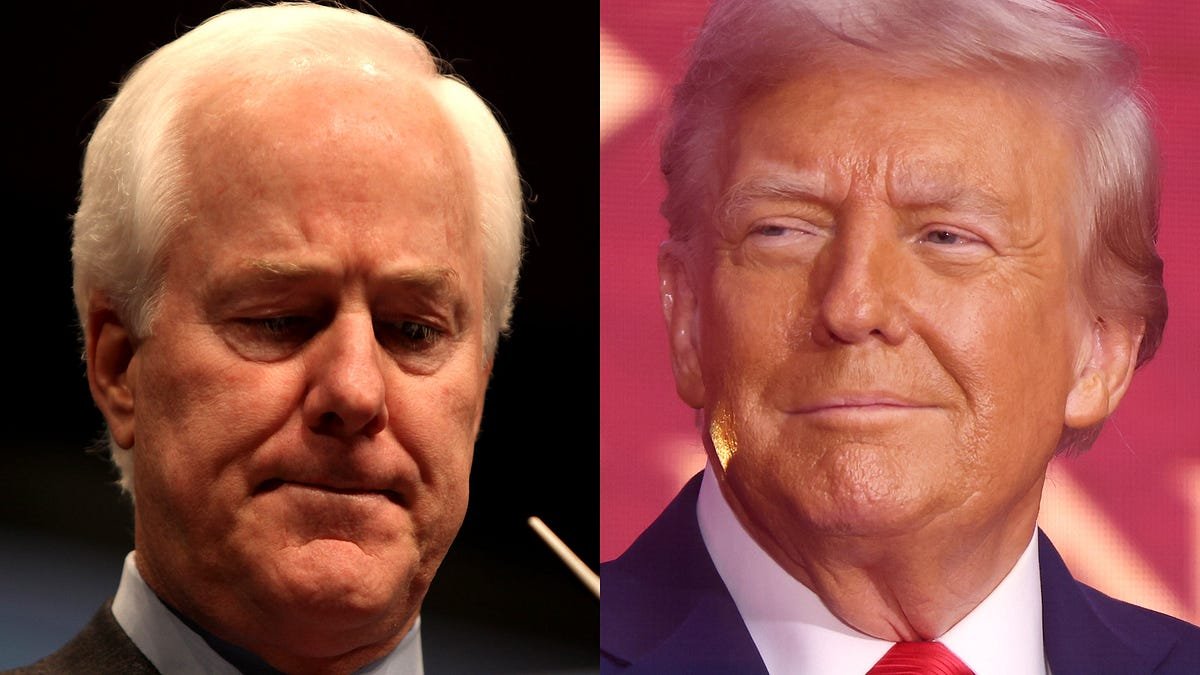
The Frontrunner: Previewing six runoffs to watch in Texas, including the Republican race between Sen. John Cornyn and state Attorney General Ken Paxton. On Tuesday, make sure to watch our livestream coverage of the Texas runoffs starting at 8 p.m. Eastern. You can watch on X, YouTube, or Substack.
Around the Corner: Upcoming elections we’re tracking at DDHQ.
Must-read items about elections and politics.
On Thursday, the Democratic National Committee released its long-awaited “autopsy” report reviewing why the party lost the 2024 presidential election. The delay in the document’s release has dogged DNC Chair Ken Martin for months. The report itself found that then-Vice President Kamala Harris’s campaign failed to make an “affirmative” case for her presidential candidacy and that it failed to significantly hinder President Donald Trump’s candidacy, among other findings.
Also on Thursday, former Detroit Mayor Mike Duggan dropped his independent bid for Michigan governor. A former Democrat, Duggan had consistently polled in third in early general election surveys. The move arguably helps Secretary of State Jocelyn Benson, the likely Democratic nominee. To that point, The Cook Political Report shifted its race rating from Toss-up to Lean Democratic following Duggan’s departure. Republicans have a competitive primary led by Rep. John James and businessman Perry Johnson.
Check out our new national precinct map on our Votes platform!
Pennsylvania Gov. Josh Shapiro could run for president in 2028. In 2022, Shapiro won 56%-42%, running ahead Democratic rival John Fetterman’s 51%-46% victory in the Pennsylvania U.S. Senate race.
Shapiro most outperformed Fetterman in Kittanning Township in western Pennsylvania, achieving a margin almost 50 percentage points better. This kind of showing in deep-red rural areas could help Shapiro make an electability argument in the 2028 Democratic presidential primary.
Sign up for free to discover important national trends and other fascinating data points on the Votes national precinct map.
Other Votes features include:
Up-to-date polling on the key issues and races
Track prediction markets for elections
25 years of election results at your fingertips
Track election results as they come in
From local to federal, find every race
Coming Soon: DDHQ Forecast
Click here to learn more about Votes and sign up now! With the 2026 primary election season in full swing, now is the perfect time!
Quick summary:
Republican Sen. John Cornyn narrowly led the March 3 primary vote, but he’s an underdog against state Attorney General Ken Paxton in the GOP runoff for U.S. Senate. President Trump has endorsed Paxton, and polls now suggest Paxton has a meaningful lead over Cornyn.
Both parties have must-watch primary runoffs in Texas’s 35th District, a potentially competitive U.S. House seat in November. The Democratic race has attracted attention because of one candidate’s controversial statements about the purported influence of Israel in American politics.
Texas’s long wait is over. This Tuesday, May 26, the Lone Star State will finally hold its primary runoff elections for offices in which no candidate won a majority in the March 3 primary. All told, 84 days will have passed since the primary, the longest runoff campaign in any of the 10 states that have runoff rules for party nomination contests.
The lengthy pre-runoff period has left ample time for drama to build in many contests, most especially in the six races that I preview below. Undoubtedly, the GOP runoff between incumbent Sen. John Cornyn and state Attorney General Ken Paxton ranks as Tuesday’s marquee race, even after President Donald Trump endorsed Paxton last week. But five other races also merit a closer look: runoffs in four U.S. House seats and the contest for attorney general. Let’s dig into the top-tier Texas action.
Polls close: 8:00 p.m. Eastern (9:00 p.m. in state’s western corner)
Top races to watch: U.S. Senate; 9th, 18th, 33rd, 35th congressional districts; attorney general
You’d be forgiven for feeling as if Texas’s GOP nomination contest for U.S. Senate is interminable. State Attorney General Ken Paxton announced his primary challenge to Sen. John Cornyn in April 2025, though his campaign had been expected for months. An incredibly expensive and contentious race has unfolded in the year-plus since. In the primary vote on March 3, Cornyn led 42.0%-40.5%, beating expectations after the incumbent had trailed Paxton in primary polling. But because no candidate won an outright majority, the contest went to a runoff.
In the days immediately following the primary, Cornyn’s slim edge nearly helped him land a pivotal endorsement from President Trump. But Paxton interrupted Cornyn’s momentum by promising that he would consider dropping out if the Senate passed the SAVE Act, a top Trump priority blocked by Democrats thanks to the chamber’s filibuster rules. This put Cornyn, a longtime defender of the filibuster, in a tough spot. The incumbent soon changed his position, announcing he would back any Senate rule change to pass the SAVE Act. However, the legislation remained stalled — and Paxton stayed in the race.
The SAVE Act episode loomed large last week when Trump endorsed Paxton instead of Cornyn. Paxton was always viewed as the more MAGA-friendly candidate compared with the establishment-flavored Cornyn, who has held this Senate seat since the 2002 election. But Trump’s support obviously raises the likelihood that the attorney general will come out on top in tomorrow’s runoff. Not only could the endorsement push some undecided Republicans into Paxton’s column, but it also signals that Trump already viewed Paxton as the favorite — after all, the president likes to back a winner.
Even before the endorsement, Paxton led in runoff polling, though Cornyn was not far behind until the days leading up to Trump’s announcement. Yet the most recent polling in the race — including surveys conducted before the endorsement — found Paxton leading by at least 10 percentage points. In Decision Desk HQ’s polling average, Paxton leads Cornyn by 15 points, 54%-39%.
Cornyn has trailed throughout even as his campaign and allies have vastly outspent Paxton’s side. AdImpact reported on May 19 that pro-Cornyn ad spending and future reservations in the runoff amounted to $20 million, four times the $5 million doled out by pro-Paxton forces. This came on the heels of the Cornyn team’s nine-to-one ad advantage in the primary over pro-Paxton and anti-Cornyn spending, $71 million to $8 million.
The Cornyn team has worked to portray Paxton as a corrupt and immoral figure. A recent ad from the Cornyn Lonestar Victory Fund said “Crooked Ken is corrupt to his core.” The spot attacks Paxton for massively increasing his net worth while serving as attorney general, and for allegedly being unfaithful to his wife, who last year launched divorce proceedings “on biblical grounds.” Such attacks have not proven effective enough to give Cornyn a polling lead, but they probably helped the incumbent keep things competitive. As CNN politics reporter Patrick Svitek recently told the Decision Desk HQ Podcast, the divorce scandal in particular had proved damaging to Paxton because Paxton’s wife is a well-known conservative Republican state senator.
Despite all this, Paxton finds himself favored, buoyed especially by Trump’s endorsement. Paxton’s campaign has been running ads promoting the president’s support for the attorney general. And a pro-Paxton group, Lone Star Liberty PAC, hinted that it’s already looking ahead to the general election campaign. The group’s new ad attacks Democratic nominee James Talarico, a state representative, as “Low T Talarico, too weak for Texas.” The spot employs clips of Talarico speaking on subjects such as gender identity, meat consumption, and racial identity. We can expect to hear more on these themes no matter who wins the GOP nomination on Tuesday. But Paxton-Talarico is now the likeliest general election matchup in a race that could play an important role in deciding which party holds a Senate majority.
Beyond the Senate contest, only one other competitive-looking federal race has runoffs. When Republicans redistricted Texas’s congressional map last year, they dramatically redrew the 35th District, turning it into a seat Trump would have carried by 10 points in the 2024 presidential election. However, Democrats could make a play for the majority-Latino constituency thanks to a blue-leaning midterm environment and shifts among Latino voters toward Democrats. Both parties have runoffs to determine their nominees.
On the Republican side, state Rep. John Lujan faces Carlos De La Cruz, an Air Force veteran and brother of Texas Rep. Monica De La Cruz. Lujan led the way in the crowded primary on March 3, finishing ahead of De La Cruz, 33%-27%, despite the latter’s endorsement from Trump. Still, De La Cruz is probably at least a slight favorite in the runoff. He’s benefited from about $1.6 million in outside support in the runoff from Defending Our Values PAC, which has links to the AI industry, and Defend American Jobs, part of Fairshake’s crypto-backed super PAC network. Lujan, meanwhile, has received negligible outside backing, though he does sport an endorsement from Texas Gov. Greg Abbott.
Yet while Republicans will start the general election campaign favored in this seat, Democrats have had the more eye-catching runoff. Housing activist and sex therapist Maureen Galindo (29%) and Bexar County Sheriff’s Deputy Johnny Garcia (27%) advanced out of the first round of voting. Then Galindo’s controversial statements regarding the purported influence of Israel and Jews in politics, media, and business took center stage. This includes an interview in which Galindo said that Garcia should be tried for treason for his support of Israel, and an Instagram post in which she proposed converting an ICE detention center into a prison for American Zionists. She elaborated that this prison would have a castration facility for pedophiles, which would likely include “most of the Zionists.”
In response, broad elements of the Democratic Party have rallied around Garcia. The Democratic Congressional Campaign Committee and Texas Democratic Party have backed him, as have Talarico and Rep. Alexandra Ocasio-Cortez. Garcia’s support from figures such as Ocasio-Cortez is especially notable because he is running as a moderate Blue Dog Democrat — not the kind of candidate whom progressives usually endorse.
Of course, Republicans — and most everyone else — view Galindo as the Democrats’ weaker general election option. Tellingly, Galindo has received nearly $1 million in support from Lead Left, a seemingly pro-Democratic super PAC that has links to Republican organizations. Democratic-aligned groups have sought to counteract this with their own spending. Project 218 has spent $1.4 million backing Garcia in the runoff, while the Blue Dog Coalition’s campaign arm has spent another $950,000 supporting Garcia or opposing Galindo.
The other congressional races are in safe seats for either party. Thanks to redistricting, fellow Democratic Reps. Al Green and Christian Menefee will meet in a runoff in the solidly blue, Houston-based 18th District. This is a race between old and new. The 78-year old Green has been in Congress since 2005, while the 38-year old Menefee just joined Congress by winning a special election at the end of January for the old 18th District. Menefee narrowly led in the March 3 primary vote for the new district, 46%-44%.
Menefee has slightly outraised Green, yet the freshman congressman may be the favorite more so because of his huge edge in outside spending support. Protect Progress, another of Fairshake’s crypto-aligned super PACs, has spent $4.2 million in the runoff to aid Menefee with advertising and direct mail. One of Protect Progress’s ads is a direct-to-camera spot featuring Rep. Jasmine Crockett, who lost the Senate primary to Talarico, asking voters to back Menefee. Green, who has received no meaningful outside support, recently hit Menefee for his backing from “Trump crypto cronies” and labeled himself as “unbought by crypto cash.” And Green cannot be written off: He currently represents about 65% of the new district’s constituents, compared to Menefee’s 25%.
The Dallas-based 33rd District is another solidly blue seat with two well-known Democrats vying to represent it. Democratic Rep. Julie Johnson is running here after Republicans turned her 32nd District into a firmly red-leaning seat. She faces former Rep. Colin Allred, her predecessor in the same district. Allred lost to Republican Sen. Ted Cruz in Texas’s 2024 Senate race, and began the cycle running for Senate once again. But just before the candidate filing deadline, he dropped out and ran here instead. Allred then ran ahead of Johnson 44%-33% in the primary.
Considering his lead in the first round, Allred is somewhat favored in the runoff. He has outraised Johnson in this race, and he entered the home stretch of the campaign with $667,000 in the bank to Johnson’s $281,000. Johnson has tried to cast Allred as ineffective during his tenure in Congress, while Allred has hit Johnson for her personal investments in Palantir, which has provided technological tools that the Trump administration has used in immigration enforcement. Outside spending support in this race has not dramatically favored one side, which is probably another point in Allred’s favor. Crockett has also involved herself in this race, campaigning on behalf of Allred. Talarico, though, has appeared with Johnson.
Another high-profile Republican runoff can be found in the new Houston-area 9th District, a Trump +20 seat. There, Trump-endorsed Army veteran Alex Mealer faces Abbott-endorsed state Rep. Briscoe Cain. Mealer led in the first round of voting, 36%-31% and is probably the favorite, thanks to a huge advantage in the resources supporting her candidacy. However, Cain is one of Texas’s most conservative state legislators, a record he believes can help him overcome Trump’s endorsement.
Mealer certainly has a monetary edge in this race, having outraised Cain $1.8 million to $583,000. But she’s also benefited from far more outside support in the runoff. Groups have doled out $3.0 million to support her or oppose Cain, 10 times the amount spent opposing her or helping Cain. Pro-Mealer groups have run ads intended to strike at Cain’s conservative reputation. This includes a spot that hits Cain for campaign contributions he received from developers behind a controversial housing project that sold land to undocumented immigrants.
Lastly, keep an eye on the Republican runoff for attorney general, which pits Rep. Chip Roy against state Sen. Mayes Middleton in the race to succeed Paxton. Although Roy is arguably the better-known figure, Middleton led the first round of voting 39%-32%. Middleton has substantially self-funded his campaign, to the tune of around $17 million in total. However, Roy received a late surge in funding from major backers, which allowed him to outraise Middleton $7.9 million to $5.7 million in the runoff period.
With little to differentiate them ideologically, the two candidates have attacked the other’s record or lack thereof. Roy has cast Middleton as inexperienced, arguing that the state legislator would be a poor choice because Middleton has little experience in the courtroom. By contrast, Roy touts his time working under Paxton as an assistant attorney general. Middleton has pushed back by attacking Roy’s conservative credentials. He’s run ads claiming that Roy, who at times has broken with Trump, “betrayed MAGA.”
The winner of the GOP runoff will probably face Democratic state Sen. Nathan Johnson, who nearly won his party’s nomination outright in March. Still, Johnson has to get past former Galveston Mayor Joe Jaworski in the Democrats’ runoff on Tuesday.
On DDHQ’s Votes portal, make sure to add these upcoming races to your watchlist:
May 26
Texas primary runoffs (including U.S. Senate)
June 2
California primary (including governor)
Iowa primary (including U.S. Senate)
Montana primary (including MT-01)
New Jersey primary (including NJ-07)
New Mexico primary (including governor)
June 9
Maine primary (including governor)
Nevada primary (including governor)
North Dakota primary (including ND-AL)
South Carolina primary (including governor)
Check out our 2026 Primary Primer for more information about the regular primaries happening in 2026.
Thanks for reading! This post is public so feel free to share it.
Share
No posts