
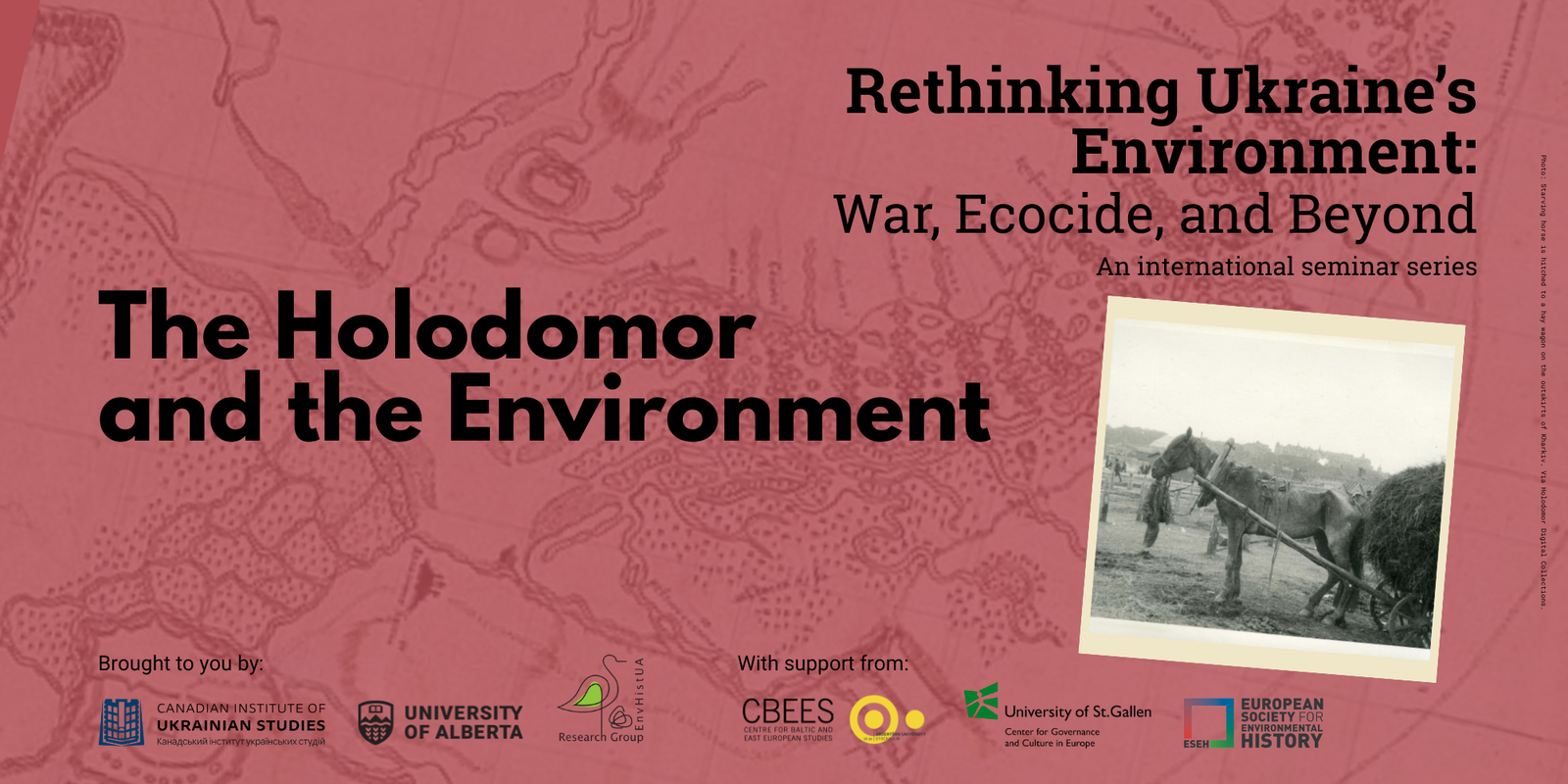
The Holodomor and the Environment
“Rethinking Ukraine’s Environment: War, Ecocide, and Beyond” Series
25 May 2026 | 10 a.m. MDT (Edmonton) / 12 p.m. EDT (Toronto) / 18:00 CEST (Warsaw) / 19:00 EEST (Kyiv)
Speakers: John Vsetecka and Iryna Skubii | Moderator: Anna Olenenko

You May Also Like
This seminar explores the environmental dimensions of the Holodomor, focusing on how famine reshaped landscapes and human–environment relations. By integrating environmental history with social and cultural approaches, the seminar reframes the Holodomor as not only a human tragedy, but also a catastrophe for non-humans, with enduring consequences.
Speakers
John Vsetecka: Mourning the Fields that Feed: Environment and Trauma in the Wake of the Holodomor
This talk uses an environmental lens to better understand the effects and legacies of the Holodomor in the immediate years after the famine. Specifically, the talk will focus on how Ukrainians confronted the toll of famine through environmental trauma and how the landscapes around them became forever altered as a result of the Holodomor.
John Vsetecka is Assistant Professor of History at Nova Southeastern University in Fort Lauderdale, FL. John is a scholar of east European and Soviet history, with a specific interest in the history of Ukraine. His research and writing focus on the history of famine, mass violence, and transitional justice. John is finishing his first book, entitled, In the Wake of Hunger: Confronting the Legacies of the 1932-1933 Famine (Holodomor) in Soviet Ukraine during the 1930s. He is also a co-editor (with Daria Mattingly) of The Holodomor in Global Perspective: How the Famine in Ukraine Shaped the World (ibidem-Verlag/Columbia University Press), which was published in February 2026. John is also the founder of H-Ukraine (part of the larger H-Net platform), which shares and promotes academic and scholarly content related to the study of Ukraine.

Iryna Skubii: Writing Environmental and Animal-Sensitive Histories of Famine: Why It Matters
This talk examines how plants, animals, and landscapes shaped everyday practices of survival during the Holodomor, presenting famine as an interconnected human and ecological catastrophe. By tracing these relationships “from the ground level,” it rethinks Soviet state violence, the impacts of famine on human and more-than-human worlds, and the wider global history of famine.
Iryna Skubii is a historian of Ukraine, the Soviet Union, and Eastern Europe. She is the inaugural Mykola Zerov Fellow in Ukrainian Studies, Senior Research Fellow at the University of Melbourne, and the President of the Ukrainian Studies Association of Australia and New Zealand. Her research explores economic, social, and environmental history, with a focus on food, famine, agriculture, material culture, and memory. She is the author of Trade in Kharkiv in the Years of NEP: Economy and Everyday Life (Kharkiv: Rarytety Ukrainy, 2017) and is completing her second monograph, Famine Ecologies and Famine Materiality: Human and Non-Human Survival in Soviet Ukraine (2027). With Daria Mattingly, she is also co-authoring Holodomor: The 1932–1933 Famine in Ukraine (Cambridge University Press, Series in Soviet and Post-Soviet History, ed. Mark Edele and Rebecca Friedman).

About the Moderator
Anna Olenenko is a PhD Candidate in Media and Cultural Studies at the University of Alberta and a research assistant at the Kule Folklore Centre and Canadian Institute of Ukrainian Studies. Anna is a co-founder of the EnvHistUA Research Group. She serves as the Regional Representative of Ukraine, Chair of the Council of Regional Representatives and a member of the Board of the European Society for Environmental History. Anna’s research interests include the environmental history of Ukraine, particularly the Steppe region, animal studies, and oral history.

This seminar is part of the international series “Rethinking Ukraine’s Environment: War, Ecocide, and Beyond,” which aims to foster a deeper understanding of historical human–environment relationships—a vital factor in addressing Ukraine’s current environmental challenges and envisioning a secure and sustainable future.
Read more about the seminar series here.
Hosted by CIUS, this international seminar series is a joint initiative of the EnvHistUA Research Group and Canadian Institute of Ukrainian Studies, with further support from the Centre for Baltic and East European Studies (Södertörn University), Center for Governance and Culture in Europe (University of St. Gallen), and the European Society for Environmental History (ESEH).
Photo: Starving horse is hitched to a hay wagon on the outskirts of Kharkiv. Via Holodomor Digital Collections.

- Virtual Event – The Holodomor and the Environment – May 5, 2026
- Événement hybride – [Ant]Arctique en objets : fabrique de l’imaginaire du voyage vers les pôles – April 30, 2026
- Call for Papers – Forecasting the Weather between Divination and Science (Antiquity to the Present) – April 6, 2026
- Recording – Mountain Voices: Memory, Story, and Permanence – April 2, 2026
- Call for Papers – Critical Feminist Histories in Canada – March 20, 2026
- Virtual Event – Multiethnic Encounters With and Indigenous Knowledge On the Environment in Ukraine – March 19, 2026
- History and Medicine – Associate Professor or Professor with Tenure – McMaster University – March 5, 2026
- Virtual Event – Mountain Voices: Memory, Story, and Permanence – March 5, 2026
- Doctoral student in the history of polar governance in the national polar research school – February 27, 2026
- Call for Applicants – Corsini Fellowship in Canadian History – February 26, 2026
